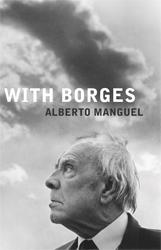
 The first thing to note about With Borges is its singularity. The only man who could have written such a book about Jorge Luis Borges has now .
The literary critic and essayist Alberto Manguel not only knows the work of Borges better than anyone else, he was also a close friend and ally of Borges. With Borges brims over with warm details of Borges the writer and Borges the man, but it is also it is also written in a circling, allusive, aphoristic style that shows Borges's own influence on Manguel.
Manguel's friendship with Borges began in a very unusual way. As a boy Manguel used to work after school in an Anglo-German bookstore called Pygmalion in Buenos Aires, and Borges was an ocasional visitor there. By this time Borges, in his late fifties, had become prey to the blindness that ran in his family, and, as someone who lived almost exclusively for books, he was in need of someone to read to him. Manguel didn't know much about him, but he was a bibliophile as well, and when asked if he would read to Borges in the evenings he consented.
For a few years, till the time Manguel left Argentina in 1968, the two would go over the books in Borges's library in the evenings—Dante, Chesterton, and Kipling were among Borges's favourite writers. Manguel would read, Borges would listen closely (he knew many of his favourite works by heart), and then make some observations of "wonderful perspicacity and wit, not only sharing with me his passion for these great writers but also showing me how they worked by taking paragraphs apart with the amorous intensity of a clockmaker". This is not the only occasion in With Borges when the reader feels more than a little envious of Manguel.
Books meant the world to Borges, and not just in the simple sense that he was greatly in love with books and literature. Rather, as Manguel explains, books were Borges's primary reality:
For Borges, the core of reality lay in books; reading books, writing books, talking about books. In a visceral way, he was conscious of continuing a dialogue begun thousands of years before and which he believed would never end. Books restored the past. 'In time,' he said to me, 'every poem becomes an elegy.' He had no patience with faddish literary theories and blamed French literature in particular for concentrating not on books but on school and coteries….He was a haphazard reader who felt content, at times, with plot summaries and articles in encylopaedias, and who confessed that, even though he had never finished Finnegan's Wake, he happily lectured on Joyce's linguistic monument. His library (which like that of every other reader was also his autobiography) reflected his belief in chance and the rules of anarchy."His library, which like that of every other reader was also his autobiography"—in utterances like this we see Manguel's own penchant for provocative Borgesian formulations. Elsewhere Manguel says:
There are writers who attempt to put the world in a book. There are others, rarer, for whom the world is a book, a book that they attempt to read for themselves and for others. Borges was one of these writers. He believed, against all odds, that our moral duty was to be happy, and be believed that happiness could be found in books, even though he was unable to explain why this is so. 'I don't know exactly why I believe that a book brings us the prospect of happiness,' he said. 'But I am truly grateful for that modest miracle.'With Borges—beautifully brought-out by a relatively new publishing house, Telegram Books—complements another beautiful essay in Manguel's 1999 collection Into The Looking-Glass Wood. That essay is titled "Borges in Love", and it is about Borges's difficult romantic life ("Throughout his almost centenary life, Borges fell in love with patient regularity and with patient regularity his hopes came to nothing."). The irony about this is that Borges produced some of the twentieth century's best poems about love.
And now some links. The universe of Borges's poems and stories—he never wrote a novel, and in fact held the novel form in some disdain—is so rich that a great many readers have been stimulated into producing rich work in response to it; Manguel is just one of many fine interpreters of Borges. Here are two particularly good essays.
One, written by Borges's translator Alistair Reid, is called "Borges Beyond Words", and it deals (in beautiful language, one might add) with the vexing issue of the relationship between reality and the language we use to describe that reality. Reid writes:
There is one quotation which Borges loved--I think it was his favorite quotation in all of English literature. It was from an essay of G. K. Chesterton's on a fairly unknown painter called G. F. Watts. "Man knows that there are in the soul tints more bewildering, more numberless, and more nameless than the colors of an autumn forest. . . . Yet he seriously believes that these things can every one of them, in all their tones and semitones, in all their blends and unions, be accurately represented by an arbitrary system of grunts and squeals. He believes that an ordinary civilized stockbroker can really produce out of his own inside noises which denote all the mysteries of memory and all the agonies of desire." In other words, language can never accommodate the enormous reality beyond it....The second is "Mother's Boy", by the literary critic Algis Valiunas, a writer whose work I admire greatly for its intelligence and verbal beauty. Again, it is contains a beautiful quote from a writer Borges admired—the philosopher FH Bradley, who says "For love unsatisfied the world is a mystery, a mystery which satisfied love appears to understand." (And perhaps one can tell, from Manguel's "Borges in Love", why Borges attached such importance to this remark.) But among the many interesting things in Valiunas's piece is the criticism of Borges's work that he proffers in the closing paragraphs.
And here is Borges's beautiful fable of the life of Shakespeare "Everything and Nothing", a piece that Valiunas takes up at the close of "Mother's Boy".
An extract from With Borges can be found here. The excellent Robert Birnbaum has a long interview with Manguel here. And the American novelist John Barth draws some parallels between the work of Borges and another giant of twentieth-century literature, Italo Calvino, here.
Lastly, an old piece about some poems by Borges, "Chess With Jorge Luis Borges".