Showing posts with label Pakistani writing. Show all posts

Wednesday, August 05, 2009

On Ali Sethi's The Wish Maker

The most startling feature of Ali Sethi’s debut novel The Wish Maker is that although it is over 400 pages long, its protagonist (who is also for the most part its narrator) is a cipher, registering on our consciousness as not very much more than a pair of eyes. When we meet Zaki Shirazi for the first time, he has just returned to his family home in Lahore (inevitably, for a wedding) after two years as a student in America. What should be the beginning of the book’s action is actually pretty much the end, and Zaki spends his time observing the new Pakistan (“We passed a hoarding on the bridge. It was advertising a new deal for mobile phones...”; “At night I went with Isa and Moosa to see the new places of leisure”) and lapsing into loops of ever-retreating flashbacks.

The Wish Maker swiftly reveals itself, to those with some experience of the genre, as that old chestnut, the three-generation South Asian novel: one tier retailing memories of Partition, the second covering the era of the wars with India and the Bangladeshi independence struggle, and the third, the Pakistan of the present day, both modern ( those"new places of leissure") and medieval when seen through the narrator’s wide-eyed gaze (“She said that such things were common in the villages, where customs were old and went largely untouched by the new ways that developed continually in the cities”). There is plenty of quasi-journalistic observation, a score of aunts, cousins and servants, and a number of songs and weddings, none of which can conceal the instrinsic hollowness of the mind and voice that speaks.

Sometimes such stories can be redeemed by depth of characterization or distinction of language, but strangely enough for someone writing his first book, Sethi shows no desire to contest any of the rules of an old, old game. Although Zaki has been brought up in Pakistan, and has been away for just two years, his eye is always noticing things in touristy ways, such as “old men sitting under trees on the footpath with colourful powders and bottles”, even as his memory is recalling such momentous occurrences as “After the maths period there was the physics period, and after that chemistry, for which we had to go to the chemistry lab in a line led by the teacher...”

Further, the narrator of The Wish Maker seems highly conscious of the need to record—indeed to celebrate—the specifics of Pakistani culture, language and place, while also trying not to turn off a global audience whose apprehension of these things is dim (one of the blurbs on the back cover of his book acclaims it as “a brilliant example of the new global novel”). This leads to a kind of backand-forth covering of bases that often clogs the narration. Sethi is the kind of writer who, when writing about a visit to a neighbourhood, will say that it was “a mohalla, a neighbourhood”, and not one or the other. Sometimes he can write an interesting English: a sentence about how the sun is “like a difficult god, present in the things it made visible” was one of the few bits of the book I enjoyed. But his English is also specked with local colour and subcontinental sounds in the most cliched way, with a carefully italicized “hai” here and a “taubah” there, and (since no narrative is authentic without a sampling of local swear words) one careful mention each of the words “bhenchod” and “maaderchod”.

The same contradictory imperative guides Sethi's attitude towards cultural detail, towards what he thinks should be explained and what only named. Zaki’s cousin, Samar Api, idolizes Amitabh Bachchan, who, Zaki explains, “was said to be the most famous actor in the world”. A police officer sits under “a framed portrait of the Quaid-e-Azam, the founder of the nation” (if an Indian novelist wrote such a line about a portrait of Mahatma Gandhi, we would think he or she was being ironic). I have no idea what Sethi’s politics are, but it was surprising to see Benazir Bhutto’s personal and political life described in great detail while, when he approaches the political scene of the late nineties, Sethi devotes a few pages to Nawaz Sharif without ever naming him, only saying that “(Daadi) was pleased when her man won the election”. These are the riddles and puzzles, more than the mysteries of character or situation, that the reader of The Wish Maker ends up pondering.

Here, as a longer example of what seems to me the mechanical nature and aridity of Sethi's narration, is a passage from the book describing a journey made by Zaki's grandfather from India to Pakistan. The passage is told from the point of view of Zaki's mother, Zakia:
[Papu] took trains. They took him from Kanpur to Agra, Agra to Jodhpur, and from Jodhpur into Sindh. The train compartments became crowded. He looked past his window and saw desert turn to desert, and his mind filled with foreboding. He had a little money, and his clothes and his diploma were in his suitcase. He kept the suitcase between his legs. He closed his eyes and tried to think of the city that awaited him, a city he had never seen but had to envision in that moment for its own sake.
'Brother,' said a voice.
It was the old man sitting across from him. He had asked Papu earlier to consider some items, some things he had with him in a cloth bundle.
Papu said he wanted nothing from the man.
'Oh,' said the man, as if hearing it for the first time. 'Oh, I see.'
The train went on shuddering on its tracks. Papu closed his eyes again. And again the man disturbed him, until Papu, unable in that crowded train to change his seat, had to sit with his eyes wide open, his face turned resolutely to the window and his ears unresponsive to the man's increasingly maudlin appeals.
Zakia said, 'Didn't it get any better?'
And Mabi said, 'It didn't.' She knew because she had been with Papu on those trains. She said that in Karachi they had had to sleep in camps...
Oh, so Papu took Mabi along on those trains, did he? But shouldn't we know this from Papu's experience of the train journey, instead of it being tacked on at the end almost as an afterthought? In fact, wouldn't Papu's concern for his wife be central to his memory of those trains, as much as his foreboding about the city they are headed towards?

Unlike in non-fiction, in fiction we are not obliged to accept that something is real, or true, merely because it is asserted as fact, as it is here. Scenes like this demonstrate, by their negative example, that realism in fiction is not a matter of getting the details of history or of culture right, and expecting that one's characters will live and breathe because thrown into this recovered world that is "true". Fiction, too, is a more difficult god than Sethi seems to allow for. Although we are told that Mabi has gone on this journey with Papu, her presence is so anachronistic that for all practical purposes she never leaves home.

And, while on the subject of "increasingly maudlin appeals" that annoy the auditor, here is another passage— one might think of it as the title scene of the novel:
'Samar Api,' I said one night, 'do you think [Mother] doesn't want to get married because of me?
We were lying in wicker beds on the roof. It was August, the last month of the monsoon. All day the rain had been slashing and insistent; trees swayed and fell and lay like logs in the roads, which were swamped. The overhead wires had snapped; there was no electricity in the neighbourhood and the house was dark.
On the roof the night was clear. The clouds had left the moon in light.
'Not at all,' said Samar Api. 'She doesn't do it because she doesn't want to. There's nothing like your first love.' She closed her eyes and released a sigh. It merged with the breeze.
'Samar Api?'
She moaned.
'Make a wish.'
She cupped her hands, brought them to her mouth and whispered the wish, which was chosen without deliberation, without hesitation, then blew it away and watched as it went up into the night.
From sighs that merge with the breeze and wishes that are watched as they go up into the night, it is hard to beat this scene for exertion in making the invisible visible, and for turning yearning into bathos.

Although original and complex fiction in English about Pakistan is being written currently by writers as diverse as Nadeem Aslam, Mohsin Hamid, Aamer Hussein, Mohammed Hanif, Musharraf Ali Farooqui, Azhar Abidi, and Daniyal Mueenuddin, Sethi’s tutelary deity is clearly the Afghan émigré Khaled Hosseini. Hosseini's long and enthusiastic blurb on the back cover ("an engaging family saga, an absorbing coming-of-age story, and an illuminating look at one of the world's most turbulent regions") sounds like just the thing Hosseini would want said about his own book The Kite Runner.

Indeed, the very title The Wish Maker seems to reach out towards the large global audience which delighted in Hosseini’s The Kite Runner. Sethi's writing and plot construction replicate many of Hosseini’s faults, though to my ear his prose has a slightly richer sound than Hosseini’s blundering and bathetic narrations. If this banal and almost willfully unsubtle work is really an example of “the new global novel”, then let us turn to our so-called local writers instead.

And two older essays: on Daniyal Mueenuddin's In Other Rooms, Other Wonders and Mohammad Hanif's A Case of Exploding Mangoes.

[A shorter version of this essay appeared last weekend in Mint]

Sunday, February 22, 2009

On Daniyal Mueenuddin's In Other Rooms, Other Wonders

“In this game of love, women have immense power...much more power than we do,” writes the Scottish painter Jack Vettriano, whose works often depict couples netted by one another, oblivious to the world. “They can really tie us up in knots. We’re animals by comparison.” It is a long stretch from Vettriano’s coolly erotic portraits of beautifully dressed (or undressed) men and women, bright in their own power, to the lawless longing, veiled wooing, insecure dependency, and difficult mingling of unequal partners in Daniyal Mueenuddin’s startling debut story collection In Other Rooms, Other Wonders. But the root feeling is the same. Many of the best moments in Muenuddin’s book involve men who are “wholly masculine” – that is, secure in their place and role in a man’s world, confident that they know what life is – being humbled by a power that disarms their own strength, being surprised by eros or by an emotion that they fear is love. Two of the eight stories in Mueenuddin’s book take their titles from the names of their female protagonists, and at least two more could have.

Mueenuddin’s linked stories – this has now become a convention in short fiction, but in this one instance the material demands it, for the characters are part of an ancient and elaborate hierarchy – wind their way leisurely through the great Lahore house and even bigger country estate of KK Harouni. A pillar of Pakistan’s old feudal order, Harouni rules over a world “as measured and as concentric as that of the Sun King at Versailles”. But Harouni is now aged and enfeebled. Unable to watch over his holdings with the same care of old, he is squeezed of his riches by his extended family of servants, retainers, managers, and workers (many of whom figure as characters in their own right, and are therefore granted a higher status in Mueenuddin’s construct than that of their master, who only cares for them insofar as they contribute to his comfort and standing).

But Mueenuddin’s stories are fascinating not only for what is present in them – the beautifully relaxed, wheeling exposition that recalls the work of Jhumpa Lahiri, the love of the natural world expressed in ripples of memorable language, the dramatisation of the jagged route that human beings take towards understanding themselves and others – but also for what is absent, which is a criticism of the feudal order through which these stories wander. His gaze is curious but uncritical; he sees the world as his characters, who mostly accept the rules of the game, see it; it is as if the world can only be this way. His interest, in fact, is in those individuals who are secretly ambitious in a world where everybody is expected to know their place; his gaze halts upon those who want to rise, and those who can raise.
In the story “Provide, Provide”, Harouni’s elderly and opportunistic estate manager Jaglani, who has long been appropriating his master’s property, takes as his mistress a married woman, Zainab. Zainab gives him whatever he asks for by way of service and bodily pleasure, but stoically, as if performing a duty. When she says she must return to her husband, Jaglani impulsively decides to marry her, although he has a family and children. Shrewdly tracking his thoughts, Mueenuddin tells us that Jaglani feels he is so powerful that “now he deserved to make this mistake, for once not to make a calculated choice”. Jaglani’s marriage brings him pleasure and pain in equal measure; he finds that “although he had made a career of fearing no one”, he fears his wife, and “yet his love kept increasing.” It is only later, when the deed has been done and its consequences have taken hold both in his home and in his mind, that Jaglani begins to regret his actions. Now he cannot even go back to the estate, which he loves, without being reminded of his folly. Here is a paragraph from Mueenuddin:
Yet Dunyapur has been spoiled for him by the presence of Zainab. He minded very much that he had given his sons a stepmother of that class, a servant woman. He minded that he had insulted his first wife in that way, by marrying again, by marrying a servant, and then by keeping the marriage a secret. His senior wife had never reproached him, but after Jaglani told her she quickly became old. She prayed a great deal, spent much of her time in bed, stopped caring for herself. Her body became rounded like a hoop, not fat but fleshed uniformly all over, a body thrown away, throwing itself away, the old woman sitting all day in bed, dreaming, muttering perhaps when left alone. He reproached himself for taking his eldest son’s daughter and giving her to Zainab, transplanting the little girl onto such different stock. Secretly, and most bitterly, he blamed himself for having been so weak as to love a woman who had never loved him. He made an idol of her, lavished himself upon her sexual body, gave himself to a woman who never gave back, except in the most practical terms. She blotted the cleanliness of his life trajectory, which he had always before believed in. She represented the culmination of his ascendance, the reward of his virtue and striving, and showed him how little it had all been, his life and his ambitions. All of it he had thrown away, his manliness and strength, for a pair of legs that grasped his waist and a pair of eyes that pierced him and that yet had at bottom the deadness of foil.
Among the many satisfactions of this passage is the way in which the pleasure of the thought – a kind of Macbethian regret at an expensive dream gone sour – is both paralleled and improved, the two linking hands as prose writing of a high order almost always does, by the acuity of Mueenuddin’s syntax. It is worth thinking about the impact of phrases which effect small, rueful inversions like “how little it had all been, his life and his ambitions” and then, immediately after, the similar, “All of it he had thrown away, his manliness and strength”. And also the sentence: “Her body became rounded like a hoop, not fat but fleshed uniformly all over, a body thrown away, throwing itself away, the old woman sitting all day in bed, dreaming, muttering perhaps when left alone.”
This observation is an example of a very characteristic and striking register of Mueenuddin’s prose, which is a sentence that seems about to close, to expire, until it suddenly takes a new breath and then runs on strongly again, as if it has seen something new late in the day (here the anticipated close might be “a body thrown away”, and the revival “throwing itself away”, which both changes the tense and, through repetition, better indicates the effect of continuous stress this is having on Jaglani’s mind). Her is another example of this kind of sentence, from the story “Lily”: “It wearied her that this memory came now as she turned and stood, appraising Murad’s clothes, loafers with unfortunate tassels, pressed jeans, white shirt tucked in – resembling somehow an army officer out of uniform, the effect touching to her, sincere, a gentleman calling on a lady.”
“Provide, Provide” works itself through to an exceptional conclusion that features neither of the principal characters, thereby greatly enhancing its beauty and strangeness (a strangeness seen again in “Nawabdin Electrician”, a story about a man shot by a thief, and who lies on the road thinking he is going to die, remembering, of all things, “the smell of frying fish”). In his attention to the minds of Zainab and Jaglani, or that of Husna, the impoverished distant relation who, in the title story, infiltrates the household and then the affections of Harouni himself, Mueenuddin serves up a series of masterful character studies set into the massive edifice of Harouni’s world.
In keeping with the need for economic security or love of luxury revealed by so many of his protagonists, Mueenuddin’s writing has a heavy, beguiling materiality. “The hard blue sky stood enormously tall over Paris,” he writes at one point, throwing us right into the scene with that unusual adjective “tall”, which is a tautology – what else could the sky be other than high, or tall? – and is yet expressive, here, a sense of freedom and possibility being experienced by the narrator. Describing Nawabdin’s prowess with tampering with electrical meters, Mueenuddin offers this bouquet of explanations: “Some thought he used magnets, others said heavy oil or porcelain chips or a substance he found in beehives.” When Husna begins to live with KK Harouni, she hoards a secret stash of goods in “two locked steel trunks, which she filled with everything from raw silk to electric sandwich makers.” A couple make love in a small hotel in the French countryside: “The loose bedsprings made long rusty sounds, like a knife leisurely sharpened on a whetstone.”
In Mueenuddin’s hands the material realm often seems to take off, almost become ethereal: “Nawab would fly down this road on his new machine, with bags and cloths hanging from every knob and brace, so that the bike, when he hit a bump, seemed to be flapping numerous small vestigial wings; and with his grinning face, as he rolled up to whichever tubewell needed servicing, with his ears almost blown off, he shone with the speed of his arrival.” It might be said that many of his characters, too, seem to be flapping “small vestigial wings” when they accrue for themselves some precious good. Some works of fiction, by their excellence of craftsmanship, singularity of worldview, and richness and precision of language, announce themselves instantly as classics, and this book of many wonders is one such.

Wednesday, July 02, 2008

On Mohammad Hanif's A Case of Exploding Mangoes

A shorter version of this piece appeared last weekend in the Sunday Telegraph.

Whenever someone famous dies in mysterious circumstances, conspiracy theories proliferate; meanings rush in to fill the void. The insight of Mohammed Hanif’s funny and anarchic novel A Case of Exploding Mangoes – a properly fictional insight – is that the wild explanations proffered in such instances may not be all false, but, remarkably, may all be true. The reasoning at the root of Hanif’s story is something like this: Conspiracy theories are almost by definition false. Therefore they are all equally untrue. If we hold that even one of them is true, it pretty much amounts to saying that any or all of them are true. And indeed, if we are prepared to consider one of them, might we not consider that all of them somehow are true?
Hanif’s book is about the mendacious Pakistani dictator Zia ul-Haq – a proponent of Islamicization, an ally of America in the Cold War – who died when his private plane went down in August 1988. In A Case of Exploding Mangoes all kinds of forces – the machinations of generals, the resentment of a junior army officer, the curse of a blind woman, the wrath of a Communist group – are shown with their sights trained on Zia, so that when he dies it is not possible to establish the immediate cause, as it were, in this vast field of possible causes.
The Zia of the novel is a suspicious old man hobbled by age and care, nurturing both delusions of grandeur and paranoia about his safety. He opens to a page of the Quran every day to look for signals from the Almighty, “as if it was not the word of God but his daily horoscope on the back page of the Pakistan Times”. Like many strongmen, General Zia is the ruler of a kingdom but not of a home: he is repeatedly insulted by his own wife, who is disgusted by his lechery.
The irreverent language and set-ups of Hanif’s novel relentlessly puncture the pretensions of power. In one marvellous scene, the First Lady heads for her husband’s office in a fit of rage, but abruptly finds herself shooed into a line of widows waiting for alms from the General. Reaching the top of the line, she declares to her astonished husband that from this day she too is a widow. In another, General Zia, dressed as a commoner, teeters out into his kingdom on a bicycle, and is picked up and humiliated by a constable.
Among the best walk-on parts is that of “a lanky man with a flowing beard” who arrives at a party hosted by the American consulate to celebrate the success of the Afghans against the Soviets, introduces himself as “OBL”, and gets very little attention from the dignitaries present. Even as it entertainingly answers the questions still asked about Zia’s death, then, Hanif’s novel raises the delicious possibility that the rage and rancour of America's most intransigent opponent first erupted when he was not invited into a group photograph.
And two old posts, one on a Pakistani dictator and the other on a lanky man with a flowing beard: "On the memoirs of President Pervez Musharraf of Pakistan" and "On Steve Coll's The Bin Ladens".

Saturday, April 07, 2007

On Mohsin Hamid's The Reluctant Fundamentalist

The Reluctant Fundamentalist, Mohsin Hamid’s taut and accomplished second novel, takes the form of a single long monologue that we are asked to imagine as a dialogue - a form which reverses the power relationship that is the subject of the book.

Changez, a resident of the Pakistani city of Lahore, encounters by chance or purpose an American tourist on the streets of his city, and presses his hospitality upon him. They get to talking—we never actually hear the interlocutor, only Changez’s reactions to him—and Changez loses no time in revealing that he has actually lived in America. He is, we learn, a graduate of Princeton, worked subsequently for a prominent American firm, and even had a love affair with an American girl. Then how is he now here? Changez’s story—which seems to gush from him like blood from a wound—traces the self’s shifting sense of itself against the rumblings of a rudely shaken world.

Changez is the scion of a prominent Lahore family. A bright student, he wins a scholarship to Princeton, where many of his American peers come from the same class of their society as he does of his. But it is a different society. The bright allure of meritocratic America seems to Changez in direct contrast to the tired air of his home country, its attention focused on military skirmishes with neighbouring India. On graduating, he takes up a lucrative offer from Underwood and Samson, a leading valuation firm. The guiding principle of his firm is “Focus on the fundamentals”.

At 22, Changez becomes part of a global elite, flying business-class and hopping from country to country. He loves the buzz of New York. “I was, in four-and-a-half years, never an American; I was immediately a New Yorker,” he exults. Returning to Pakistan to visit his family, he is depressed by the shabbiness of the house in which he grew up, but realizes that “I had changed; I was looking about me with the eyes of a foreigner”. It is a persuasive portrait of how life in a new country reshapes one’s old attitudes and certainties.

In New York, Changez also falls in love with Erica, a girl from a wealthy American family. As their attachment develops, he learns that Erica has a past: Her long-time boyfriend, Chris, passed away recently. Changez feels that it is only a matter of time before Erica leaves behind her memories and embraces the present, but disturbingly she seems instead to regress, and he feels powerless to help her.

Changez, then, has multiple allegiances to America. Yet, while on assignment in the Philippines, when he sees on TV the spectacle of the World Trade Center being mowed down by terrorists, he finds himself perplexed by the fact that his immediate reaction is one of satisfaction. “[A]t that moment, my thoughts were not with the victims of the attack,” he analyses, “…no, I was caught up in the symbolism of it all, the fact that someone had so visibly brought America to her knees.”

Those italicised emphases—of which there are many in The Reluctant Fundamentalist—are Hamid’s way of signalling tremors in his otherwise understated writing; they are suggestive also of the cadences of Changez’s analytical mind at work, seeking precise nuances and distinctions so as to avoid falsifications of his experience.

In the wake of the 9/11 attacks, Changez finds that something in the air has changed: almost overnight, he has been pushed out to the margins of a world in which he felt so much at home. If the complaint of the unnamed black protagonist in Ralph Ellison's landmark novel Invisible Man (1952) is that his skin colour has made him invisible ("Look at me!" he shouts), then Changez's predicament is that he is too visible - because of his ethnicity, he is viewed with suspicion as he never was before. He is alarmed also by the martial stance of his adopted country, intent upon a reprisal that will lead to the deaths of many more innocents. He finds America in the grip of “a dangerous nostalgia” not dissimilar to that of Erica, pining for her departed companion.

But Changez’s doubts and fears are not solely directed outward. He begins to see himself, too, as complicit with a world order he finds morally repugnant. After all, “finance was a primary means by which the American empire exercised his power”. He feels he cannot abide any more within his insulated world. Instructed to focus on the fundamentals, he sees now that those fundamentals were akin to a pair of blinders. He becomes—in a clever subversion of the expectations raised by the novel’s title and its alienated Pakistani protagonist—a reluctant fundamentalist.

Hamid's narration recalls not just the Dostoevskian universe of humiliation, resentment, and self-loathing, but even Dostoevsky's pairs or doubles: attempting to get Erica to warm to him in bed, Changez invites her to imagine he is Chris, his dead rival.

And just like Dostoevsky’s Ivan Karamazov, who rather than believe in an unjust order decides to “return my ticket”, Changez, too, forsakes his gilded life in America and returns to Pakistan to teach. During the course of his narration, he asserts repeatedly that he means his unidentified American companion no harm. But the reader has heard in his voice the dark undertow of what Orhan Pamuk has called “the anger of the damned”, and is not so sure.

Some links:
Mohsin Hamid writes about the gestation of his book here, in an essay called "My Reluctant Fundamentalist".

And he writes here about applying for British citizenship: "It...occurs to me that I have something to lose. I am a Pakistani and proud of it. Inevitably, I wonder if I am not somehow being disloyal to the country in which I was born and which I have always loved. I have the nagging guilt that I imagine accompanies thoughts of divorce. But then I remind myself that I am allowed dual citizenship. My situation is not analogous to that of a husband who is leaving his wife for another woman. No, I tell myself, I am more like a father who is about to have a second child. Of course I am nervous about neglecting my first-born. But surely I can find within me the affection and commitment to be true to both."

And here are two pieces on Pakistan by Hamid for Time magazine: "The Usual Ally", written just after 9/11 ("I remember, as a boy in Lahore, the moment I learned Pakistan had become, once again, America's ally" - the pauses in that sentence sound just like Changez's voice) and "Divided We Fall", written last year, in which he writes sagely of "the inability of our society to channel dissent into debate". He articulates his doubts over Pervez Musharraf's continuing hold on power in a recent piece in the New York Times, "Pakistan's Silent Majority Is Not To Be Feared".

Monday, December 18, 2006

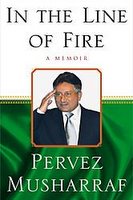
On the memoirs of President Pervez Musharraf of Pakistan

"At the precise instant of India's arrival at independence, I tumbled forth into the world," says Saleem Sinai in the first chapter of Salman Rushdie's Midnight's Children, as he reveals that "thanks to the occult tyrannies of those blandly saluting clocks I had been mysteriously handcuffed to history, my destinies indissolubly chained to those of my country." In the prologue to his memoir In The Line of Fire, Pakistan's president General Pervez Musharraf, born four years before the creation of the state of Pakistan, sounds very much like a Pakistani Saleem: "The story of my life coincides almost from the beginning with the story of my country - so the chapters that follow are not only the biography of a man, but of Pakistan as well".

Saleem Sinai's claim is supposed to be interpreted by the reader as comic: Rushdie wants us to marvel at this fantastical linking of the destinies of man and nation, and Saleem himself always bemoans "that benighted moment" that robbed him, as it were, of his own independence as a sovereign individual. But the good General's claim is made in all seriousness. Providence has singled him out - the son of middle-class immigrants, reconciled at one stage to seeing out his career as a high-ranking military officer - for some reason for a special place in history, and, handcuffed to history, it is his duty now to carry out his role, responsibly if reluctantly, of commander of the ship of the Pakistani state.

"My autobiography," he says solemnly, "is my contribution to the history of our era." A simple, plainspeaking, moral man ("truthfulness is a sine qua non of good character" he tells us in a passage on moral development), he will along the way also tell us the real truth, obscured until now, about many things - the tussle in which he overthrew Pakistan's erstwhile prime minister Nawaz Sharif, the Kargil episode, Pakistan's role in the War on Terror and the hunt for Osama Bin Laden. "I want the world to learn the truth." "It is time to lay bare what has been shrouded in mystery." This I-know-it-better-than-anybody-else air is the characteristic tenor of In The Line of Fire.

If In The Line of Fire reveals anything of interest about the president, it is the centrality of the army and the martial way of life to his worldview. "I was only eighteen when I entered the Pakistan Military Academy in 1961," he recounts in an chapter about his youth, one of the few which is low on rhetoric. Indeed, it is somehow symbolic that he has spent all his adult life as a soldier. In his book the word "army" is always associated with positive values: valour and heroism, commitment and sacrifice, integrity and intelligence. The army is a world within the world - a bastion of discipline and order to counterbalance the confused, disorganised sprawl of civilian life and of electoral politics.

When it comes to his beloved army, Musharraf is especially sensitive to insult and especially susceptible to grand posturing. What stung him most in the aftermath of what he sees as Sharif's ill-advised withdrawal from Kargil in 1999 is the sullying of the army's image by the country's own government: "I am ashamed to say, our political leadership insinuated that the achievements of our troops amounted to a 'debacle'. Some people even called the Pakistan Army a 'rogue army'."

The truth, he would have us know, is quite the opposite. "Considered purely in military terms, the Kargil operations were a landmark in the history of the Pakistan Army." Against all evidence he doggedly maintains that "whatever movement has taken place so far in the direction of finding a solution to Kashmir is due considerably to the Kargil conflict". This is a curious stand coming from a man who has, since coming to power, purported to taking the lead in resolving the Kashmir problem through dialogue.

For someone who considers himself "a soldier's man", the General also reveals himself to be an expert juggler with words. Although he agrees that he deposed Nawaz Sharif after the famous hijacking drama of October 12, 1999, he does not agree that it was a coup d'etat - instead it was "a countercoup". In the General's opinion it was Sharif who actually launched "a coup against the army and myself" by dismissing him as chief of the army while he was away in Sri Lanka and appointing another general in his place, and what the General did in reply was the countercoup - "for there can be no other word for it".

By refashioning the meaning of the word "coup", which my Shorter OED defines as "a violent and illegal change of government", the General carves out a kind of moral legitimacy for himself, even as he unintentionally demonstrates how in Pakistan, a country which has seen four military rulers in its short history, the army's self-image and functions often overlap with those of the state. To depose the chief of the army in such a country can also be a "coup".

The General drips with contempt for his two predecessors as the head of Pakistan's government, Benazir Bhutto and Nawaz Sharif - particularly Sharif. For him the decade between 1988 and 1999, when Benazir and Sharif each spent two terms in power after winning elections, was a period of "sham democracy". Nor does he think very highly of Indian democracy, using quote marks always to show what he thinks of "the largest democracy in the world".

But democracy, through elections, confers legitimacy upon leaders, and every leader craves legitimacy. Musharraf had his own tryst with the electorate in the infamous yes-or-no referendum on his rule in 2002, in which he emerged with a staggering 97% yes vote. In a piece on this exercise called "The April Fool Referendum", the Pakistani human rights lawyer Asma Jahangir testified that "the rigging was so brazen that it will embarrass any foreign government to accept the exercise and its result as a democratic process". But while Musharraf himself admits that the exercise "ended in a near catastrophe", here is his wily attempt at explaining it:

The referendum went smoothly. There was a very high turnout, and the overall count was strongly in my favour. There were some irregularities, though. I found that in some places overenthusiastic administrative officials and bureaucrats had allowed people to vote more than once, and had even filled out ballot papers themselves. I also later found out that this absolutely unwarranted "support" was helped along by the opposition in certain areas where they have a hold and where they stuffed ballot boxes in my favor as to provide supposed evidence for claims of foul play. The whole exercise ended in a near catastrophe.[…] Finally, in a national broadcast, I had to come clean. I thanked the people for their support but also admitted that some excesses had indeed taken place without my knowledge or consent. (my italics)
In this passage Musharraf appears more sinned against than sinning, with both his supporters and opponents remarkably conspiring towards the same ends (to rephrase the old saying: with enemies like these, who needs friends?). Meanwhile, the General was oblivious to these happenings, but the chorus of "I founds" are meant to attest that, insofar as he had any agency in the whole case, it was in bringing the wrongdoings to light.

To be fair to the General, life has not been easy since he came to power. He took over a country on the brink of economic collapse. Later, the American government's demands after 9/11 and the resentment of Pakistan's religious hardliners put him between a rock and a hard place. His crackdown on terrorism led to two attempts being made upon his life; Time magazine declared that he held "the world's most dangerous job". Musharraf's account of how he negotiated his way through these troubles shows a commendable understanding of realpolitik. One of his good qualities appears to be that, at least in domestic matters, he has no patience with fundamentalism and religious obscurantism. On the demonization of Islam around the world as a religion of intolerance, he sensibly observes:

It is all very well for us to say that Islam is nothing of the sort, that it is in fact a very progressive, moderate and tolerant religion - which indeed it is - but why should the people of the world bother to go out of their way and spend their precious time to explore the authentic sources of Islam? They are going to judge Islam by the utterances and actions of Muslims, especially those actions and utterances that affect their lives directly, and not just by the protestations of academics and moderates, no matter how justified.
Six years in power have taught the General to weight and to aim his words carefully - his book, which made it to the Amazon.com bestseller list, can itself be seen as a work tailored carefully for a Western audience interested in Asian affairs but not expert in the finer details. His book tour in the US in 2006, which featured amongst other events a hit appearance on Jon Stewart's "The Daily Show", was in stark contrast to his official visit to the US in 2005. That turned out to be a PR disaster after he spoke recklessly on the Mukhtar Mai rape case, suggesting that rape in his country was used as a tool by women to gain riches and to emigrate.

Now, in his book, his thoughts on the case are shoehorned into a chapter full of pieties called "The Emancipation of Women" written, as Tunku Varadarajan says in his piece on the book, "with all the passion of a government circular". It is a chapter that shows he has learnt that, whether or not he actually walks the walk, a statesman should always talk the talk. He drones:

Rape, no matter where it happens in the world, is a tragedy and deeply traumatic for the victim. My heart, therefore, goes out to Mukhtaran Mai and any woman to whom such a fate befalls.
"My heart, therefore" - how insincere is that? And what is the point of that phrase "no matter where it happens in the world" - how should that be relevant in any way? We understand when, a little later, the General reveals that no rape case should be allowed to besmirch the good name of the nation:
Rape and violence against women are universal phenomena, but this does not justify their presence in Pakistan. We need to set our house in order. I only object when Pakistan is singled out and demonized.
When a case of female victimization in Pakistan comes to light, sometimes the first victim is the truth.
In The Line of Fire itself often takes liberties with the truth, but in doing so it is so revelatory of the General's personality that it makes for a far more interesting book than a safer, more cautious account. Autobiography often stands at an angle to historical truth, but in doing so it lets us in on other valuable truths. This is not a book we need to read to understand contemporary Pakistan, as the General would have us believe, but it is certainly something to read if we want to understand the General.

A series of extracts from In The Line of Fire can be found here. And here are two perceptive pieces on the book, by Husain Haqqani and Vir Sanghvi. An audio clip of Musharraf's controversial remarks on the Mukhtar Mai case can be found here, and the video of his appearance on "The Daily Show" here.

Mukhtar Mai has also recently published a memoir called - in an uncanny echo of the title of Musharraf' memoir - In the Name of Honour. And see also a very good essay by Salman Rushdie, "Where is the honour in this vile code...?" on the parallels between the Mukhtar Mai case in Pakistan and the Imrana case in India.