Showing posts with label cinema. Show all posts

Thursday, October 16, 2025

On Dadasaheb Phalke's Kaliya Mardan

From a grove of trees by a river, a child bearing a crown of peacock feathers emerges skipping and dancing, silhouetted against the sky and trailed by a claque of impassioned women. The group advances to the foreground of the frame, where the women entreat the cherub to play his flute. Shaking his head vehemently, Krishna waves his flute around his head like a scimitar. Finally he consents, and as he lifts his musical wand to his lips, the lilting sound of the flute comes cresting over the tabla on the soundtrack.

Delirious with joy, the women pick up the child and carry him to a small clearing, where they set him down on a pedestal. As he plays, they scamper out of the frame and return each carrying a tree branch, with which they begin to play dandiya, swiftly interchanging positions around Krishna’s still centre. In their trancelike state, they do not notice when Krishna jumps out and disappears. It is as though the flautist’s music has pervaded the entire universe; the creator disappears into his own creation.

This is an enthralling sequence from Kaliya Mardan (1919), the only work by the first genius of Indian cinema, Dadasaheb Phalke (1870-1944) that survives in something close to its entirety. Between 1913, when Phalke made what is now considered the first Indian feature film (Raja Harishchandra) and 1934, when sound in cinema became the norm and “movies” became “talkies”, over 1300 silent films were made in India. 

Regrettably, only a few scraps of this vast corpus still exist (India’s National Film Archive was established only in 1964), and so Kaliya Mardan might also be seen as a master key to this era. In harnessing the wonder and magic of the new technology of the moving image to the willing suspension of disbelief rooted in the thicket of divine myths and legends stored in the imaginations of the Indian audience, cinema in its early years in India, in the words of the film critic Chidananda Das Gupta, actually used science in a way that “reinforced faith and blurred the distinction between myth and fact.” 

By removing actors from the orbit of the audience, and speeding up storytelling with cuts and other kinds of montage, the new cinema could scale up the make-believe of theatre a hundredfold while still drinking deeply from the technical repertoire and mudras of dance, music, literature and the visual arts. Phalke’s advertisement for Raja Harishchandra gives some sense of the wonder of this new super-form: “A performance with 57,000 photographs. A picture two miles long. All for three annas.” 

That is why, although it was by some distance the oldest film on show at the International Film Festival of India in 2024, Kaliya Mardan still felt in many ways like the most novel. The film is rapt in its own leela, as the women are in Krishna’s music. We sense we are watching not just a great artist, but an entire medium discovering its own expressive power. Except for short captions inserted periodically into the story, the form has no need for words (although its effect is greatly intensified by sound, which in the IFFI screening was provided by a live orchestra). When talk came into the movies a few years later, cinema immediately became lazier. Even today, we can readily recognize cinema’s own version of a resource curse. The surfeit of words, images, and music, all planted upon stars who sometimes play nothing and no one but themselves, underwhelms rather than overpowers.

In Kaliya Mardan, Phalke also introduced to Indian cinema one of its first stars: his seven-year-old daughter Mandakini, who plays Krishna with great panache. The film’s opening sequence has no narrative content at all, as little Krishna, sparkling with mischief and delight, makes eyes at the camera and emotes for the pure joy of emoting, taking us on a rapid tour of the navarasa, the nine emotions central to Indian dramatic theory. 

Then we are led through a series of legendary episodes in the life of the child Krishna, culminating 40 minutes later in a great setpiece. The giant serpent Kaliya has devastated the waters of the Yamuna with poison and ravaged the life of Vrindavan. Only a solitary tree survives by the riverbank. A long shot shows Krishna approaching the tree and sizing up his task, a tiny figure in the bottom corner of the frame. 

Then he slowly climbs the tree and plunges into the river – a journey inventively and economically shown by Phalke against a background of black cloth, with Krishna exiting one frame with his head last and appearing in the next with his feet first – as the villagers cry out in fear and dread. Down “below” he is enfolded by the coils of the snake, even as up above, the villagers decide he has been killed and run away to mourn their beloved child. 

But when they return to the riverside for a final despairing round, they see Krishna rising out of the water, both victorious and winsome, atop the arched head of the snake. Both the story and the medium have come together in a beautiful embrace to stage a miracle.

You can watch the entire film here.

Wednesday, August 19, 2009

Utpal Dutt on theatre and film

“I believe any discussion on films in semi-colonial or newly independent countries must start from the illiteracy, poverty and cultural starvation of the masses,” wrote the great stalwart of Indian theatre and film Utpal Dutt in an essay in 1979. “It seems blasphemous to engage in comfortable talk about the aesthetics of cinema in a country where the majority starves.” What can we say about this clearly Marxist aesthetic? Is it true? Was it more relevant thirty years ago than it is now? Shouldn’t art be seen as a site, a force, independent of social and economic realities? Are artworks themselves a product of class and power interests, or can they be seen as something more ambiguous and capacious, combating propaganda as often as complicit with it?

T
he great merit of the two new collections of Dutt’s combative essays written from the fifties to the nineties, On Theatre and On Cinema, is that he writes not just from viewpoint of someone with a definite politics but also as a practitioner in these arts, trawling the artistic seas of his time in search of productions that catch his eye. What is the place of local Indian theatre traditions like jatra, yakshagana, and tamasha in modern Indian plays? Do Indian films make cunning use of religious rhetoric to camouflage the iniquities of Indian social life and keep the masses quiet? Are Indian actors on stage and screen guilty of overacting? These are some of the still-relevant questions explored in these essays, at once critical and empathetic, written by Dutt in the sixties and the seventies.
Outside of Bengal, most Indians probably remember Dutt today as the goggle-eyed, hectoring patriarch of Hindi comedies like Golmaal, in which he memorably asserted a continuum between Indian tradition, manhood and virility, and moustaches. But Dutt’s work for commercial Hindi and Bengali was only a small part of his oeuvre, and probably to him the least important. As a teenager in the nineteen-forties, he came across the travelling theatre of the Kendals and received a rigorous training in Shakespearean drama. In his thirties he wrote a string of plays critical of past and present power structures (he was jailed by the Congress government in Bengal in 1965 for the subversive message of his play Kallol). Dutt’s range was vast. He acted in and directed Jatra plays, and reviewed new plays and films (usually under the pseudonym Iago) for journals. One month he might be seen in a Satyajit Ray film, the next in a speedily made farce.
Like many intellectuals of his time, Dutt looked – with glasses that were too rose-coloured – not to the West but to the Soviet Union as the crucible where the future of humanity was being shaped. Following Marx and Lenin, he deplored “the all-pervasive alienation of men in any society based on private property”. He can be heard on these pages haranguing bourgeois society for commodifying “all that mankind once considered sacred” and for peddling crude superstitions instead of standing up for independence of thought.
He often has a point. In a speech given in 1991, Dutt excoriates the TV Ramayana that brought all Indian life to a standstill on Sunday mornings in the eighties for its crude glitz and covert ideological agenda – “monkeys and bears speaking Sanskritized Hindi, holy men flying over painted clouds” – and connects this to the jingoism and chauvinism that led to the sacking of the Babri Masjid a few years later. The serial, he thunders, is nothing but “a fairytale written by an alcoholic.” After the Babri Masjid was destroyed, Dutt declares, "a new god appeared in the Hindu pantheon – the common brick", with the name of Ram inscribed on it.

If this makes Dutt seem like too much of a scold, then elsewhere on these pages we find himself reviewing one of his own performances under a pseudonym and cheekily declaring: “Mr.Dutt as Othello was rather a pitiable sight, with his voice gone, his breathing laboured and his bulk enormous.” There are excellent appreciations here of the films of Satyajit Ray, Mrinal Sen, and Chaplin, written in rich language with great attention to individual scenes and points of detail. Here is Dutt on Ray's film Devi:

Already in Pather Panchali, Ray's protagonists suffer not because gods have willed it but because of poverty created by men. They are evicted from their home by a power that is stronger than gods – a social system that condones exploitation. And this revolt against the concept of gods who crush human beings reaches fruition in Devi, where a girl, a common housewife, is declared a goddess incarnate and is expected to heal and cure every sick villager, until the boy she loves more than her life is dying and is placed before her so that she can touch and heal him. She dare not play with this boy's life and tries to flee, her sari torn and her mascara running all over her face. One has merely to compare this film with dozens churned out from the cinema-machine of the country, where a dying child, given up for dead by medical science, is placed before the image of a goddess – and, of course, there is a lengthy song glorifying the goddess – be it Santoshi Ma or some such forgotten local deity. Then the stone image is seen to smile, or to drop a flower on the boy's corpse, and lo and behold, what the best doctors could not do, the piece of stone achieves in a second! The corpse opens its eyes, even sits up. This is followed either by another unending song of thanksgiving, or the boy's parents weeping and rolling on the ground to show their gratitude. This kind of brazen superstition is peddled by film after film in this country every year. Are they any less dangerous than drugs? If drugs destroy the bodies of our young men, these films destroy their minds.[...] Devi is a revolutionary film in the Indian context. It is a direct attack on the black magic that is passed off as divinity in this country. Instead of the vulgarized Ramayana and Mahabharata, the Indian TV could have telecast Devi again and again; then perhaps we would not have had to discuss the outrages of the monkey brigade in Ayodhya.
And here are Dutt's entertaining riffs on the Sanskritization of Hindustani practised by Doordarshan:

The present rulers have gone after Hindi with a knife, excising every work of Urdu, Persian or Arabic origin (even though that word may be understood all over India), and replaced it with something concocted from a Sanskrit dictionary. The result is a new broadcast which no one but Benares pundits understand. 'Ab aap hindi mein samachar suniye,' wo bolte hain aajkal. Bolna chahiye, 'ab aap samachar mein hindi suniye.' [This quote is attributed to the comedian Johnny Walker by the actor Balraj Sahni in an address given at Jawaharlal Nehru University in 1972.] That would make more sense. For example, replacing a word like zaroorat. The word zaroorat has entered every single Indian language from Bengali to Marathi. It is, however, being replaced by something called avshyakta. [...] Anyway, what is the object of setting a bunch of half-educated clerks to massacring a beautiful and simple language such as Hindustani? What is the reason behind this madness? The ruling class, all over the world and throughout history, wishes to create an esoteric language of its own. And the Indian rulers describe this destruction of Hindi as the restoration of an ancient tradition, as if our rishis in their forests spoke like TV newscasters.

Thus their vague insistence on a "link language"
– whatever that might mean for India – not only wilfully obstructs the growth of other languages but destroys Hindi itself. It makes Hindi a barren grammatical exercise, not spoken by anyone in the country. A language grows only by being spoken by millions and by borrowing from other languages – consciously and unconsciously. Far from uniting the country, this idiotic bastardization of Sanskrit is rapidly disuniting it.
Like most practicing artists, Dutt never lost his capacity for wonder, for pure pleasure in an artistic idea truthfully realised or a detail vividly brought to life. His politics can be too rigid and censorious, but his aesthetic sense never allowed itself to be shackled, and nowhere on these pages can he be found supporting the banalities of socialist realism. He knew very well, as someone who became a character each time he went on stage or faced a film camera, that “all artistic activity consists in camouflage.” Anybody interested in the arts can read these books for both profit and pleasure.
And here an old post on the film critic Chidananda Das Gupta's excellent book Seeing Is Believing, which also has much to say about the currents of mythology that run deep in Indian cinema. Alok Rai's essay "The Persistence of Hindustani" can be found here. Dutt's play The Rights of Man has also just been published by Seagull, whose excellent list is well worth browsing. Lastly, here are two old posts on films: "On Nagesh Kukunoor's Dor" and "On Tahmineh Milani's Two Women".
[A shorter version of this essay first appeared a few weeks ago in Mint]

Friday, July 25, 2008

On Chidananda Das Gupta's Seeing Is Believing

"Today, serious cinema is far ahead of serious film criticism.” This remark, taken from an essay written in 1982 by the Indian film critic Chidananda Das Gupta, seems even more true today than it must have been then. Most film reviews in the Indian press offer little more than plot summaries and a few desultory remarks of praise or condemnation. Their original perceptions, if any, are limited to telling the reader which foreign film the movie being discussed has been copied from, and their language is often stilted and ugly. They are published because of the enormous enthusiasm and appetite of Indian viewers for cinema, but they very rarely enhance the experience of a movie for a viewer, which might be thought of as the first prerequisite of good criticism.

It is a pleasant surprise then to read a set of essays on Indian cinema as combative, as vigorous, and as cogent as those in Das Gupta’s Seeing is Believing. In these pieces, published in different books and journals over the last 25 years, we see a powerful analytical mind at work, able to make searching connections between our movies and our society, our literature, our art, our music and our religion. But we also realize that we are reading a critic in whose work conceptual and analytical rigour and the desire to build interpretative structures is not used as a substitute (the distinction is one made by Das Gupta himself) for the play of sensibility: the attention to the unique rhythms and personality of each work of art, and to our aesthetic experience of the work.

Das Gupta’s attractive title refers to the powerful illusion intrinsic to cinema, more than any other art form, that what we are watching is real. He then takes this thought and runs with it, showing how, although film originated in the West, its transplantation to a pre-industrial society heavily invested in faith and myth instantly made it a very different thing in India. Most of the early Indian feature films were mythologicals, which enraptured audiences by bringing the gods and goddesses of Hindu myth from the hinterland of the imagination (where they had always resided) to visible, palpable life. Here is Das Gupta's winning recreation of that experience:

When films began in earnest in India, with Phalke’s Harishchandra in 1913, suddenly the gods and godlike men of mythology came to life. [...] Hitherto the Hindus had seen the trinity and pantheon in their minds and in images of clay, wood and stone; now they saw them walking, flying in space, throwing flaming discuses, setting offenders aflame with a burning look, making the dead come alive, appearing out of, and vanishing into, nowhere.This is how the gods had dwelt in the mind’s recesses, held aloft by a network of myths and legends spawned by the epics and the Puranas. The loves and hates of the gods had been seen as leela, divine play, evoked by the bhakta or devotee in his imagination. These now became reality; here was Raja Harishchandra walking barefoot through the brambles, giving away his son Rohita, his wife Taramati, for the sake of charity; and there, Rama roaming the Dandakaranya forest with Sita. Inside the cinema theatre, the devout took off their shoes, sat with folded hands, and even threw offerings at the screen. [...] As the screen lit up in the vast night in the open air or inside the dark womb of the theatre, before their eyes a primeval dream unfolded in which the gods lived and had their being, emerging from an ancient communal memory secreted within the self.

[...] This was different from seeing [the actors] in the folk theatre. The actors in the folk theatre were too real; too often you knew where they lived, and saw them paint their faces before they entered the arena. In the cinema they were real and shadowy, not gross enough to lose their distance and dignity.
"Too often you knew where they lived, and saw them paint their faces before they entered the arena"— there is a kind of rapture to be felt in lines like these, lines that allow us not just to register but actually to enter the worldview of that early Indian film audience Das Gupta is describing.

Cinema, then, was a product of science but, in this case, science had "reinforced faith and blurred the distinction between myth and fact”. Although the pure mythological film has made a retreat with the passage of time, Das Gupta argues that the basic accord between cinema and religiosity has not changed. Even where the exterior of what is being depicted is modern, beneath the surface, the present is being mythologized constantly and the currents of traditional belief are being kept alive. Again, Das Gupta is very good on the Hindi film song, and on why the songs are so often better than the films themselves. The Hindi film song

is the transcendental element in the language of popular cinema. It expounds philosophies; proposes inductive and dedeuctive syllogisms on the truths of individual life in relation to the social universe; explains hidden meanings; comments, like a chorus, of the worth or consequences of an action, besides providing aural enchantment to the otherwise music-less urban world at its rural grassroots.

[...] The song is like divine speech, filling the firmament, and all vacant space on earth. It flows into the poers of the mind, like balm on wounds inflicted by the daily battles of existence. It represents an experience shared by a vast, varied, divided populace in the cinema theatres, in roadside restaurants for the poor, at fairs, festivals, temple yards, weddings, and all celebrations.[...] Film music blares forth everywhere for everyone, including the unwilling ears of those who are used to high art. This imminence of the film song shared by all lifts it way above the bounds of realism required by particular films and gives it an autonomous, transcendental presence in society.
But Das Gupta does not succumb to the glorification of Bollywood drama, increasingly prevalent in film studies, as the most authentic kind of Indian film. Popular cinema, he argues, must inevitably be populist, because it is made on large budgets and for the delectation of mass audiences. But, for criticism to follow the line of “what is most popular is best” is to truckle to this populism, and that would be a fatal mistake.

Accordingly, a number of Das Gupta’s essays are vibrant appreciations of work, socially engaging, psychologically complex and technically innovative, produced in parallel and regional cinema: not just Satyajit Ray, Shyam Benegal, Mrinal Sen, Ritwik Ghatak, Adoor Gopalakrishnan and M.S. Sathyu, but also lesser-known figures such as G. Aravindan and Girish Kasaravalli. Indeed, he shows how there has been, and still is, a strong current of Indian cinema that wishes to challenge societal prejudice and entrenched inequalities, and that promulgates, often without didacticism, a concern for the deprived or the oppressed sections of society whom our expanding middle class would rather turn its eyes from.

One exceptional essay explains how M.G. Ramachandran and N.T. Rama Rao ascended the throne of politics on the back of their on-screen personae in Tamil Nadu and Andhra Pradesh: Here again was an example of “seeing is believing” on the part of the audience. Another argues that Indian film studies rely too reflexively on trends in Western criticism, and on Western ideas such as catharsis and alienation, instead of drawing from our own rich native traditions. This is one of the richest and most satisfying books of criticism I have ever had the pleasure of reading.

An essay by Das Gupta on Ray's Pather Panchali is here.

And here are some old posts on books on Bollywood and on movies: On Mihir Bose's Bollywood: A History, on Nagesh Kukunoor's Dor, and Tahmineh Milani's Two Women.

Sunday, October 23, 2005

Anger in Tahmineh Milani's Two Women

Art, it is often said, serves as a mirror to society, a mirror that prompts reflection about what is good or bad about the way in which we live. Also, there are two kinds of injustice: the kind which we readily acknowledge and which is punished by the law, but also a subtler kind that is built into the very fabric of a society, so much so that everyone accepts it as the way of the world. Occasionally there appears in the cultural life of every society a mirror – an essay, a book, or a film – that, by adjusting the point of view from which society is accustomed to seeing itself and hearing its stories told, completely blows away the façade that it has built around its hidden and licensed injustices. I thought of all this while watching Two Women (1998), the Iranian filmmaker Tahmineh Milani’s devastating broadside against the suffocating patriarchal values of Iran, a country where women are effectively second-class citizens.


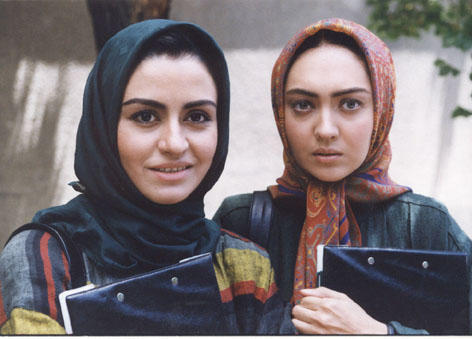
Briefly, Two Women is about the lives of Roya (Marila Zare'i, above left) and Fereshteh (Niki Karimi, right), two friends in the same class at university in Tehran. Fereshteh, who hails from the small town of Isfahan, is the more talented and accomplished of the two; what she wants most from life is to complete her studies and get a good job. But her life is suddenly threatened by a stalker, Hassan, who pursues her obsessively on his motorbike. He wants to marry her, but plucky Fereshteh laughs in his face and tells him to be off. He trails her as far back as Isfahan, where his pursuit of her leads to an ugly accident that takes the life of a child and lands him a long jail sentence.

That should be the end of Fereshteh’s troubles, but in fact it is only the beginning. Firstly, her father attacks her for having disgraced the family name, leaving her puzzled and angry. Then, a family friend, Ahmad, offers to pay the compensation the court has ordered Fereshteh to provide, and later he proposes marriage. Fereshteh finds herself betrothed to a man who is nominally a good husband, and later father, but who absolutely cannot comprehend the fact that she has some needs and desires of her own. Instead, suspicious of her ‘liberated’ ways (he arrives at this conclusion after he finds out that Fereshteh used to speak to male students while at university), he confines her to the four walls of their house. Confined to the duties of a wife and a mother, Fereshteh gradually loses all sense of herself and becomes a cipher, though she never stops fighting against her predicament. As Jasmin Darznik remarks in this piece: "A point of great irony and poignancy in the film is that Fereshteh acts as an acute observer of her own mental deterioration. She does not only suffer; she recognizes and articulates her experience with uncommon acuity."

In an interview Milani has argued that Two Women is “about the negation of the identity of a human being”:
One of the most important problems that we are faced with in Iran's society is that we are unable to express our true personality. Meaning that the society does not allow us to manifest who you really are, and this is worse in regards to women. In my opinion, 90 percent of the women and even the men in our society related to the character Fereshteh. The fact that in our society or in their private lives, there is a constant effort to change or make them into what they want them to be.
The film’s last two scenes had every spectator in the theatre on the edge of their seats - here, Milani brings all the threads of the film together to achieve some kind of resolution, and the quality of her dialogue is exceptional.

First, fleeing from her home after yet another fight with her husband, Fereshteh runs into Hassan, now out of prison but even more embittered and vengeful than before. He chases her with a knife in hand, and corners her in an alley. Sure that she is going to die, she falls down on the ground and waits for him to knife her. The assailant and the victim whose paths first crossed thirteen years ago now encounter each other again. Both now look back at that time long past, and the refrain of the dialogue on both sides is ‘you didn’t let me’. “I would have done anything for you, but you didn’t let me!” charges Hassan. “I wanted to be everything for you, but you didn’t let me!” And Fereshteh, who has encountered far too much of men finding her culpable for their lives going off track, boils over in turn. Referring to how his pursuit of her changed her life forever, and threw her into a chain of events from which she could never extricate herself, she cries (I approximate from memory), “I wanted to study in peace, but you didn’t let me! I wanted to make something of my life, but you didn’t let me!” At this point Ahmad bursts in on the action, attacks Hassan, and is knifed by him while Fereshteh watches in horror.

And in the film’s last scene, we see Roya reunited with Fereshteh after many years, at a hospital in Tehran, where Ahmad lies critically ill. While Roya has retained her good looks, Fereshteh’s troubles have broken her spirit and given her a haggard, dejected appearance. The doctors tell Roya to prepare her friend for the worst. Roya takes Fereshteh home to meet her husband; there, they receive a phone call saying that Ahmad has died.
Fereshteh’s reaction recalls the famous soliloquies of Shakespeare’s tragic heroes: she wanders around the room voicing her thoughts to Roya and her husband, but in truth she is speaking to herself. “I loved him, as a prisoner loves his jailor,” she quavers. “I didn’t want him to die.” She struggles to grasp the implications of her new situation. “Roya!” “Yes, sweetheart?” responds Roya. “What shall I do now? How am I to take care of two children on my own?” says Fereshteh. And then something of the old, plucky, independent-minded Fereshteh returns. “I must learn a new skill to make ends meet – computers, perhaps. A lot of work lies ahead. I must start planning right away. There’s no time to be wasted.” As she goes on and on in this fashion it is clear – especially by the way she keeps saying “Roya!” - that she has to some extent lost her mental balance. Tears roll down Roya’s cheeks.

Milani says in her characteristically provocative manner:

The two female characters in my film are a single person with two personalities - the heroine's actual personality and her potential personality, what she is and what she wants to be but can't because of society and its mores.
Clearly, Milani could not have made such a film without facing her own troubles with censorship. Indeed, the script of Two Women was thought to be so controversial that it took seven years for it to be passed by Iran’s Ministry of Culture, which monitors all film production in the country. After it was made, the film won several awards at film festivals around the world, and sealed Milani’s reputation. But, having tested the waters with Two Women, Milani got into even deeper trouble with the authorities with her next film, The Hidden Half, and was briefly jailed by the government. Milani speaks about the making of Two Women here, and gives an account of her own life and work here.
The story of Two Women has many parallels with aspects of the lives of women in India; among the Indian films I can think of which successfully explore the way women are imprisoned within gender roles is Shyam Benegal's Bhumika.