For the last two days I've been lying in bed knocked out not only by high fever but also by the most agonising headaches (though this should not be interpreted as an accusation, readers; it has nothing to do with the quality of comments you've been sending in, or with what small numbers visit the Middle Stage these days).
I went to see a GP on the first day, and he said it was a mild viral infection ("Mild? No, you've got it wrong right there, sir!"), and gave me a large set of pills to take, in different colours and with some broken into half. But all those pills went down to no effect, and the next day was just as bad as the first. Nor could I eat anything - I vomited everything straight back out, as if I'd suddenly turned into a human equivalent of a paper shredder.
Lying in bed in unbearable pain, I began to feel I was going to die. I thought of how, from being a person, I would suddenly change into a memory. I thought of all the things I would never manage to do, such as carry out a grand romance, skewer some enemies for good, or write a novel about Eros - heck, any kind of novel. I thought of all my books, growing lonely in their cupboards, and decided that I would generously leave behind my economics and philosophy books to Amit Varma, my books of reportage to Sonia Faleiro, my film books to Rahul Bhatia, my old science fiction books to Jai Arjun Singh, and some of my novels to my Hungarian friend Magda Sdebi. (General people want their ashes sprinkled over the face of the earth, but writers want their books.) I thought of England, where I studied for three years and which I was scheduled to visit next week, and of how I would never again see that beautiful little isle with its handkerchief fields, persistent low-hanging clouds and solemn beer-guzzling people.
As you can see, lying in bed in great pain does tend to encourage the most morbid thoughts, though the good thing is that one can twist them by ten degrees later and make them sound very funny.
Finally I was taken to hospital last evening, where, struggling to even sit up, I was ministered to by a bevy of doctors. In between our appointments my mother kept asking if I'd been working too hard lately (as anyone who knows me well will attest, this is a laughable contention). After many prods, taps and readings one doctor said he suspected I'd caught a mightily serious infection, and suggested I get admitted right away so that they could monitor me closely. I might be in hospital for three days to two weeks.
I have a great horror of hospitals - just entering them makes me feel ill. If I was ever given one wish, instead of asking for a million dollars I'd ask never to have to go to a hospital ever in my life. And strangely enough, within five minutes of him saying this, a young man's blood being what it is, I suddenly began to feel much better. I said I'd take whatever tests he recommended, but after that could I go home please? The doctors agreed, and I was told I could go home after taking a brain scan.
A brain scan involves lying on a long rack, having something strapped onto your forehead, and then being rolled into a large machine. My thoughts were still a bit morbid, and as I began to enter the little cavern it seemed to me as if this was the closest I'd ever get to understanding what it felt like to being inside a grave (not that it usually "feels like" anything to those sent into that underground world).
Ah well, I said to myself, trying to cheer myself up, at least it's totally painless. At this very moment an attendant and a nurse approached me from the left-hand side. They asked me to extend my arm with my fist closed, and before I could protests swiftly inserted a needle into my vein with the force one would expect of an attempt to puncture a bullock hide. What was worse was that, as I lay there with my eyes closed in agony, I could hear the attendant lustily shouting for cotton wool to be brought quickly to him, as if I was bleeding to death before his eyes.
Shortly after, still clutching my arm gloomily, I escaped the hospital.
I feel much better this morning (as you can see), but I'm off now to the hospital for more tests. But I can sit up, walk and think without pain, so if my body's telling the truth, then I think I'm going to be well again soon.
And to celebrate it all I'm going to be back tomorrow or the day after - or perhaps a bit later if I'm asked not to work in front of a screen - and hopefully this day next weekend I'll be bowling off a very long run-up (this is not the same as bowling very fast, but it is the closest approximation of that experience, and if nothing else it is indicative of a great zest of life, to be willing to put in so much effort for such little result) on a lovely green cricket field beneath a blue summery sky in England.
Saturday, May 20, 2006


Thursday, May 11, 2006
The sweet voice and harsh words of Osip Mandelstam
 The Russian poet Osip Mandelstam (1881-1938) was the brightest in a room full of brilliant flares, one of an extraordinary generation of poets that included Anna Akhmatova, Boris Pasternak, Aleksandr Blok, Vladimir Mayakovsky, and Marina Tsvetayeva, who made up what is called the Silver Age of Russian poetry. No writer more than Mandelstam bore the brunt of the political experiment launched by his country in the second decade of the twentieth century. It could be said that he loved and lived for his native Russia, and died at the hands of the Soviet Union.
Mandelstam grew up in St.Petersburg; his father was a leather merchant, and his mother a piano teacher. After graduating from school he visited Paris and became enamoured, like TS Eliot, of the work of the French Symbolists, but on his return to Russia he became associated with a poetic movement called Acmeism that emphasized clear language and concrete imagery. In any case, the work of great poets exceeds the bounds of poetic schools. Mandelstam once referred to poetry as "sweet-voiced labour". Here, in a translation by Albert C. Todd, is "A Body Was Given To Me", a poem from his late twenties ripe with the sound of a polished "sweet voice":
A Body Was Given To Me"For the quiet joy of breathing and living,/Who is it, tell me, that I must thank?" - what beautiful lines are those. Note especially how the pause in the second line "fills out" the line - the words "tell me" are not strictly necessary, but the pause makes the line sound somehow reverential and prayerful. Just looking at these lines one can see how, as the writer and translator Christopher Logue says in an interview, "a poem’s text is a sort of [musical]score as well as a text". The work of the young Mandelstam celebrates the music of life and of poetry. "And if a song's properly sung/With a full heart, then at last/All disappears; there remain/Just the singer, space and the stars!"
A body was given to me - what to do with it,
So unique and so much my own?
For the quiet joy of breathing and living,
Who is it, tell me, that I must thank?
I am the gardener, I am the flower as well,
In the dungeon of the world I am not alone.
On the glass of eternity has already settled
My breathing, my warmth.
A pattern prints itself on it,
Unrecognizable of late.
Let the lees of the moment trickle down -
The lovely pattern must not be wiped away.
The great and unavoidable event of Mandelstam's life, as of the lives of everybody of his generation, was the Bolshevik Revolution of 1917 that sought, and managed to bring about by force, a complete break with all the ways of the old tsarist Russia. Mandelstam, like many other Russian poets and intellectuals, felt ambivalently towards the Revolution; it both attracted and terrifed him. In one of his poems, "The Age", he compares the age to a wild animal with a broken back, looking at its own footprints.
Although he realised swiftly enough that there was something warped about the Communist dream, the confidence radiated by many of his peers threw Mandelstam into corrosive self-doubt (indeed, it was to be decades before the truth about the worst excesses of the Communist regime in Russia emerged). As his wife Nadezhda Mandelstam, whose book Hope Against Hope is one of the greatest works of Russian dissident literature, remarked, "It is not so simple to go against everybody and against the times. The power of the 'general will' is enormous - to resist it is much harder than people think - and we are all marked by the times we live in."
At the time the mere suspicion of dissent brought in its wake harassment by the Cheka, the Soviet secret police. Mandelstam soon found visitors from the government landing up at his home to ask him questions and explain to him the meaning of this or that line from his work. Mandelstam gave up writing poetry for several years. When he began writing again in the nineteen-thirties, the truth had become clear to him, though not to millions of his countrymen. His voice was now, in the words of his wife, "the voice of an outsider who knew he was alone and prized his isolation".
And what isolation. Here is Mandelstam's poem about Stalin from 1934, "We Live, Not Feeling":
We Live, Not FeelingEach detail of this poem is carefully selected to give a sense of looming menace. People speak in whispers; the only time they can raise their voice is when they speak well of the "Kremlin mountain man". Images of metal, hard and unfeeling, predominate in the description of Stalin - his words like pound weights, his decrees his horsehoes. He exudes danger from every angle and every pore, and both the people with him and those oppressed by him have been reduced to "half-people", who live not feeling.
We live, not feeling the country beneath us,
Our speech inaudible ten steps away,
But where they're up to half a conversation -
They'll speak of the Kremlin mountain man.
His thick fingers are fat like worms,
And his words certain as pound weights.
His cockroach whiskers laugh,
And the top of his boots glisten.
And all around his rabble of thick-skinned leaders,
He plays through services of half-people.
Some whistle, some meow, some snivel,
He alone merely caterwauls and prods.
Like horseshoes he forges decree after decree-
Some get it in the forehead, some in the brow,
some in the groin, and some in the eye.
Whatever the execution - it's a raspberry to him
And his Georgian chest is broad.
And the "sweet voice" of the young Mandelstam - it has itself become harsh and metallic in these new circumstances. Mandelstam was arrested soon after, and sent to prison, where he lost his mental balance and tried to commit suicide; eventually he died in prison in 1938. His wife zealously preserved his manuscripts, often in ingenious hiding places, through the long years of Soviet censorship, and they began to appear in the sixties and seventies under the more liberal regimes of those years.
More poems by Mandelstam can be found here and here. Adam Kirsch has an excellent essay on Mandelstam here. Mandelstam can be heard reading some of his poems here at the large archive of Russian poetry www.russianpoetry.net. An extract from Nadezhda Mandelstam's Hope Against Hope, "The Date of Death", can be found here.
And here are some links to aspects of the Russian experiment with Communism, perhaps the worst set of political ideas ever to have been given credence by intelligent men and women across wide swathes of space and time. Frances Stonor Saunders's beautiful essay "The Lost Tribe of Russia" - one of the sharpest book reviews I've ever read - deals with Lesley Chamberlain's recent book The Philosophy Steamer, about a group of Russian intellectuals sent into exile by Lenin in 1922 and sundered from their homeland for good.
In February there were a host of essays published in the world press to mark the fiftieth anniversary of Khrushchev's famed secret speech to the Twentieth Congress in 1956, of which here is one of the best, "Khrushchev’s secret speech and the end of Communism", written by the Soviet dissident Roy Medvedev.
And from some years ago, "You Are Strong, You Are Weak, Mother Russia" by the scholar of Russian history Robert Conquest, about why the reasons for Russia's problems with the transition to democracy, in the wake of the collapse of the Soviet Union, may be glimpsed in Russia's centuries-long history of authoritarian rule. ("Above all, nations do not escape their history.")
And finally, an old post about the Turkish poet Nazim Hikmet, who also spent a great deal of time in prison, and whose work also devotes itself to understanding what it is to "live with feeling".
Saturday, May 06, 2006
The Books Interview: Samrat Upadhyay
 Samrat Upadhyay’s book of short stories The Royal Ghosts, which I reviewed for the Los Angeles Times in February, is among the two or three best books I’ve read this year. Samrat kindly consented to an interview over email, and I present here his replies to some questions I asked him about his writing and reading. The Royal Ghosts will be out in India soon.
You have now written two books of short stories and one novel, which is unusual given that most writers today privilege the writing of novels. What do you find attractive about short story form?
The short story remains my first love. It is the form in which I began seeing myself as a serious writer, starting as an M.A. student in the late eighties. I love its compression, the deadline it gives me: I have a number of pages in which to accomplish certain things. No time or room to dilly-dally (although great writers are adept at taking us to the edge of dillydally-ness and turning around). I like the story’s shunning of luxury, a luxury the novel welcomes. In a way the story is saying, “Here are the rules, here are ways to break the rules, but you’d better be really careful.” (I just realized how closely that sounds to the mother in Jamaica Kincaid’s “Girl” offering admonishment and advice to her daughter. Kincaid’s story in itself is a meditation on the form of the story.)
Another attraction of short stories is that working on them allows me to enter multiple worlds and perspectives, some drastically different from one another. I am not bound to one world for months on end, as I am while writing a novel. I find this incredibly freeing. If I get tired of a story, I can bring it to a reasonable end and move onto something else. Alice Munro has said that the story form’s absence of elongated engagement suited her life as a busy mother. Nadine Gordimer has talked of stories being appropriate for our modern, restless consciousness; I greatly like how she talks of the story as a flash of the firefly for its sudden illumination.
Could you talk a little about the stories from which you've learnt the most about matters of technique or the delineation of character?
Kafka’s “The Metamorphosis” remains an all-time favorite with me: the shock of the first line (“When Gregor Samsa awoke from troubled dreams one morning, he found that he had been transformed in his bed into an enormous bug”) followed by a languorous opening of several long paragraphs in which the body of the cockroach battles fiercely with the soul of a traveling salesman. It can’t get better than this, just in terms of “bursting” into a story, turning our world topsy-turvy, then relaxing and teasing out the implications of the opening line. When I read “The Metamorphosis,” I find myself participating in the writing process.
I’ve learned much from Nadine Gordimer on how to control narrative distance—you know, move away to provide a larger, omniscient picture, then zoom in on an individual character’s intimate feelings and thoughts. William Trevor is a writer whose technique I admire the most, but feel as if it’ll take me a couple of lifetimes to master what he does: provide a startlingly visual picture for the reader without compromising psychological accuracy. His compassion for his characters, even the “baddest” ones, seeps through the gaps between the words, and I’m in awe of it. “The Potato Dealer” from his collection After Rain is a good example of this. Simultaneously, we experience three characters’ point of view, and Trevor manages to make us feel for all of them.
Realist fiction relies to a great extent on verisimilitude, on its ability to persuade the reader through minutely observed details. Your stories are full of details about Nepal, but you yourself do not live in that country any more. How hard is that when it comes to matters of description, of scene setting? Or is your distance from Nepal helpful?
It’s not hard at all. Most of the core images I use come from my first twenty-one years of life in Nepal, often from my childhood. Both the emotional and geographical distance helps me observe, I believe, the terrain of my stories more objectively than I would otherwise. Of course, I visit Nepal at least once every couple of years, as my parents and relatives still live there. Naturally, I “update” myself with the latest changes so that at least in terms of sensory images my stories maintain an illusion of verisimilitude. I say ‘illusion’ because some people take realism to mean “authentic,” a term which then is used to lash out against writers who they feel aren’t “representing” reality as they see fit. Needless to say, South Asian writers living in the west are easy targets of what Vikram Chandra has called “the cult of authenticity”. The epigraph to my first book Arresting God in Kathmandu recalls the Tibetan yoga’s practice of regarding every life detail as a dream—that’s my philosophy of fiction.
The American novelist and short-story writer Bernard Malamud once said of his methods, “I would write a book, or a short story, at least three times - once to understand it, the second time to improve the prose, and a third to compel it to say what it still must say. Somewhere I put it this way: first drafts are for learning what one's fiction wants him to say. Revision works with that knowledge to enlarge and enhance an idea, to re-form it. Revision is one of the exquisite pleasures of writing.” Would you agree with that?
Yes, I do, although with the caveat that it depends upon the story. Only one story I’ve written, “Deepak Misra’s Secretary” from my first collection, didn’t go through the three stages that Malamud speaks of. That story I finished in a week, did some minor editing, and that’s how it was published in a journal and later in the book. All the rest have gone through various stages of exploration and discovery. In almost half of my stories the pleasure has come about only in the revision stage, once the story really begins to come together. But then, sometimes revision is pure drudgery—but necessary.
Every reader has some favorite passage from literature, something that seems to him or her an example of the sharpest, most subtle writing? Is there a passage like that you'd like to cite from a book, explaining what you like about it?
I can recall many such favorite passages, but the one that gives me goose bumps every time I teach it, and one that I even managed to echo in one of my stories, is from Raymond Carver’s “A Small, Good Thing.” The story charts the agony of a mother forced to live through her son’s coma and eventual death, all the while hounded by a baker who keeps making nasty phone calls about the son’s birthday cake that was never picked up. After their son’s death, the furious mother, accompanied by her husband, goes to the baker’s shop to accost him. When they tell him that their son is dead, the baker changes. The passage below, for me, shows what great literature really does: bring together antagonistic forces, with ample respect for the complexities of emotions involved, so that even the most extremes of feelings become transformed into some sweet, earthly, and meditative:
"You probably need to eat something," the baker said. "I hope you'll eat some of my hot rolls. You have to eat and keep going. Eating is a small, good thing in a time like this," he said.You work in the USA as a teacher of creative writing. I'd like to ask you to what extent it is possible to teach someone to writer better fiction or poetry? And is there another way to the same goal? Is it possible to write better by learning to read better?
He served them warm cinnamon rolls just out of the oven, the icing still runny. He put butter on the table and knives to spread the butter. Then the baker sat down at the table with them. He waited. He waited until they each took a roll from the platter and began to eat. "It's good to eat something," he said, watching them. "There's more. Eat up. Eat all you want. There's all the rolls in the world in here."
They ate rolls and drank coffee. Ann was suddenly hungry, and the rolls were warm and sweet. She ate three of them, which pleased the baker. Then he began to talk. They listened carefully. Although they were tired and in anguish, they listened to what the baker had to say. They nodded when the baker began to speak of loneliness, and of the sense of doubt and limitation that had come to him in his middle years. He told them what it was like to be childless all these years. To repeat the days with the ovens endlessly full and endlessly empty. The party food, the celebrations he'd worked over. Icing knuckle-deep. The tiny wedding couples stuck into cakes. Hundreds of them, no, thousands by now. Birthdays. Just imagine all those candles burning. He had a necessary trade. He was a baker. He was glad he wasn't a florist. It was better to be feeding people. This was a better smell anytime than flowers.
"Smell this," the baker said, breaking open a dark loaf. "It's a heavy bread, but rich." They smelled it, then he had them taste it. It had the taste of molasses and coarse grains. They listened to him. They ate what they could. They swallowed the dark bread. It was like daylight under the fluorescent trays of light. They talked on into the early morning, the high, pale cast of light in the windows, and they did not think of leaving.
If you think of learning how to write as similar to learning music, then “creative writing” doesn’t seem like such a bizarre notion. I can’t teach those students who have no ear for language, or those who can not distinguish between easy, clichéd ploys of commercial, genre-oriented literature and serious, artistically compelling stuff. But I can teach students to gain better control of their material, to expand and refine their vision, and to come to terms with the reality of the profession. If you think of writing as an “apprenticeship,” which includes both learning skills and practicing, then reading becomes a way of learning skills. But this doesn’t necessarily need to happen in academia; writers groups in local communities can mirror the kind of gathering one finds in MFA programs like ours at Indiana University.
Which are the dozen or so books that you would like to take with you into the afterlife, if such a thing exists?
Gustave Flaubert, Madame Bovary
Charles Dickens, A Tale of Two Cities
V. S. Naipaul, A House for Mr. Biswas
Anita Desai, In Custody
Rohinton Mistry, Such a Long Journey
William Trevor, Collected Stories
Kazuo Ishiguro, The Remains of the Day
E. M. Forster, A Passage to India
Pablo Neruda, Selected Poems
Franz Kafka, Complete Stories
What are your work habits like?
I tend to get up very early in the morning to write, but get tired easily. Also, I have a full time job of teaching, so I write at most 3-4 hours a day.
Do you read literary criticism or book reviews? What, in your opinion, is the work of such activity? Are there any critics you specially like reading?
I do read book reviews; not only my reviews of my work but of others. I think discussion and reflection are nourishing activities for writers. I prefer to read works of criticism or essays by writers themselves, as I find them more illuminating. So, Salman Rushdie’s Imaginary Homelands remains a favorite of mine, a work I’ve often gone back to repeatedly. I’ve also learned much about the social responsibility of the writer from Nadine Gordimer’s The Essential Gesture: Writing, Politics and Places, a collection of essays on what it meant to be a writer under apartheid.
Would you care to make any observations on the political situation in Nepal today?
Now that an autocratic regime has been defeated, I am very optimistic about the resolution of the Maoist political impasse in Nepal. Here’s my recent op-ed on the subject, "A King in Check", from the New York Times. And here’s another essay that appeared in the Times three years ago.
Have you been to India? Did you find yourself comparing to to Nepal in this way and that?
I have traveled extensively in northern India; studied in Bombay for a year in the early eighties; and now frequently visit Kolkata as my sister lives there. I grew up on a steady diet of Hindi movies, and I think sometimes my stories have undercurrents of the dramas of Hindi movies of yore. Nepali and Indian cultures are quite similar, with similarities in food and Hindu rituals and festivals.
These interviews always end with a question not related to literature, though related to the good life. Please tell us what your favorite meal is - and if you cook yourself, how it is cooked.
Momos, Nepali dumplings. Even thinking about momos makes my mouth water. Best momos will explode in your mouth, filling your palate with sharp, tangy juice that’s simply heavenly. The meat itself is yummily spicy, and before you even finish swallowing one momo, you must plop the next one into your mouth so that it’s a continuous, seamless orgasm.
I know of no Nepali who doesn’t like momos, so I’d venture to say that momos are probably more a symbol of Nepali unity that the institution of monarchy can ever be! Here’s the recipe my friend Karl Eisenhower put up on his website after he learned how to cook momos from my wife Babita. Chicken instead of pork will do just as well.
Tuesday, May 02, 2006
Fakir Mohan Senapati's roundabout fictions
My long essay on Fakir Mohan Senapati's novel Six Acres and a Third appears today in the new issue of Himal, a bimonthly magazine published from Kathmandu.
 The 19th century Oriya novelist Fakir Mohan Senapati was a most oblique writer – he hardly said or meant anything in a straightforward way. Much of his work is ironical and satirical, and of course irony and satire work through indirection, by way of the meaningful glance rather than the plainspoken word. Yet irony, while aiming to surprise, can sometimes be applied too predictably, and then it becomes as unsubtle as the more homespun narrative mode it disdains. Thankfully this is not the case with Senapati: he worked with a very light and delicate hand.
At one point in Senapati’s newly translated novel Chha Mana Atha Guntha (Six Acres and a Third), the narrator, who often addresses the reader directly, remarks that “unpleasant truths are better left unspoken; in other words, we are forced to forget half the truth and tell you the other half.” This might serve as a loose definition of satire, which tells the truth by denying the truth. When Senapati describes the greedy ways of his hero, the venal zamindar Ramachandra Mangaraj, defending him all the while by saying that he is really a “kind and pious man” who is slandered by his subjects, Mangaraj is exposed more effectively than a simple and uninflected chronicle of his evils could have managed. The narrator is, in effect, repaying Mangaraj with the same duplicity that Mangaraj himself practices on those around him – he has a friendly hand on Mangaraj’s shoulder while simultaneously winking at the reader, confident that “for intelligent people, hints usually suffice”. This jaunty line of attack is Senapati’s way of pointing to unpleasant truths in a way that also gives the reader pleasure.
Chha Mana Atha Ghunta was written in 1902; at this point the novel in India, a legacy of colonial rule, was about four decades old. Most of the novel’s initial practitioners belonged to the new class of Indians who had, after the implementation of Lord Thomas Macaulay’s Minute on Indian Education in 1835, received an education in English. (In fact, in 1864 the young Bankimchandra Chatterjee, then a district magistrate in Khulna in Bengal, wrote his first novel, Rajmohan’s Wife, in English.)
Senapati, like Bankimchandra and many other early Indian novelists, had some connection with the business of government and therefore to British rule. He was born Braja Mohan Senapati, but when a mysterious illness threatened to take his life when he was still a child, his grandmother took him to a dargah and promised to offer him as a fakir, a Muslim mendicant, if he lived. The boy recovered, but the grandmother was loath to give him up, and instead he was renamed Fakir Mohan and made a "fakir" for eight days every Mohurrum. In his autobiography Story of My Life, a classic of Indian literature still to be published in its entirety in English, Senapati recalls the fakir's garb he wore at Mohurrum: "shorts which would reach down to my knees, a multicoloured shirt, a fakir cap, a patchwork shoulder bag, a red walking-stick."
Later, Senapati worked as a schoolteacher and a dewan, or administrator, on feudatory estates. Six Acres and a Third, which is set in a feudal world and concerns a land dispute, probably has its roots in these experiences. Although Senapati’s book is recognisably a novel, it is has many Indian twists with no precedent in the classic Victorian novel then available to Indian writers - it is the novel form soaked in the crucible of Senapati's own reading and experience. Its plot is not linear, its methods of characterisation are fruitfully eccentric, and its storyteller’s tone seems to fuse the form of traditional novelistic narrative with older Indian narrative traditions.
The plot of Six Acres and a Third revolves around Ramachandra Mangaraj’s attempt to appropriate a village farmer’s verdant smallholding, six-and-a-third acres in area. Senapati’s is a moral tale: Mangaraj’s devious stratagems are successful, but soon his deeds return to haunt him, and he falls spectacularly from grace, losing every piece of his wealth.
This plot outline makes the novel sound more unsophisticated than it really is, for Senapati was not just an incomparably subtle but also a happily digressive writer. In Six Acres and a Third, the reader will find long sections on the place of the temple and the pond in village life, extended character portraits such as the one of Mangaraj’s shrewish maid Champa, and meditations upon human nature and Indian history. One of the features of Senapati’s narrative is the multiple levels on which it works simultaneously. “What do these six acres and a third represent?” the narrator asks towards the end of the book. It is reallly a rhetorical question, for we already know how much a plot of land can represent in the hands of a writer as astute as Senapati. His novel casts a searching ironic light upon the injustices of the zamindari system as well, the depredations of British colonialism, the suffocating hierarchies and prejudices of caste, and more generally at man’s capacity for inhumanity to other men.
But the truth is – and this is what is most charming about Senapati – that the author was really a kind of incorrigible ironist. His work is not dependent on the gross folly of the wicked, but the naturally crooked timber of humanity. In fact, if his novel persuades us about anything, it is about the ubiquity of human vanity and frailty. The tone of his narrative is that of the village gossip – sly, garrulous, conspiratorial, and full of hints and winks and insinuations. At one point, while describing the representations of some mythological scenes in Mangaraj’s courtyard, the narrator remarks, “Somewhere in Rajasthan, on seeing the image of a nude woman, Tod Sahib came to the conclusion that all women in ancient India went about naked.” (‘Tod Sahib’ refers to Colonel James Tod, the author of a widely-read book called Annals and Antiquities of Rajasthan.) On another occasion, we are told about the village priest, a greatly respected man who runs the shrine of the village goddess, Budhi Mangala. “The priest was very highly regarded in the village, particularly by the women,” the narrator notes. “The goddess frequently appeared to him in his dreams and talked to him about everything.” That "about everything" – as if the goddess personally reports to the priest – is a damning phrase.
Cranes and kingfishers
One strand of thought in Six Acres and a Third that seems particularly striking from our twenty-first century point of view is Senapati’s response to the British – their reshaping of Indian civilisation, the adoption of new systems of government and jurisprudence, the newly emergent discourse of Western rationalism and scientific progress, and the missionary zeal of Christianity.
Senapati’s reading of these matters is quite complex. On the one hand, he makes fun of the assumptions of racial superiority held by the British. “Today, in the 19th century, the sciences enjoy great prestige, for they form the basis of all progress,” the narrator declares. “See, the British are white-skinned, whereas Oriyas are dark in complexion. This is because the former have studied the sciences, whereas the latter have no knowledge of these.” Senapati jocularly asserts that what are thought to be racial differences really have their bases in matters of environment: once the Oriyas learn science, they too will become white-skinned, and then the British will have neither an intellectual nor racial basis for lording over them.
But at other points Senapati chastises his own countrymen for the weakness of their opposition to the outsiders. “Historians say it took Clive less time to get the Bengal Subedari from the emperor of Delhi,” the narrator remarks, “than it takes one to buy and sell a donkey.” He is also concerned about the manner in which "English culture is rushing in like the first floods of the river Mahanadi". He mocks the way the new class of English-educated Indians have uncritically adopted Western assumptions: “Ask a new babu his grandfather’s father’s name,” he sniffs, “and he will hem and haw, but the names of the ancestors of England’s Charles the Third will readily roll of his tongue.”
Senapati was a naturally metaphorical writer. Indeed, his metaphors are often striking not just for their vividness and specificity – water lilies fold themselves up and hide during the day “like young Hindu daughters-in-law”; cows chew their cud “like baishnavas, moving their mouths as if they were repeating the divine name” - but for the ways in which grand meanings suddenly emerge from everyday juxtapositions. At one point, speaking of the birds found near the village pond, the narrator notes how the cranes churn the mud “like lowly farmhands” looking for fish all day long, while kingfishers appear suddenly, conduct swift raids, and gorge themselves on the stolen pickings. “Oh, stupid Hindu cranes,” he laments, “look at these English kingfishers…”
The great virtue of this new translation (by Rabi Shankar Mishra, Satya P Mohanty, Jatindra K Nayak and Paul St-Pierre) is that it renders the music of Senapati’s wonderfully salty and colloquial Oriya into a limber and mellifluous English. Nayak has already translated sections of Senapati’s autobiography, and perhaps the entire book will be widely available in an English translation soon. In the meantime, we have this piquant and gossipy book, one of the cleverest and most subtle novels ever written.
Some links: Satya P Mohanty writes about the linguistic and technical innovations of Six Acres and a Third here. A very funny chapter from the novel, "A brief history of the Asura Pond", can be found here. And here is an essay by Jaitirth Rao with some rather unorthodox opinions, "In praise of Thomas Macaulay".
And an old essay on an Indian writer whose work shares some similarities with Senapati: "The world of Bibhutibhushan Bandyopadhyay".
Sunday, April 30, 2006
Some thoughts on playing cricket at the Oval
A few days ago I was at morning cricket nets at the Oval Maidan in Bombay, a weekly affair where we exercise our two-bit skills with high seriousness and fidelity to ritual. Not far from where we were playing a bespectacled young man, clad in a tracksuit and a cap, was conducting some summer cricket coaching with a dozen boys in whites.
Caught up with the mechanics of trying to bowl an outswinger correctly, I soon forgot all about them. But a little later, while chasing down a hit, I happened to come across the scene of a standard fielding drill taking place. The man had lined all his wards up, and was hitting balls towards them. They were supposed to run up one by one, field the ball and throw it back, and return to the back of the line.
Unsurprisingly it was the coach himself who seemed most enthusiastic- all kids think of is bowling or batting. He hit the ball and shouted, in a tone meant to gee up the kid, "Come on, get it, it's yours!" But the boy running towards it seemed unable to turn his speed up a notch; in fact he had a struggling, striving air, like a butterfly fighting against a breeze.
He was being held up by his shoes, which were clearly two or three sizes too big for him - perhaps hand-me-downs from an older brother or cousin. As he ran in they seemed somehow to have a life of their own, independent of the feet inside them. He stopped the ball a little sheepishly, returned it, and ran back.
But no great tragedy need be read into all this. If the boy was slightly embarrassed, he was still happy and "switched-on", pursuing his dream, even if in shoes two sizes too big.

I've been going to nets for about three years now, mostly at the Oval and the more crowded Cross Maidan (where a small rectangular patch of land has a dozen pitches). The young cricketers playing all around me, and playing for reasons very different from mine, are mostly teenagers from middle- or lower middle-class backgrounds. In all these years of observing them I feel I understand something - in fact it is difficult not to be struck by it - of what cricket means to them.
Actually one needs to say no more than just this: cricket means something to them. It means something when very little else in their lives means anything, and this overpowering preeminence of cricket in their lives is not merely because of the magic of the game and the impassioned blinkers of youth (think of the boy Tendulkar, going from match to match on his coach's scooter, and of all the other boys who must have done similar things, if not to the same end) but because everything else in life is so profoundly dull and uninspiring.
Education, for instance, which serves in theory to free us, to make us more aware of ourselves and what we want to pursue, is almost everywhere in our country a bad joke, a set of dud formulae to be remembered and meaninglessly regurgitated. Where it should teach us to take an interest in the world, it renders the world opaque. Who can take any pleasure in school other than that of japes and camaraderie with friends? There is very little about life in these training-grounds that allows us to dream, glimpse a way forward for our lives.
But cricket - there is a spark in it that immediately rouses ambition and competitive spirits, that gives meaning and purpose to constrained lives. To play cricket is to wake up. On the field one lives fully, intensely, relying on one's wits from moment to moment. In the angle of one's bowling arm, or the calculation of which ball to play and which one to leave, lies the very same maths problem that induces such sleep in school.
For this reason, even if few of these kids go on to become cricketers of any standing, cricket is good for them because it serves as a beacon in their lives. While most other fields in life lie fallow, the maidans, at least in the imagination, are always green. It seems to me that kids who play cricket seriously, whether they play badly or well, learn something about themselves and about life that many others don't.
And yet of course, as one grows older, reality checks in, and other problems and issues present themselves, cricket is usually left behind. Just as on the Oval maidan the heat is fierce and the dust flies thickly, and even shiny new balls become cracked and chapped in a few minutes of use, so the demands of adult life, too, overpower people over time.
And sometimes on the train or bus one sees people who one feels must have once been those very same boys playing at Shivaji Park or at the Oval, only ten years older now and disabused of the lifegiving illusions of adolescence - still with a bit of fire in the eyes, but undeniably wearied, haggard and disenchanted. Cricket is over; many other things have taken its place.
Photograph by Amit Varma
Tuesday, April 25, 2006
Memories of a Borges book, and the old Twentieth Century bookshop
I'm pleased with some of the responses to my recent post on Jorge Luis Borges, quoting bits of work that relate in some way to Borges's writing - in fact this proves, as Guiseppe Mazzotta writes in this beautiful piece on Dante, how "all arts are engaged in an endless conversation". With comments like these blogging also becomes a shared endeavour, an endless conversation.
And occasionally a comment happens to jolt one's memory, and things long past return vividly. Yesterday, while responding to a question about Borges, I remembered a book by Borges I'd read many years ago, and a great many other things besides. I thought I'd put up the comment again as a post - it's my personal tribute to Borges.
The Borges book that I like best myself is one that I no longer possess, but often remember with nostalgia.
In the year 1999 I was a college student in Delhi, and two minutes away from our residence in Connaught Place there was a most dusty and smelly bookshop called Twentieth Century Bookshop. (A couple of years later, as if obedient to the boundary line offered by its own name, it shut down, but clearly it was founded at a point when an enormous swathe of the twentieth century stretched out before the proprietor. For him the name was in sync with, even ahead of the times; now it was only a relic of it.)
It was here one afternoon that I joyfully bought, for the sum of fifty rupees, a pink paperback authored by Borges and his longtime friend and collaborator, Adolfo Bioy-Casares, called The Chronicles of Bustos Domecq.
The pompous and gullible H. Bustos Domecq was among the best characters Borges ever created (in fact, his voice always became notably "lighter" when he worked with Bioy-Casares). Bustos Domecq was supposedly a literary journalist, and the book is a collection of highly earnest essays written by him on subjects like modernism, abstract art, and so on.
In truth these pieces were devastating indictments of literary fads and fashions, and in particular the excesses of Modernism. Thrilling things were achieved by the sly wit of Borges and Bioy-Casares, firing away from behind their pedantic and credulous character. I remember this as one of the first books that showed me how much fun could be had with literary criticism, and indeed how literary criticism was itself a branch of literature.
Sadly, in those days I was more youthful, less wise and more kind than I am now, and in zest for somebody to share my enthusiasm for my book I lent it to a friend, who promptly lost it. To my regret I have never been able to find another copy.
I now possess The Chronicles of H. Bustos Domecq only in memory. And often it seems to me as if that book is a symbol of those beautiful days, now lost forever, to use a Borgesian phrase, in the labyrinth of time.
Sunday, April 23, 2006
Alberto Manguel with Borges
 The first thing to note about With Borges is its singularity. The only man who could have written such a book about Jorge Luis Borges has now .
The literary critic and essayist Alberto Manguel not only knows the work of Borges better than anyone else, he was also a close friend and ally of Borges. With Borges brims over with warm details of Borges the writer and Borges the man, but it is also it is also written in a circling, allusive, aphoristic style that shows Borges's own influence on Manguel.
Manguel's friendship with Borges began in a very unusual way. As a boy Manguel used to work after school in an Anglo-German bookstore called Pygmalion in Buenos Aires, and Borges was an ocasional visitor there. By this time Borges, in his late fifties, had become prey to the blindness that ran in his family, and, as someone who lived almost exclusively for books, he was in need of someone to read to him. Manguel didn't know much about him, but he was a bibliophile as well, and when asked if he would read to Borges in the evenings he consented.
For a few years, till the time Manguel left Argentina in 1968, the two would go over the books in Borges's library in the evenings—Dante, Chesterton, and Kipling were among Borges's favourite writers. Manguel would read, Borges would listen closely (he knew many of his favourite works by heart), and then make some observations of "wonderful perspicacity and wit, not only sharing with me his passion for these great writers but also showing me how they worked by taking paragraphs apart with the amorous intensity of a clockmaker". This is not the only occasion in With Borges when the reader feels more than a little envious of Manguel.
Books meant the world to Borges, and not just in the simple sense that he was greatly in love with books and literature. Rather, as Manguel explains, books were Borges's primary reality:
For Borges, the core of reality lay in books; reading books, writing books, talking about books. In a visceral way, he was conscious of continuing a dialogue begun thousands of years before and which he believed would never end. Books restored the past. 'In time,' he said to me, 'every poem becomes an elegy.' He had no patience with faddish literary theories and blamed French literature in particular for concentrating not on books but on school and coteries….He was a haphazard reader who felt content, at times, with plot summaries and articles in encylopaedias, and who confessed that, even though he had never finished Finnegan's Wake, he happily lectured on Joyce's linguistic monument. His library (which like that of every other reader was also his autobiography) reflected his belief in chance and the rules of anarchy."His library, which like that of every other reader was also his autobiography"—in utterances like this we see Manguel's own penchant for provocative Borgesian formulations. Elsewhere Manguel says:
There are writers who attempt to put the world in a book. There are others, rarer, for whom the world is a book, a book that they attempt to read for themselves and for others. Borges was one of these writers. He believed, against all odds, that our moral duty was to be happy, and be believed that happiness could be found in books, even though he was unable to explain why this is so. 'I don't know exactly why I believe that a book brings us the prospect of happiness,' he said. 'But I am truly grateful for that modest miracle.'With Borges—beautifully brought-out by a relatively new publishing house, Telegram Books—complements another beautiful essay in Manguel's 1999 collection Into The Looking-Glass Wood. That essay is titled "Borges in Love", and it is about Borges's difficult romantic life ("Throughout his almost centenary life, Borges fell in love with patient regularity and with patient regularity his hopes came to nothing."). The irony about this is that Borges produced some of the twentieth century's best poems about love.
And now some links. The universe of Borges's poems and stories—he never wrote a novel, and in fact held the novel form in some disdain—is so rich that a great many readers have been stimulated into producing rich work in response to it; Manguel is just one of many fine interpreters of Borges. Here are two particularly good essays.
One, written by Borges's translator Alistair Reid, is called "Borges Beyond Words", and it deals (in beautiful language, one might add) with the vexing issue of the relationship between reality and the language we use to describe that reality. Reid writes:
There is one quotation which Borges loved--I think it was his favorite quotation in all of English literature. It was from an essay of G. K. Chesterton's on a fairly unknown painter called G. F. Watts. "Man knows that there are in the soul tints more bewildering, more numberless, and more nameless than the colors of an autumn forest. . . . Yet he seriously believes that these things can every one of them, in all their tones and semitones, in all their blends and unions, be accurately represented by an arbitrary system of grunts and squeals. He believes that an ordinary civilized stockbroker can really produce out of his own inside noises which denote all the mysteries of memory and all the agonies of desire." In other words, language can never accommodate the enormous reality beyond it....The second is "Mother's Boy", by the literary critic Algis Valiunas, a writer whose work I admire greatly for its intelligence and verbal beauty. Again, it is contains a beautiful quote from a writer Borges admired—the philosopher FH Bradley, who says "For love unsatisfied the world is a mystery, a mystery which satisfied love appears to understand." (And perhaps one can tell, from Manguel's "Borges in Love", why Borges attached such importance to this remark.) But among the many interesting things in Valiunas's piece is the criticism of Borges's work that he proffers in the closing paragraphs.
And here is Borges's beautiful fable of the life of Shakespeare "Everything and Nothing", a piece that Valiunas takes up at the close of "Mother's Boy".
An extract from With Borges can be found here. The excellent Robert Birnbaum has a long interview with Manguel here. And the American novelist John Barth draws some parallels between the work of Borges and another giant of twentieth-century literature, Italo Calvino, here.
Lastly, an old piece about some poems by Borges, "Chess With Jorge Luis Borges".
Wednesday, April 12, 2006
A year of the Middle Stage
Today it is a year since I began blogging about literature - about other things too, but mostly about literature - at the Middle Stage.
I began writing here last April at the invitation of my friend (and then colleague) Amit Varma, who used to write both this blog and India Uncut. After a while Amit was kind enough to give it to me for keeps, and so this is now the place where I am most easily and regularly found.
In retrospect, the Middle Stage was curiously appropriate for me when I took it over, because at that time I really was at an in-between stage - a middle stage - of my life. I'd just given up my job, but without much idea of how I was going to manage thereafter - I only knew I was dissatisfied, and that I didn't want to continue doing what I was doing. I was also struggling to get my work published anywhere, and was in very low spirits. But not only was I dispirited, I was also lazy and out of shape. Sometimes I wrote no more than one piece a month. If I didn't manage to find commissioned work, I wouldn't do any. I moped more than I worked.
All that changed from the day I took the site up. I still remember not sleeping very well on the night of 11 April 2005, consumed by thoughts of what I could write that would be of interest to Amit's captive audience (in this respect I was fortunate - I didn't have to start from scratch). After I’d put up a couple of posts I began to see the potentialities of the form, and realised there were a great many things I knew that were of no use from the point of view of marketable writing - who wants a piece on Willa Cather or Constantine Cavafy? - but which were of value nonetheless and I could extend to my readers to enjoy.
Best of all, the sense of responsibility I began to feel to my small batch of dedicated readers - even today, although their tribe has increased substantially, I don't think they number that many - had a galvanising effect on my writing. From my experience it seems to me that writers' blogs work similarly to literary magazines, in that one writes for a small but interested audience whose involvement and feedback is of great value. Because I now occupied a public space, I'd make an effort to write something every four or five days to please my readers, to thank them for their time (really, that's all a writer wants - good readers, and a bit of company in the evenings). I found myself dredging out books from the back of my dusty cupboard to look up a point, and reading poets I hadn't looked at for years.
The regular work, and the time I freed up for myself by abstaining from the drudgery of a job, had a good effect on my work. As time passed, my writing became sharper, and work also began coming in, if only in fits and starts. From around the new year my luck seemed to turn. In fact I now have more work than I can handle. But even though I write now for several newspapers and periodicals, I think I care the most passionately for what I put up on this space.
This is partly because a blog is like a generous editor - it allows you to do whatever you want to do in the hope that you will do it well. I find I can write here about two areas of my interest, poetry and classical literature, when nobody wants a piece on any of these things for a newspaper. There are no restrictions on space - although I try not to misuse this by being verbose or imprecise. And I'm not limited to current books - I can write about whatever I want, and one of the things I like doing best is bringing the work of little-known or neglected authors to light.
There have been some debates in the Indian blogosphere recently - it is a good thing that there are these debates, and that the quality of debate here is better than in Indian newspapers - about what reviewing and writing about literature, about what work they should properly do and how they should go about it. But I must confess that, reading these opinions, I cannot agree with any one of them. The sentiments expressed here are not the sentiments that animate me.
I think of my work as a form of love. It is a way of sharing out with people books that have given me aesthetic pleasure and intellectual nourishment. When I write about current books I try to judge those by the highest standards. Nevertheless I get some kind of pleasure or the other out of most books. I try not to be cutting about low-quality or middle-grade writing, because after all each one can only do the work he or she is capable of doing, and often poor work is the stepping stone to better work. It is only with what I consider to be dishonest or wilfully mendacious work that I feel harsh. I take my work seriously, and ask also to be taken seriously and judged rigorously. I devote almost no time to thinking upon the subjective-objective questions raised recently. To my mind a good critic’s subjectivity is a kind of objectivity.
So I'd like to thank you, my readers, for how you have helped my work, and to say that I look forward to many more years of our interaction. To celebrate I thought I'd invite both you and most of the writers featured here over the last year to a party, but since many of them are now dead (though not, I assure you, as a result of being written about here), the only space that these workers in words can occupy in common is a space itself made up of words - a paragraph. Here's the guest-list:
Anton Chekhov, Bibhutibhushan Bandopadhyay, Constantine Cavafy, Orhan Pamuk, Jorge Luis Borges, Saadat Hasan Manto, Willa Cather, José Saramago, Amartya Sen, Ryszard Kapuscinski, Naguib Mahfouz, Minoo Masani, Attila Jozsef, Sirshendu Mukhopadhyay, Mirza Abu Taleb, Joseph Mitchell, Amrita Sher-Gil, Monica Ali, Nazim Hikmet, Siddharth Chowdhury, Ruben Gallego, Giovanni Boccaccio, Harold Pinter, Ramachandra Guha, Mo Yan, Adam Kirsch, Javier Marias, Saratchandra Chattopadhyay, Jahiz, Dandin, Giovanni Verga, Altaf Tyrewala, Antonio Machado, Hushang Golshiri, Attia Hosain, Joseph Epstein, Nikolai Gogol and Samrat Upadhyay.
I enjoy going to the movies very much, but don’t feel I have as good an understanding of the form as of novels. But here are some of the occasional pieces on cinema I’ve done over the last year: on Nagesh Kukunoor’s Iqbal, Anurag Kashyap’s Black Friday, Tahmineh Milani’s Two Women, and Rakeysh Mehra’s Rang De Basanti.
I don't do much cricket work any more, but I enjoy writing the occasional piece for a periodical or else on the cricket blog Different Strokes. Here are some recent pieces on new-generation players of whom I think highly: Virender Sehwag, Mahendra Singh Dhoni, Ramesh Powar, and Suresh Raina.
And I would like to do more non-fiction writing, but this is difficult because it requires more time and expense than writing about books, and when I do travel I prefer to store away my notes for a set of stories I'm working on. Here's the one piece I've done in this area in the last twelve months: “Seven Views of Puri”.
Sunday, April 09, 2006
On Kiran Nagarkar's God's Little Soldier
[A version of this piece appears today in the Indian Express]
It is not unusual or surprising that Kiran Nagarkar has chosen in Zia Khan, the protagonist of his new novel God's Little Soldier, a man who is self-involved, confused, violent, spiteful, and deluded. Excellent novels have been written about such characters. Indeed, what could be more fascinating than the story of a man who has to deal with the world but cannot see clearly and is shackled by his own failings?
What is unusual, however, is the extent to which the narratorial perspective of God's Little Soldier exists in faithful servitude to the worldview of its central character. Instead of summoning sober intelligence to balance out Zia's vast madness, Nagarkar's narration aggrandises him even further, echoing Zia's slapdash thinking and love of anarchy with a linguistic sloppiness and a bogus grandiosity of its own. Zia is a terrorist, and God's Little Soldier itself enacts a kind of literary terrorism, gleefully blowing up every literary convention and nicety over more than five hundred pages at once tedious and alarming.
Zia's story is credible for only a fraction of this book. This is the early section where Nagarkar takes us through his childhood, his immersion in Islamic doctrine at the urging of his devout aunt Zubeida, and his conviction as he grows up that he is destined to be "God's little soldier", a defender of Islamic values in a degenerate and immoral world. Here one can take genuine pleasure in Nagarkar's tracking of his protagonist. "The power of mass prayer was a revelation to Zia," he writes of Zia's first visit to the mosque by himself. "He discovered that his prayers had more body and weight and rapture when he was among the believers in the mosque." One understands why Zia might want to do something to shake up the world.
But how he shakes it up. Nagarkar's Zia is a Superman. He is a mathematical genius who nevertheless has no great love for mathematics; he has three girlfriends at his posh school but is indifferent towards all of them; he is petty in his dealings with family members yet they all, like Nagarkar, love him to bits. As a student in Cambridge, he decides to assassinate Salman Rushdie, the "obstreperous Midnight's Child" and the scourge of Islam, and hunts him down, only to be stymied at the last moment; this makes him flee the country. Later he becomes a guerilla in Afghanistan and Kashmir.
In the second part of the novel, we find that Zia has renounced his precious Islamic faith to become the zealous Brother Lucens, a monk at an abbey. Here his activities include making massive profits on the stock market, running a campaign against abortion, and setting up an organisation called The Guardian Angels dedicated to nothing less than the moral rejuvenation of godless, sinful America. (It is worth noting that while Nagarkar mocks capitalism, his narrative is steeped with gratuitous references to foreign brand names, as if to establish that he really knows his US and his UK.)
And in the third part of the novel we find that Lucens has taken up with a Hindu godman, Shakta Muni, and has taken on a new name, Tejas Nirantar. Zia is infinitely elastic; at one point Nagarkar even calls him - whether in seriousness or in jest it is hard to say, as Nagarkar seems to believe all seriousness must also be jest - Zia-Lucens-Nirantar, as if to suggest there is nothing like a stable Zia but only a succession of Zia avatars. Zia has only the appearance of independence; in reality he is a hostage - God's little soldier - to his whimsical creator, who makes him whatever he wants him to be.
Worst of all is that this tall tale is narrated in Nagarkar's new wild-eyed vagabond prose, so different from that of Cuckold. His protagonist wants to assassinate Rushdie, and Nagarkar himself sounds mostly like he has the one-point aim of parodying the work of "Midnight's Child". One of the reasons that God's Little Soldier is so long is that a great deal of the time the narrator appears to be working only for the pleasure of the sound of his own voice. Nagarkar needs not the slightest excuse to lurch into verbal excess.
Here is how a cold wind blows around Zia: "It tore at him, slipped inside his trouser legs, groped at his crotch, ferreted in his armpits and careened into his lungs." This establishes only that the writer knows many verbs and body parts; as a sentence in a novel it is risible. There is nothing very significant about the wind groping at Zia's crotch; one loses faith in a writer if his powers of discrimination are so poor and his emphases so illogical. Here is the best analogy Nagarkar can find to dramatise a particular mental state of his protagonist: "Zia became a rod of uranium-238, inflammable with self-loathing and spite." Elsewhere Nagarkar provides, "There was a manhole in his soul, and he had fallen into it." Who can countenance work like this?
Nagarkar's shopworn and tacky language is paralleled by a moral flabbiness - in fact he seems determinedly obtuse, as if to affect a kind of unorthodox bravura. Zia is a monster, but the only person with the courage to criticise him is his brother Amanat (whose writing, as quoted by Nagarkar, accounts for most of the book's sane moments). Nagarkar's narration itself records Zia's thoughts and activities without the least trace of irony. At several points he seems desperate to bat for his protagonist, to explain away his improbable deeds.
At one point Zia comes up with a business plan to brings funds into Concord-Ashton, the base of The Guardian Angels ("Tempt them with tax holidays and benefits, incentives, competitive insurance packages….Yes, like the Mafia dons, let's make them an offer they can't refuse."). This is only one of many instances when Nagarkar sounds like nothing so much as a hack brochure writer. And Nagarkar carries on the narration after Zia's speech: "You may call it a juvenile stunt, but it worked. Word about the tax holiday and other benefits got around…" "You may call it a juvenile stunt"? Why is Nagarkar so worried here about what the reader is thinking?
Late in the novel, when Zia embarks upon his grand venture to reform the United States, Nagarkar explains: "What was needed was to turn the world upside down. The very nature of the value system in the country had to be changed.The US had to be taken back, by force if necessary, to a state of innocence and grace." The "value system" indeed! "By force if necessary"! At such points we find it is not the novelist who reveals something about the character but the character who reveals something about the novelist.
Although God's Little Soldier purports to deal with questions of faith, and hollers out the names of Allah and Jesus at every opportunity, what it offers through the study of its cartoonish protagonist is really a parody of the life of faith, even militant faith. Its main quality is that it is a book greatly in love with the idea of its own cleverness; the insight it offers into the large themes it almost programmatically embraces is negligible. This preening and shabby novel exhausts all negative superlatives, and deserves to be sold with the novel-reader's equivalent of the kind of warning found on cigarette cartons and whisky bottles.
Some links: Nagarkar offers an interpretation of his protagonist ("Zia is a good man gone really bad...") consistent with the way he treats him in his novel in a pre-publication interview here, and makes some more bizarre claims here ("[Zia's] intolerance makes me examine my own prejudices and reflect that maybe I'm intolerant as well – towards intolerant people!").
And here are two older pieces on novels that address questions of faith far more sensitively than God's Little Soldier - Naguib Mahfouz's Akhenaten, Dweller in Truth and Leila Aboulela's Minaret.
And, since Salman Rushdie appears so often in Nagarkar's novel, here is a recent piece by Rushdie written the 25th anniversary of the publication of Midnight's Children. Called "The Birth Pangs of Midnight's Children", it is a striking account of how that landmark novel came into being. In the passage I cite below, note in particular not just Rushdie's acknowledgement of a debt to Charles Dickens but also his acute portrait (Rushdie has always been an exceptional reader) of Dickens's work:
In the end I had two titles and couldn’t choose between them: Midnight’s Children and Children of Midnight. I typed them out one after the other, over and over, and then all at once I understood that there was no contest, that Children of Midnight was a banal title and Midnight’s Children a good one. To know the title was also to understand the book better, and after that it became easier, a little easier, to write. I have written and spoken elsewhere about my debt to the oral narrative traditions of India; also to those great Indian novelists Jane Austen and Charles Dickens — Austen for her portraits of brilliant women caged by the social convention of their time, women whose Indian counterparts I knew well; Dickens for his great, rotting, Bombay-like city, and his ability to root his larger-than-life characters and surrealist imagery in a sharply observed, almost hyper-realistic background, out of which the comic and fantastic elements of his work seemed toAlso, Vikram Doctor's piece in the Economic Times last week on Midnight's Children and the city that inspired it can be found here (link via Kitabkhana).
grow organically, becoming intensifications of, and not escapes from, the real world.
Thursday, April 06, 2006
The supremely light feet of Suresh Raina
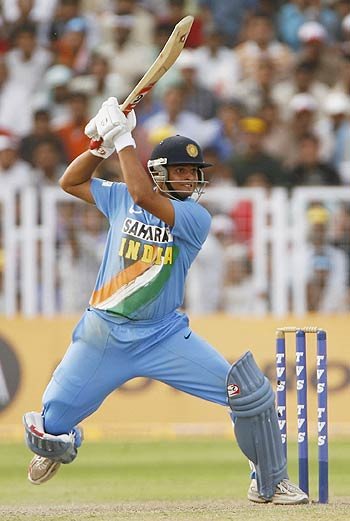 As the cricket season is due to end shortly, I'm making up for some slack months by writing a few pieces on players who've caught my eye. I've put up a post today on Different Strokes on the rising star of Indian batting. It's called "The supremely light feet of Suresh Raina", and here's an excerpt:

A great many of the batting artists of our age - Virender Sehwag, Damien Martyn, VVS Laxman - bat in a way that makes us admire the work of their hands rather than their feet. Batting was traditionally was thought to begin with, and indeed rest upon, a batsman's footwork. But the thickness and striking force of modern-day bats sometimes makes precise footwork redundant. It has been a pleasure, then, to watch the two splendid half-centuries made over the last week at Faridabad and at Goa by young Suresh Raina, and to observe how much his batting owes to his supremely light feet.Also coming up on the Middle Stage over the next two weeks: pieces on Kiran Nagarkar's new novel God's Little Soldier, Hamid Ismailov's The Railway, and Alberto Manguel's With Borges.
Friday, March 31, 2006
On the bowling of Ramesh Powar
I have a piece on the maverick Indian off-spin bowler Ramesh Powar up on the cricket blog Different Strokes today. Here's the first paragraph:
The whole piece is here.
Ramesh Powar is that rare thing: the genuinely slow bowler, someone whose bowling never quite "arrives". One knows that Powar is a tease even before he rolls his arm over: the substantial Powar waistline, the zany red Powar sunglasses, the glimmer of a Powar grin that appears on the ten-step Powar gambol to the wicket, all convey to the batsman the air of a seriously unserious cricketer having a bit of a lark. But there is no harm in all this. Spin bowling, after all, is basically about subterfuge.
The whole piece is here.
Wednesday, March 29, 2006
Antonio Machado's eyes
 If most people in the English-speaking world are acquainted the work of a Spanish poet in translation at all, then that work is almost always that of Federico García Lorca, also the greatest dramatist of twentieth-century Spain (Blood Wedding, The House of Bernarda Alba). Like Amrita Sher-Gil, the subject of my last post, García Lorca led a flamboyant and colourful life and died young, and the legend of his life has to some extent ensured that his work is not forgotten.
But a Spanish poet of equal (if not greater) distinction and a curious charm is Antonio Machado (1885-1939), a slightly older and definitely more old-fashioned poet than Garcia Lorca. Their lives could not have been more contrasting. Lorca achieved early fame, toured the world, won notoriety for his homosexuality, and was murdered by political opponents at the start of the Spanish civil war (an irony of which is that this event, reported around the world, also secured his reputation). Machado's life was a placid unrippled pool by comparison - he lived all his life in small towns in the province of Castile, served for decades as a schoolteacher, and journeyed out of Spain only three times in his life. One is tempted to draw a comparison between the Indian writer in English, often earning large advances and moving from one world capital to another, and writers in the vernacular, often working away quietly and in relative anonymity for decades before they have a chance of even a wider Indian readership.
But to return to Machado - it was not that his life had no drama to it, it was only that it was a more private drama. Just as Dante had Beatrice, so Machado had his own love the image of whom he carried always in his heart, Leonor. This was a girl nine years younger to him - the daughter of his landlady in Soria, a town where he was then teaching - whom he married when she was fifteen, and who died of tubercolosis when she was twenty-four. Machado never remarried, and many of his poems express the sense of the transient nature of all that in life that makes us happy.
Consider the complex play of feelings in one of Machado's best poems, "The Eyes" (here in Alan S. Trueblood's translation):
The EyesThe man wants the memory of his beloved to be undimmed and untarnished, to stop time at the point that she left him. But time hurries on, and despite his best efforts she begins to recede from his memory. The conclusion of the poem, in which he walks down the street and sees a pair of eyes "like those", beautifully expresses his double sense of wanting to be true to someone's memory but also his yearning to love again. Are the eyes of the woman in the window really "like those"? They can hardly be, but immediate experience is always more powerful than memory, and something always arrives to fill in the gap for that which we cannot recover. The poem is simultaneously an elegy to a a person lost forever and a recognition of the truth that ultimately we have no choice than to live in the present. Note Machado's marvellous use of ellipses to convey the jagged rush of thought - "He lowered his…/and walked right on…Like those!"
I
When his beloved died
he thought he'd just grow old,
shutting himself in the house
alone, with memories and the mirror
that she had looked in one bright day.
Like gold in the miser's chest,
he thought he'd keep all yesterday
in the clear mirror intact.
For him time's flow would cease.
II
But after a year had passed,
he began to wonder about her eyes:
"Were they brown or black? Or green? ...Or grey?
What were they like? Good God! I can't recall..."
III
One day in spring he left the house
and took his double mourning down the street
in silence, his heart tight shut...
In the dim hollow of a window
he caught a flash of eyes. He lowered his...
and walked right on...Like those!
Machado was the best kind of poet, able to explore the most serious concerns while also retaining an ability to laugh at himself. Here is the poem "Last Night As I Was Sleeping", in a translation by the poet Robert Bly:
Last Night As I Was SleepingThat repeated interjection - "marvellous error!" - transforms the meaning of the whole poem. Paradoxically the speaker's words appears more vivid, more true, precisely because he asks cleverly if they are only dreams with no significance to real life.
Last night as I was sleeping,
I dreamt - marvellous error! -
that a spring was breaking
out in my heart
I said: Along which secret aqueduct
Oh water, are you coming to me,
water of a new life
that I have never drunk?
Last night as I was sleeping,
I dreamt - marvellous error! -
that I had a beehive
here inside my heart.
And the golden bees
were making white combs
and sweet honey
from my old failures.
Last night as I was sleeping,
I dreamt - marvellous error! -
that a fiery sun was giving
light inside my heart.
It was fiery because I felt,
warmth as from a hearth,
and sun because it gave light
and brought tears to my eyes.
Last night as I was sleeping,
I dreamt - marvellous error! -
That it was God I had
here inside my heart.
Here are some other poems by Machado: "Has My Heart Gone To Sleep?", "Evening Rainbow", "Portrait" ("In my dealings with women I’ve been no Don Juan/(I could never be bothered to dress for the part),/but I received the dart allotted me by Cupid/and have enjoyed all the comforts women bring") and a selection of translations by AS Kline.
A good essay on Machado's poetry by William Zander can be found here. And here is a piece by David Grayson on Garcia Lorca's influential theory of the duende - that mysterious power "which everyone senses and no philosopher explains".
Some old Middle Stage posts about other poets: "Constantine Cavafy's City", "Chess with Jorge Luis Borges", "Nazim Hikmet in prison", and "The despair of Attila Jozsef".
And one other post with some relation to "The Eyes" - "Sirshendu Mukhopadhyay's language of love".
Wednesday, March 22, 2006
Amrita Sher-Gil for a short time
 In the preface to her book Amrita Sher-Gil: A Life, Yashodhara Dalmia says it is her aim to show, through close attention to Sher-Gil's life, "how genius is not born but made, indeed self-made". This is an admirable way of approaching the life of an artist, and Amrita Sher-Gil contains a great many rich and beautiful passages that show us how Sher-Gil, rapt in her own talent and hungry for a way forward, turned talent into genius by learning from both art and life.
Sher-Gil (1913-41) was a woman well in advance of her time. Half-Indian and half-Hungarian, of aristocratic lineage, she was born in Budapest and brought up in the Hungarian capital and in Shimla. She studied art in Paris in the wake of high modernism - unusually, her family relocated to Paris just so that she could make good on her talent - and reached a level of considerable technical accomplishment while still in her teens.
Her youthful work, already highly proficient, blossomed out in several directions upon her return to India for good in 1934 at the age of 21. Travelling around the country and taking inspiration from indigenous traditions - the frescoes at Ajanta and other sites in south India, Mughal miniatures, paintings of the Basohli school - she produced through her twenties works of haunting beauty and striking, if not always successful, technical innovation. Sher-Gil's life was just as vivid: she had many lovers, friends and enemies, married her first cousin, and died tragically young at the age of 28, possibly as the result of a failed abortion.
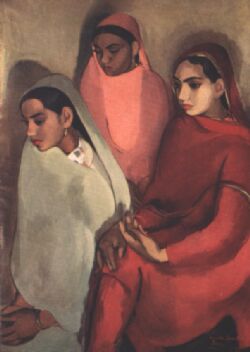
Although her work was very varied, Sher-Gil's women are of special interest. Dalmia quotes an entry from Sher-Gil's diary when she was just twelve, about a child bride, noting the pathos of the little girl sitting silently in a corner, a "helpless toy" in the hands of those responsible for her well-being. The women of Sher-Gil's paintings are grave, although they often seem tremulous with suppressed feeling. One of her earliest successes, made during her Paris years, was The Professional Model (1933). The woman is ostensibly independent, but her slouched posture, sagging breasts hanging over a pouchy stomach, and plaintive eyes show that she too is helpless and pathetic in her own way - she does not even bother to strike a pose.
Two years later, after her return to India, Sher-Gil made Group of Three Girls (at right) - t
 he girls very still from foreground to background, their eyes lowered or averted, each lost in thought, a group and yet not a group, the light sober and low, the heavy colours of the clothes, the scene giving off a gloominess, a sense of something cramped and silent. Her two major works - Bride's Toilet and Brahmacharis, both made in 1937 - also convey this air of quiescence and melancholy. Like many artists, Sher-Gil appears to have found images of Indian life constricted by poverty and oppressive social strictures morally disturbing but aesthetically striking. In her early years in India she writes often of wanting to paint "those images of infinite submission and patience".

"Those images of infinite submission and patience" - three decades later, another young artist with roots in India would arrive in the country of his forebears, and be struck at once by just this aspect of the country. This is VS Naipaul on page two of An Area of Darkness (1964), describing how he is received aboard ship at Bombay by the Goan guide Coelho. Naipaul and Coelho speak roughly as equals, but there soon appears a third presence - "Coelho's man" - who appears to be a denizen of a different universe:
[Coelho] clapped his hands and at once a barefooted man, stunted and bony, appeared and began to take our suitcases away. He had been waiting, unseen, unheard, ever since Coelho came aboard. Carrying only the doll and the bag containing the bottles, we climbed down into the launch. Coelho's man stowed away the suitcases. Then he squatted on the floor, as though to squeeze himself into the smallest possible space, as though to apologize for his presence, even at the exposed stern, in the launch in which his master was travelling.The best thing about Amrita Sher-Gil is that Sher-Gil is not just spoken about on these pages; she also does a lot of speaking herself (and therefore seems not dead, and memorialized, but still alive and thriving, as she is in one sense). Sher-Gil shared a lively correspondence with several people, including her lover and eventual husband Victor Egan and the Bombay-based art critic Karl Khandalavala, who was a great champion of her work and wrote a book about her shortly after her death. Dalmia quotes liberally from her correspondence, showing what an adept interpreter she was not just of Gauguin (whom she admired greatly), Basohli paintings or the Ajanta frescoes but also of her own work, both the intent with which she began and the actual strengths and weaknesses of the result. In fact, she was not shy of speaking her mind on any subject. Here she is in a talk delivered at Lahore in 1937, castigating Indian film-makers for presenting in their work only the make-believe world of the studio:
When the people who are responsible for the production of films in this country discover the rich beauty of a blade of corn, the rough unctuous texture of the earth, the rhythm of movement found in massive bullock drawing ploughs…and learn to discard the synthetic substitute of the studio they will do great things. […] I would like them to notice the undulating lines in South Indian sarees and the beauty of the thin peasants in their strange straight dhoties, to notice the glossy beauty of the rice fields and the shimmer of dust rising in the sun, to focus their lens on small objects and invest them with a charm and a significance that surpasses all pomp and tinsel of the ancient courts or Indra's heaven.This paean to natural beauty has an almost direct echo in a lyrical passage from "My Life, My Work", a lecture delivered by Satyajit Ray in 1982, in which he describes (in Gopa Majumdar's translation) how he made the move out from the controlled conditions of studio shooting and attempted to grapple with the problems of capturing sights and sounds on location:
If the books on film-making helped, it was only in a general sort of way. For instance, none of them tells you how to handle an actor who has never faced the camera before. You had to devise your own method. You had to find out by yourself how to catch the hushed stillness of dusk in a Bengali village, when the wind drops and turns the ponds into sheets of glass, dappled by he leaves of shaluk and shapla, and the smoke from ovens settles in wispy trails over the landscape, and the plaintive blows on conch shells from homes far and near are joined by the chorus of crickets, which rises as the night falls, until all one sees are the stars in the sky, and the stars that blink and swirl in the thickets.In a letter written in 1931 Sher-Gil declares: "I will enjoy my beauty because it is given for a short time and joy is a short-lived thing." She was not to know that life itself was given to her "for a short time". But the colour and pitch of that short, incandescent span of years emerges vividly in Amrita Sher-Gil: A Life. The logical sequel to this book would be for Dalmia to now bring out a collection of Sher-Gil's radiant letters and essays.
Sher-Gil's painting Village Scene recently sold for Rs. 6.9 crore at an auction in New Delhi. Here is Dalmia's piece on that event, and here is an essay by Karl Khandalavala on Sher-Gil's work. Several Sher-Gil paintings are part of the collection of the National Gallery of Modern Art in Delhi.
And here are some more exceptional essays on artworks and artists: the great art critic Robert Hughes on Rembrandt, Sebastian Smee again on Rembrandt (it was Rembrandt's 400th birth anniversary recently, and discussion of his famous self-portraits also appears in Dalmia's book), Rochelle Gurstein on the Mona Lisa, and John Updike on Goya. And lastly this fun essay by Jacob Weisberg: "Matisse vs. Picasso: You're Either One of the Other", and an essay by Pankaj Mishra on Naipaul's An Area of Darkness.
Subscribe to:
Posts (Atom)