Puri, in Orissa on the east coast of India, is one of India's four dhams, places thought to be marked by the presence of the gods. Historically a spiritual retreat and a place of pilgrimage, it is now also a modern-day seaside resort and tourist draw.
One
Puri beach on a Sunday evening in November. To my right the sun is sinking rapidly, and to my left a gibbous moon is already halfway up the sky. In front of me great surf-topped waves rear and expend themselves upon the shore, and on the beach a clamorous throng of people are at work and play.
Men undressing for a dip, youths at sport with beach balls, mothers leading children by the hand into the water, a gaggle of squealing and giggling girls, and some doleful elderly couples who look as if they have been sent on vacation by force. Intermixed with these vacationers are photographers of dubious merit hanging around like touts; purveyors of cotton candy and bobbing balloons and jhal muri sellers with their tins strapped around their waist do their rounds; and sellers of singaras and roshogollas carrying their wares on a wooden pole across their shoulders, stooped and sombre like yoked bullocks. And animals: bucking ponies with tinkling bells around their necks, a bad-tempered camel loping across the sand with its nose in the air, and bony mongrels scavenging for scraps in the sand and occasionally lifting up a hind leg to water it.
And behind me, at the balcony of almost every room of the seven-storeyed pink-and-yellow Puri Hotel and of several other hotels on either side of it, are dozens of chatting, eating, smoking or silent vacationers, determined to exploit the view from their rooms.
Two
Almost no one who comes to Puri leaves without visiting the temple of Lord Jagannath, the town's throbbing centre and the motor of its economy as much as its spiritual life. I have arrived at the time of the panchuka, the auspicious last five days of the month of Kartik, and the temple and its environs teem and ripple with thousands upon thousands of people. Large tents outside the temple are the sites of sermons, discussions and devotional singing; the sounds of pounding drums, clashing cymbals, and voices on loudspeakers rend the air. It takes me ten minutes to leave my shoes at a stand, and another five to wash my feet before I enter.
Almost a thousand years old, and segregated from the rest of the city by a fortress-like wall, the temple complex is a world unto itself. It contains not just the main shrine housing the trinity of Jagannath, Balabhadra and Subhadra but also dozens of subsidiary temples; a vast kitchen that makes many different types of preparations, all steam-cooked in earthen pots over firewood, and which can feed as many as a lakh of people a day; and a market, Ananda Bazar, where this mahaprasad is sold.
As with a great city, so with the temple: one's first encounter with it is disorienting. Milling devotees, grasping priests, ululating women, wizened old people with skin like parchment sitting placidly on the great marble slabs, muscular servitors bearing fragrant baskets of prasad to the market, chattering monkeys performing acrobatics from the scaffolding on one side of the temple, the smell of flowers, ghee and incense - the senses are assailed from all sides. And then there are the gods themselves. As I enter the main temple and move in the near darkness, pushed forward involuntarily by the crowd throbbing with religious ecstasy, towards the three deities installed in the inner sanctum, I feel hypnotised by the great staring eyes of these strangest of gods, and forget even to raise my hands. The experience ends abruptly: any person lingering in front of the deities is herded towards the exit by an irate policeman, and one moves out of this mysterious twilight world into the bright sunlight in a few seconds. I go out and come around a second time, and pay my respects properly.
Three
The first floor of a dilapidated building opposite the temple is home to a most gloomy and tenebrous old library - one can barely make out the books lying aged and tattered in the old wooden cupboards - called the Raghunandan Public Library. Only two people are seated at the tables inside: a youth reading Competition Success magazine, and a middle-aged man who is presumably the custodian: portly, bespectacled, and even more sullen than the camel on the beach. His myopic eyes stare out at some indefinable point in the middle distance; one imagines that many years spent in this hushed, airless gloom has gradually led to the dwindling of his powers of sight. When I ask him a question or two about books on the history of Puri he continues to look out blankly in front of him, venturing after a few seconds a reply in a voice so low that the sound melts away before the ear can pick it up. With some difficulty I gather that the library is soon about to close for the day; there is nothing he can possibly do for me.
I drop my interest in the books and, following a tip from a fellow traveller to Puri, get down to business: could I please go up through the library to the top floor to take a look at the temple from there? He freezes again for a while, then gets up and fetches a large register which he opens in front of me. In it I see a roster of names, none of them sounding Indian, and the amount each one of these people has donated, usually not less than a hundred rupees. Non-Hindus are not allowed inside the temple; this is how most foreigners take a look at it. I enter my name and write '20' next to it."Make it fifty," he says, his voice suddenly clear as a bell. "Twenty," I insist.
Somewhat grudgingly an ancient key is fetched to open the rusty lock of a door, and up we go one level, where we find another door. This too is unlocked; my friend steps back and ushers me up another flight of stairs; leaving him behind, I ascend onto a shaded terrace. Here I find a beautiful view not just of the eastern side of the temple but also, away to my right, the sandy Bada Danda, the great central road of Puri. If ever one was to shoot a film in Puri, this is the view one would want for an establishing shot: the road full of pilgrims and seekers, cycle rickshaws and vendors, priests and beggars, and lined on either side by high dharamshalas. If I take in this view for no more than a minute, it is because I am struck suddenly by the fear of the custodian, who retreated rather suspiciously at the last set of doors, locking me in and going off home. I imagine myself perched here for the rest of the day, my shouts drowned out by the din of the jostling masses below. I scurry down the stairs and find to my relief the doors still open. Descending another level I find the custodian, his face inscrutable as ever, shutting and barring the beautiful green and pink stained-glass windows looking out onto the street. "Aapne dekha?" he asks.
Four
Laxmi Talkies, the oldest of Puri's five decrepit cinemas, was set up in 1934. Located on a cramped little lane, it has temples to either side of it, making for a rather strange atmosphere: a pleasure-house surrounded by piety. The film currently playing is Sasu Ghara Chali Jibi (literally, I Will Go Off To My In-laws, a translation that makes the film look like a comedy). I buy a balcony ticket for ten rupees, walk up the dingy ill-lit staircase stained by chewing tobacco- and paan-spit, and settle down at the back of the cinema. More than a decade has passed since I last saw an Oriya film.
To my surprise, the opening credits show that it is a Rajshri production - I didn't know the Barjatyas were into producing Oriya films. About a quarter of an hour into the film, I realise that we are watching an Oriya adaptation of Hum Aapke Hain Koun, the Salman Khan-Madhuri Dixit blockbuster from 1994. All the staples of a Rajshri film are present: the characters utter hoary pieties about the sanctity of family values and traditions; everyone seems obsessed with the idea of marriage; and several dream sequences provide convenient opportunities for song and dance. There is even a Laxmikant Berde lookalike for some juvenile comedy, and the soundtrack is liberally laced with tunes borrowed from other Rajshri hits, such as Maine Pyar Kiya. The heroine, Anu Choudhury, is surprisingly attractive and good at her job, but the hero, Siddhant Mohapatra, looks too old for the role, and in my memory at least he will never be able to live down his appearance in one song in a transparent white muslin shirt with puffs at the shoulders.
During the brief periods in the film without background music I hear a loud whirring - the sound of the film projector upstairs. During the interval I climb up another dark flight of stairs and come upon Rashmi Ranjan Das, the projectionist, at work in his little garret. His ancient 35mm Westrex projection system, clamped down into the floor, exudes an elephant-like strength and solidity. Das himself is agitated: his assistant has just tangled up a spool of film while reloading it into its can after use. "A nice bit of work you've left me here!" he snaps. Looking at the coils of exposed film lying on the table in the near darkness, I can just about discern the shapes of human figures on their surface - still photographs lined by a sound track which, rushed through the Westrex at twenty-four frames a second, bloom into the very image of reality.
Five
Swargadwar ("Gateway to Heaven"), the area at the south end of the road running alongside Puri beach, is called so because of the holy cremation ghat it houses, but the mood in the streets around it is anything but funereal, especially in the evenings. Brightly lit shops ("We accept all Visa and Mastercards") sell Orissa handloom sarees, jewellery, and replicas of the Jagannath Temple and the Sun Temple of Konark; beachside stalls and Bengali restaurants cater to the tourist traffic; and newspaper vendors cycle up and down the streets calling out "Ananda Bazar Patrika! Bartaman!"
The ghat itself is a little square of darkness and silence in the centre of this worldly bustle; here the only lights are not those of bulbs and lanterns but of the slow-burning funeral pyres. Groups of men stand around the pyres, and cows nestle in the sand, drawing warmth from it on this cold winter evening. Hindu funeral rites are more distressing than those of many other religions; one watches as a familiar form is set ablaze and turns into a heap of bones and ashes before one's eyes; no one who has witnessed one cremation can ever view life in quite the same way again. Walking down the cement paths lining the sandpits I come across a grisly scene: a pair of small, thin legs sticking out a lighted pyre. A child! perhaps seven or eight years old, sent early on its way. As I look at the crackling flames and the two forlorn legs refusing to burn, the order of existence seems terribly unjust and arbitrary.
I ask one of the men standing by the pyre how the death happened. "Of natural causes," he says in a low voice, and points to another man. "She was his grandmother - very old, in her eighties." The meaning of the scene suddenly changes, and the spectacle seems more bearable; I breathe a little easier. I begin to walk again; the faces all around me are blank, expressionless. Above our heads thick smoke drifts into the sky, carrying off, if one so believes, spirits released from their earthly shells.
Six
Across the road from Swargadwar can be found a quite different sort of crackling and roasting - fish and chicken being fried at Santosh's fast food stall and the stalls of several others like him. Santosh is 28, and he works the stall in conjunction with his father. Their day begins early with a visit to Ghoda Bazaar, the fish market near the railway station, where they buy prawns, crabs, and bhetki quite cheaply; these are then taken home and spiced or prepared in other ways for the final dip in hot oil at the stall in the evening. Santosh is a cheerful sort; he calls out in Bengali to the passing tourists, "Hello, sir! What's the matter this evening? Won't you be stopping for a bite?" Those who stop to eat are shepherded by his assistant to a row of plastic chairs behind the stall, where they wait while Santosh serves up their order. A batter-fried bhetki sells for ten rupees; a crab for seven; a chicken leg for fifteen; and little prawn baras for a rupee each. These are served with chopped onion ("Careful!" exclaims Santosh to his helper, "Onions are twenty rupees a kilo!") and dashes of red and green sauce that go under the brand name of Poonam's, which he buys at sixteen rupees a litre. Profit margins are small; the business depends on volumes. Tomorrow Santosh is off with his father to Cuttack for the Balijatra, the annual festival in celebration of Orissa's maritime past, where they have rented a stall and will make only vegetarian food - chowmein, pakoras. I sample a bhetki - fair - and then a crab, whose sweet meat is more to my liking.
The next morning I rise at five and take a rickshaw to Ghoda Bazaar to look at the fish market. All is quiet; near the station I cross a family of four being taken, luggage and all, on a rickshaw, almost in slow motion. In my mind I have an image of the big, bustling fish market opposite Novelty Cinema near Grant Road station in Bombay, but the reality is quite different. At about half-past six a few surly, bedraggled fisherfolk turn up on a narrow street with baskets of fish they lay out on pieces of tarpaulin. There are prawns and crabs, bhetki and rohu; heaps of small, almost translucent fish, and some large silver fish predictably called chandi. I can't buy any: the only one I know who will cook them for me is Santosh, and he is off today to the Balijatra.
Seven
On my last evening in Puri I decide to visit some of the dozen or so dharamshalas, massive granitic structures mostly between three and seven decades old, that line the Bada Danda; indeed, the wide straight swathe of the Bada Danda and the symmetrical, orderly facades of the dharamshalas are the only clean lines in a scene otherwise flooded with disorder.
The Debidutt Dooduawala dharamshala, the most majestic and imposing of the lot, was built in 1929 by the aforenamed man's son, Rai Bahadur Hazarimull Dooduawala. It has 65 rooms over three stories for the use of pilgrims on a first-come-first served basis, with a maximum stay of three nights. "The only exception we make is for the old widows who come to observe the vrat of the month of Kartik. We allow them to stay the whole month," says Madhusudan Kuntia, the manager, in his poky little office just off the entrance into the building. "Four to six people can stay in a room. Small rooms cost 25 rupees a night, large rooms 40 rupees. Tell me, where can you find rooms at such prices these days?" On Mr.Kuntia's desk is an electricity bill for a little over four thousand rupees, and a giant red book almost the size of a canvas, the biggest bound volume I have ever seen. It is his ledger; he opens it and shows me his list of entries of which party has come, how many rooms they have taken, how many men, how many ladies, how many children. It is like the great book of life; one imagines that somewhere there exists a book very much like this containing the names of every person who has done time in this world, which families they were born into, how many years they lived, the main good and bad deeds they did, and so on.
With Mr.Kuntia's permission I take a walk through the building, which is like taking a tour of the home of a joint family so vast that some of the members hardly know each other, though they live together in trust and fellowship. It is built in a traditional Indian style, three stories of rooms forming a square around a large central courtyard or aangan. Stacks of luggage spill out from the rooms onto the corridors; people are gathered on the edges of the courtyard and the steps of the staircases; here a widow in white is lighting a diya; there two children are holding a bottle under the common tank of drinking water. On the first floor I find four widows seated in a line against the wall of the corridor, their eyes carrying the vacancy of expectation and passivity characteristic of many old people. Today is Kartik Purnima, the last day of the month of Kartik; tomorrow they will leave the dharamshala and return to their homes in different villages. Perhaps next year they will be seen again in Puri.
By the time I leave the mansion darkness is falling; as I emerge onto the raised platform on which the building is set I see, rising slowly above the dharamshalas on the opposite side of the road, a bright full moon. Santosh must be setting up his stall in Cuttack; Rashmi Ranjan Das starting up the evening show at Laxmi Talkies; evening rituals must be beginning at the Jagannath temple and dozens of other temples; the figures on Puri beach must be turning into silhouettes, and smoke must be rising above Swargadwar. Life must be moving on.
Tuesday, November 29, 2005


Sunday, November 27, 2005
Back soon, and Golshiri
I've been away for three weeks, travelling through Orissa and Madhya Pradesh, and haven't had much time for my blog, but I'll be back on Tuesday with a post about my days in the town of Puri in Orissa.
In the meantime, here's my review of the Iranian novelist Hushang Golshiri's novel The Prince in today's Scotland on Sunday. An edited version appears in the paper; my original piece is here:
The Prince
Hushang Golshiri (translated by James Buchan)
Harvill Secker, £ 12.00
In this stark, hallucinatory work the late Iranian novelist Hushang Golshiri, a leading figure of modern Persian prose, compresses the events of an entire era into a single night, showing us the nightmare world of an ailing prince, the last of a deposed dynasty, as he sits cloistered in his room at night surrounded by the photographs and the artifacts of his forebears.
Golshiri's Prince Ehtejab, like Lampedusa's Prince Fabrizio (The Prince first appeared in Persian in 1969, about a decade after The Leopard), is the representative of an order that no longer commands power, but he has none of the consolations of family, of the only slightly diminished respect of the world, or of astronomy that Prince Fabrizio possesses - his world is impoverished not just materially but morally, emotionally. He is peevish, whimsical, nervy, and something of a recluse. While his rapacious ancestors - 'Grandfather' and 'Father' in the narrative - murdered and pillaged at will, Prince Ehtejab has no taste for such things, but this does not redound entirely to his credit. He is something of a petty tyrant. Taunted about his weakness and impotence by his cool, sardonic wife Fakhronissa, he responds by taking on their servant-woman Fakhri as his mistress, inflicting upon her the arbitrary cruelty that is something of a family trait. After Fakhronissa dies, he insists that Fakhri impersonate her departed mistress.
"Prince Ehtejab was sunk in his armchair, his scalding forehead in both hands, coughing away. Once his maid had come upstairs, and once his wife." The novel's opening sentences show us the prince wracked by the fatal consumption that runs in his family, and also that there is no longer any boundary line between imagination and reality for him - his wife, we soon come to know, is dead. As he sits in the dark Prince Ehtejab's imagination conjures up scenes from the lives of his ancestors and his late wife; like Scrooge, he also sees his own childhood self pass before his eyes.One of the influences on Golshiri's work was the contemporary French nouveau roman of Robbe-Grillet and Claude Simon, works in which conventional character exposition and plot lines are abjured and the reader's sense of point of view and chronology muddied. In The Prince this narrative style is naturalised, as it were, by the delusionary mind of the protagonist.
But Golshiri also seeks other points of view. In one of the novel's most striking scenes, we see the plump, healthy Fakhri seated in front of the mirror trying to approximate, through dress and make-up, the frail, bony Fahkronissa. We hear the agitated burr of her thoughts, and see her, guilt-stricken, carrying on an imaginary dialogue with her late mistress - her world, too, has become disordered. She is not satisfied until she puts on Fakronissa's thick glasses which, even as they distort her vision, present to her something like the image of her mistress in the mirror. Glasses, photographs, mirrors: these abound in this novel of ghosts, visions and whispers.
In the meantime, here's my review of the Iranian novelist Hushang Golshiri's novel The Prince in today's Scotland on Sunday. An edited version appears in the paper; my original piece is here:
The Prince
Hushang Golshiri (translated by James Buchan)
Harvill Secker, £ 12.00
In this stark, hallucinatory work the late Iranian novelist Hushang Golshiri, a leading figure of modern Persian prose, compresses the events of an entire era into a single night, showing us the nightmare world of an ailing prince, the last of a deposed dynasty, as he sits cloistered in his room at night surrounded by the photographs and the artifacts of his forebears.
Golshiri's Prince Ehtejab, like Lampedusa's Prince Fabrizio (The Prince first appeared in Persian in 1969, about a decade after The Leopard), is the representative of an order that no longer commands power, but he has none of the consolations of family, of the only slightly diminished respect of the world, or of astronomy that Prince Fabrizio possesses - his world is impoverished not just materially but morally, emotionally. He is peevish, whimsical, nervy, and something of a recluse. While his rapacious ancestors - 'Grandfather' and 'Father' in the narrative - murdered and pillaged at will, Prince Ehtejab has no taste for such things, but this does not redound entirely to his credit. He is something of a petty tyrant. Taunted about his weakness and impotence by his cool, sardonic wife Fakhronissa, he responds by taking on their servant-woman Fakhri as his mistress, inflicting upon her the arbitrary cruelty that is something of a family trait. After Fakhronissa dies, he insists that Fakhri impersonate her departed mistress.
"Prince Ehtejab was sunk in his armchair, his scalding forehead in both hands, coughing away. Once his maid had come upstairs, and once his wife." The novel's opening sentences show us the prince wracked by the fatal consumption that runs in his family, and also that there is no longer any boundary line between imagination and reality for him - his wife, we soon come to know, is dead. As he sits in the dark Prince Ehtejab's imagination conjures up scenes from the lives of his ancestors and his late wife; like Scrooge, he also sees his own childhood self pass before his eyes.One of the influences on Golshiri's work was the contemporary French nouveau roman of Robbe-Grillet and Claude Simon, works in which conventional character exposition and plot lines are abjured and the reader's sense of point of view and chronology muddied. In The Prince this narrative style is naturalised, as it were, by the delusionary mind of the protagonist.
But Golshiri also seeks other points of view. In one of the novel's most striking scenes, we see the plump, healthy Fakhri seated in front of the mirror trying to approximate, through dress and make-up, the frail, bony Fahkronissa. We hear the agitated burr of her thoughts, and see her, guilt-stricken, carrying on an imaginary dialogue with her late mistress - her world, too, has become disordered. She is not satisfied until she puts on Fakronissa's thick glasses which, even as they distort her vision, present to her something like the image of her mistress in the mirror. Glasses, photographs, mirrors: these abound in this novel of ghosts, visions and whispers.
Monday, November 07, 2005
Hitchcock in Hijab
Sunday, October 23, 2005
Anger in Tahmineh Milani's Two Women
Art, it is often said, serves as a mirror to society, a mirror that prompts reflection about what is good or bad about the way in which we live. Also, there are two kinds of injustice: the kind which we readily acknowledge and which is punished by the law, but also a subtler kind that is built into the very fabric of a society, so much so that everyone accepts it as the way of the world. Occasionally there appears in the cultural life of every society a mirror – an essay, a book, or a film – that, by adjusting the point of view from which society is accustomed to seeing itself and hearing its stories told, completely blows away the façade that it has built around its hidden and licensed injustices. I thought of all this while watching Two Women (1998), the Iranian filmmaker Tahmineh Milani’s devastating broadside against the suffocating patriarchal values of Iran, a country where women are effectively second-class citizens.
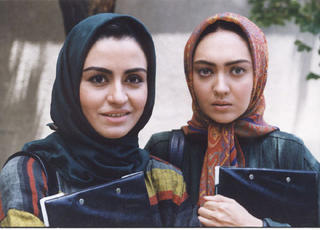
Briefly, Two Women is about the lives of Roya (Marila Zare'i, above left) and Fereshteh (Niki Karimi, right), two friends in the same class at university in Tehran. Fereshteh, who hails from the small town of Isfahan, is the more talented and accomplished of the two; what she wants most from life is to complete her studies and get a good job. But her life is suddenly threatened by a stalker, Hassan, who pursues her obsessively on his motorbike. He wants to marry her, but plucky Fereshteh laughs in his face and tells him to be off. He trails her as far back as Isfahan, where his pursuit of her leads to an ugly accident that takes the life of a child and lands him a long jail sentence.
That should be the end of Fereshteh’s troubles, but in fact it is only the beginning. Firstly, her father attacks her for having disgraced the family name, leaving her puzzled and angry. Then, a family friend, Ahmad, offers to pay the compensation the court has ordered Fereshteh to provide, and later he proposes marriage. Fereshteh finds herself betrothed to a man who is nominally a good husband, and later father, but who absolutely cannot comprehend the fact that she has some needs and desires of her own. Instead, suspicious of her ‘liberated’ ways (he arrives at this conclusion after he finds out that Fereshteh used to speak to male students while at university), he confines her to the four walls of their house. Confined to the duties of a wife and a mother, Fereshteh gradually loses all sense of herself and becomes a cipher, though she never stops fighting against her predicament. As Jasmin Darznik remarks in this piece: "A point of great irony and poignancy in the film is that Fereshteh acts as an acute observer of her own mental deterioration. She does not only suffer; she recognizes and articulates her experience with uncommon acuity."
In an interview Milani has argued that Two Women is “about the negation of the identity of a human being”:
First, fleeing from her home after yet another fight with her husband, Fereshteh runs into Hassan, now out of prison but even more embittered and vengeful than before. He chases her with a knife in hand, and corners her in an alley. Sure that she is going to die, she falls down on the ground and waits for him to knife her. The assailant and the victim whose paths first crossed thirteen years ago now encounter each other again. Both now look back at that time long past, and the refrain of the dialogue on both sides is ‘you didn’t let me’. “I would have done anything for you, but you didn’t let me!” charges Hassan. “I wanted to be everything for you, but you didn’t let me!” And Fereshteh, who has encountered far too much of men finding her culpable for their lives going off track, boils over in turn. Referring to how his pursuit of her changed her life forever, and threw her into a chain of events from which she could never extricate herself, she cries (I approximate from memory), “I wanted to study in peace, but you didn’t let me! I wanted to make something of my life, but you didn’t let me!” At this point Ahmad bursts in on the action, attacks Hassan, and is knifed by him while Fereshteh watches in horror.
And in the film’s last scene, we see Roya reunited with Fereshteh after many years, at a hospital in Tehran, where Ahmad lies critically ill. While Roya has retained her good looks, Fereshteh’s troubles have broken her spirit and given her a haggard, dejected appearance. The doctors tell Roya to prepare her friend for the worst. Roya takes Fereshteh home to meet her husband; there, they receive a phone call saying that Ahmad has died.
Fereshteh’s reaction recalls the famous soliloquies of Shakespeare’s tragic heroes: she wanders around the room voicing her thoughts to Roya and her husband, but in truth she is speaking to herself. “I loved him, as a prisoner loves his jailor,” she quavers. “I didn’t want him to die.” She struggles to grasp the implications of her new situation. “Roya!” “Yes, sweetheart?” responds Roya. “What shall I do now? How am I to take care of two children on my own?” says Fereshteh. And then something of the old, plucky, independent-minded Fereshteh returns. “I must learn a new skill to make ends meet – computers, perhaps. A lot of work lies ahead. I must start planning right away. There’s no time to be wasted.” As she goes on and on in this fashion it is clear – especially by the way she keeps saying “Roya!” - that she has to some extent lost her mental balance. Tears roll down Roya’s cheeks.
Milani says in her characteristically provocative manner:
The story of Two Women has many parallels with aspects of the lives of women in India; among the Indian films I can think of which successfully explore the way women are imprisoned within gender roles is Shyam Benegal's Bhumika.
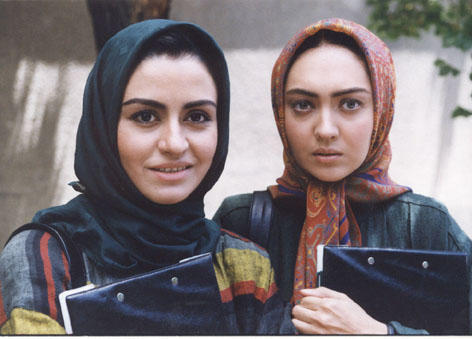
Briefly, Two Women is about the lives of Roya (Marila Zare'i, above left) and Fereshteh (Niki Karimi, right), two friends in the same class at university in Tehran. Fereshteh, who hails from the small town of Isfahan, is the more talented and accomplished of the two; what she wants most from life is to complete her studies and get a good job. But her life is suddenly threatened by a stalker, Hassan, who pursues her obsessively on his motorbike. He wants to marry her, but plucky Fereshteh laughs in his face and tells him to be off. He trails her as far back as Isfahan, where his pursuit of her leads to an ugly accident that takes the life of a child and lands him a long jail sentence.
That should be the end of Fereshteh’s troubles, but in fact it is only the beginning. Firstly, her father attacks her for having disgraced the family name, leaving her puzzled and angry. Then, a family friend, Ahmad, offers to pay the compensation the court has ordered Fereshteh to provide, and later he proposes marriage. Fereshteh finds herself betrothed to a man who is nominally a good husband, and later father, but who absolutely cannot comprehend the fact that she has some needs and desires of her own. Instead, suspicious of her ‘liberated’ ways (he arrives at this conclusion after he finds out that Fereshteh used to speak to male students while at university), he confines her to the four walls of their house. Confined to the duties of a wife and a mother, Fereshteh gradually loses all sense of herself and becomes a cipher, though she never stops fighting against her predicament. As Jasmin Darznik remarks in this piece: "A point of great irony and poignancy in the film is that Fereshteh acts as an acute observer of her own mental deterioration. She does not only suffer; she recognizes and articulates her experience with uncommon acuity."
In an interview Milani has argued that Two Women is “about the negation of the identity of a human being”:
One of the most important problems that we are faced with in Iran's society is that we are unable to express our true personality. Meaning that the society does not allow us to manifest who you really are, and this is worse in regards to women. In my opinion, 90 percent of the women and even the men in our society related to the character Fereshteh. The fact that in our society or in their private lives, there is a constant effort to change or make them into what they want them to be.The film’s last two scenes had every spectator in the theatre on the edge of their seats - here, Milani brings all the threads of the film together to achieve some kind of resolution, and the quality of her dialogue is exceptional.
First, fleeing from her home after yet another fight with her husband, Fereshteh runs into Hassan, now out of prison but even more embittered and vengeful than before. He chases her with a knife in hand, and corners her in an alley. Sure that she is going to die, she falls down on the ground and waits for him to knife her. The assailant and the victim whose paths first crossed thirteen years ago now encounter each other again. Both now look back at that time long past, and the refrain of the dialogue on both sides is ‘you didn’t let me’. “I would have done anything for you, but you didn’t let me!” charges Hassan. “I wanted to be everything for you, but you didn’t let me!” And Fereshteh, who has encountered far too much of men finding her culpable for their lives going off track, boils over in turn. Referring to how his pursuit of her changed her life forever, and threw her into a chain of events from which she could never extricate herself, she cries (I approximate from memory), “I wanted to study in peace, but you didn’t let me! I wanted to make something of my life, but you didn’t let me!” At this point Ahmad bursts in on the action, attacks Hassan, and is knifed by him while Fereshteh watches in horror.
And in the film’s last scene, we see Roya reunited with Fereshteh after many years, at a hospital in Tehran, where Ahmad lies critically ill. While Roya has retained her good looks, Fereshteh’s troubles have broken her spirit and given her a haggard, dejected appearance. The doctors tell Roya to prepare her friend for the worst. Roya takes Fereshteh home to meet her husband; there, they receive a phone call saying that Ahmad has died.
Fereshteh’s reaction recalls the famous soliloquies of Shakespeare’s tragic heroes: she wanders around the room voicing her thoughts to Roya and her husband, but in truth she is speaking to herself. “I loved him, as a prisoner loves his jailor,” she quavers. “I didn’t want him to die.” She struggles to grasp the implications of her new situation. “Roya!” “Yes, sweetheart?” responds Roya. “What shall I do now? How am I to take care of two children on my own?” says Fereshteh. And then something of the old, plucky, independent-minded Fereshteh returns. “I must learn a new skill to make ends meet – computers, perhaps. A lot of work lies ahead. I must start planning right away. There’s no time to be wasted.” As she goes on and on in this fashion it is clear – especially by the way she keeps saying “Roya!” - that she has to some extent lost her mental balance. Tears roll down Roya’s cheeks.
Milani says in her characteristically provocative manner:
The two female characters in my film are a single person with two personalities - the heroine's actual personality and her potential personality, what she is and what she wants to be but can't because of society and its mores.Clearly, Milani could not have made such a film without facing her own troubles with censorship. Indeed, the script of Two Women was thought to be so controversial that it took seven years for it to be passed by Iran’s Ministry of Culture, which monitors all film production in the country. After it was made, the film won several awards at film festivals around the world, and sealed Milani’s reputation. But, having tested the waters with Two Women, Milani got into even deeper trouble with the authorities with her next film, The Hidden Half, and was briefly jailed by the government. Milani speaks about the making of Two Women here, and gives an account of her own life and work here.
The story of Two Women has many parallels with aspects of the lives of women in India; among the Indian films I can think of which successfully explore the way women are imprisoned within gender roles is Shyam Benegal's Bhumika.
Saturday, October 22, 2005
The playground of war in Ziad Doueiri's West Beyrouth
Ziad Doueiri’s West Beyrouth, the high point of the first day of the Asian Film Festival, is set in the civil war-torn Lebanon of 1975. With the war the city of Beirut has broken up into two: West Beirut, controlled by Muslims, and East Beirut, controlled by Christians. But the teenager Tareq and his friend Omar are not entirely displeased by these developments. The violence spiralling all over the city means, after all, the shutting down of school, and a chance to listen to music and talk about women in each other’s homes, hang out on the streets, and shoot all kinds of sequences on Omar’s prized Super-8 film camera, from close-ups of Omar’s gorgeous aunt from a chink in the door to footage of a rally that the two friends join without knowing what it’s for.
War, and all its predations upon settled existence, is of course a deadly serious business, as we know when we see Tareq’s parents deeply disturbed by the conflict, and left without an immediate prospect of an income. Tareq’s mother wants to leave the city; his father insists they will stay and see the crisis through, and tempers fray easily and arguments break out. Indeed - as we are shown in a scene in which the crowing of one family’s rooster at the crack of dawn drives a neighbour wild and culminates in the entire neighbourhood participating in a slanging match - everybody in the large apartment block in which Tareq’s family stays in West Beirut is on edge. But for Tareq and Omar life has grown more pleasurable, not less, and this, the happy and blinkered self-absorption of adolescence, is the subject of Doueiri’s marvellous paean to youthful friendship and coming of age.
Doueiri was an assistant cameraman to Quentin Tarantino on the filming on Reservoir Dogs, and in an interview he speaks of how he learnt one or two things about dealing with actors from Tarantino – about putting them at ease on the sets, and talking to them rather than instructing them. That skill with handling actors shows on West Beyrouth, in which the two lead actors (Rami Doueiri, the director’s younger brother - below left - and Mohammad Chamas, some of whose feistiness must be genuine, for Doueiri picked him up from an orphanage) are unbelievably good – in one scene, we see the two smoking cigarettes and jiving to “Rock You Baby”; in another, Omar narrates to Tareq how his family has suddenly gone all religious and are insisting that film, theatre and music are all agents of deadly corruption, prompting from Tareq the puzzled question: “Is Paul Anka the work of Satan?”
War, and all its predations upon settled existence, is of course a deadly serious business, as we know when we see Tareq’s parents deeply disturbed by the conflict, and left without an immediate prospect of an income. Tareq’s mother wants to leave the city; his father insists they will stay and see the crisis through, and tempers fray easily and arguments break out. Indeed - as we are shown in a scene in which the crowing of one family’s rooster at the crack of dawn drives a neighbour wild and culminates in the entire neighbourhood participating in a slanging match - everybody in the large apartment block in which Tareq’s family stays in West Beirut is on edge. But for Tareq and Omar life has grown more pleasurable, not less, and this, the happy and blinkered self-absorption of adolescence, is the subject of Doueiri’s marvellous paean to youthful friendship and coming of age.
Doueiri was an assistant cameraman to Quentin Tarantino on the filming on Reservoir Dogs, and in an interview he speaks of how he learnt one or two things about dealing with actors from Tarantino – about putting them at ease on the sets, and talking to them rather than instructing them. That skill with handling actors shows on West Beyrouth, in which the two lead actors (Rami Doueiri, the director’s younger brother - below left - and Mohammad Chamas, some of whose feistiness must be genuine, for Doueiri picked him up from an orphanage) are unbelievably good – in one scene, we see the two smoking cigarettes and jiving to “Rock You Baby”; in another, Omar narrates to Tareq how his family has suddenly gone all religious and are insisting that film, theatre and music are all agents of deadly corruption, prompting from Tareq the puzzled question: “Is Paul Anka the work of Satan?”

Late in the film, the two friends lose track of each other when soldiers fire at the rally they have joined. Tareq dives into a car for refuge, while Omar runs around looking for his friend, and we fear is there is tragedy lying around the corner, and that Omar will lose his life. But nothing of the sort happens. Instead, the owner of the car drives off, and Tareq finds himself being driven into enemy territory, East Beirut. Gingerly making his way out after the car has been parked, he accidentally enters a brothel run by one of the most legendary figures in Beirut, a massively obese and gravel-voiced woman called Oum Walid. “We thought you were a myth,” confesses the awestruck Tareq to Oum Walid, “but it turns out you’re for real.” For Oum Walid there is no East Beirut and West Beirut, only Beirut. “Since when did a bed have religion?” she hollers. Oum Walid thinks Tareq too young to keep such company, and throws him out, but not before he has enjoyed a cup of coffee prepared by a gorgeous siren. Reaching home late that night, Tareq tells the relieved Omar all about his day and describes how marvellous the cup of coffee was. “Nescafe!” Omar spits out in disgust. “I almost get shot, while you hang out at the whorehouse!”
In the film’s most beautifully realised scene, Tareq and Omar go out bicycling with a beautiful Christian girl, May, whom Tareq has befriended, much to Omar’s disgust. After a scrape with some militia, in which the cross on May’s neck almost lands them in trouble, the three teenagers fight, Tareq stomps off and Omar chases him down, and they lose track of May. They run back down the streets they had taken, searching for her. Finally they find May sitting, absolutely serene, at her piano lessons. She smiles at them without interrupting her playing, and they look on in silent admiration. The notes become louder and wash over the scene, at which point we suddenly cut to scene of bombings and carnage, of a cripple scrounging in a garbage heap for food, while the same beautiful and soothing notes continue in the background. The juxtaposition is not a facile one pointing to all the horrors that are taking place while three teenagers listen to music – rather it suggests that, for May, music provides a place of refuge that keeps out the trauma of the present, banishes it for a while. (West Beyrouth’s music, incidentally, has been scored by Stewart Copeland, the former drummer of The Police.) And we know that the reality of West Beirut does finally invade Tareq's consciousness - the film's last shots, which present some black and white Super-8 footage of him with his mother on the beach, suggests that his mother lost her life in the war.
Doueiri is a startlingly blunt talker, with a great line in black humour. This interview with Anthony Kaufman is full of highly quotable material, and ends with this droll rendition of how, since West Beyrouth, despite all the acclaim it received, didn’t make him too much money, he had to go back to working in commercials and doing other kinds of donkey work:
But there is no shame in working, so I don't feel guilty. But it's like this commercial I was doing, the entire crew came from London. And we were laying out the shot and the camera. And the director says, "Guys, by the way, I saw this great movie called 'West Beirut'" And the D.P. turns to him, pointing to me and says, "That's the director." And he says, "Oh right." And the D.P. said, "I swear, that's the director." And then the director, he comes to me, and his whole demeanor is changed throughout the commercial. I swear to you, he says, "Do you think we could put the camera here?" And I'm like, "Yeah, we can put the camera there."
Tomorrow, a post about either Tahmineh Milani's Two Women, or Bahman Ghobadi's Turtles Can Fly.
Thursday, October 20, 2005
The Middle Stage goes to the movies
Starting tomorrow, the Middle Stage is going to put away all the books on its desk, and instead it's going to pack into a bag a sandwich, a bottle of water, a notebook, and a pen, and go off to the movies instead - for a week anyway. The Third Eye Asian Film Festival is beginning in Mumbai tomorrow, and everybody knows there's nothing as much fun as a film festival. So I'll be off tomorrow morning to the cinema, and watch three films a day - it's been many years since I had this luxury - and write short posts about the best films I see, and perhaps a longer piece for a newspaper.
Among the films I'm eagerly looking forward to seeing are Tapan Sinha's Kabuliwala and Atithi, the Iraqi director Bahman Ghobadi's Turtles Can Fly, and, best of all, two films by the Japanese master Yasujiro Ozu: Tokyo Story and An Autumn Afternoon.
Come along if you can.
Among the films I'm eagerly looking forward to seeing are Tapan Sinha's Kabuliwala and Atithi, the Iraqi director Bahman Ghobadi's Turtles Can Fly, and, best of all, two films by the Japanese master Yasujiro Ozu: Tokyo Story and An Autumn Afternoon.
Come along if you can.
Wednesday, October 19, 2005
A Harold Pinter story
The closest I ever came to Harold Pinter - the plays, that is, not the man - was during my days as a college student in Delhi some years ago, a marvellously happy and carefree time of life. I was a minor member of the college dramatics society, carrying out various kinds of backstage work while my actor friends performed, and ferrying bread pakoras from the college canteen to them while they rehearsed.
This almost daily contact with the world of theatre - watching play texts being performed dozens of times in rehearsal, observing the way actors gave life to their lines and used their bodies, spending a great deal of time in darkness stageside scrabbling around with light controls - made me more interested in drama than in any other form, except perhaps poetry. In addition to all the playwrights on my English degree syllabus - Sophocles, Shakespeare, Congreve, Bernard Shaw, Beckett - I fished around in bookshops and libraries (and there were two excellent ones, the British Council library and the Max Mueller Centre library, just down the road from our flat in Connaught Place, a great privilege) looking for other plays to read. I remember reading and enjoying Marivaux and Moliere, Badal Sarkar's Evam Indrajit, Georg Buchner's hugely powerful Woyzeck, and John Guare's Six Degrees of Separation.
I even wanted to write plays. It seemed the most prestigious work in the whole world. Imagine writing something and then not just having someone read it, but having a whole band of people, from director to actors to backstage hands, totally give over their lives to it for a month or more, commit to memory its every line and its every pause - there could no honour as grand, as terrific, as this! Inspired by Buchner, I began writing a mightily tragic play called Ilyas, and wrote a grand total of two immensely vivid, powerful scenes - or so they seemed to me then as I paced up and down my room - before, for some unaccountable reason, I gave it up. In a curiously appropriate way that play remained, just like Buchner's, an unfinished fragment.
On one weekend visit to the British Council library, having always heard Pinter spoken of as a giant of British theatre, and finding on the shelf in front of me a long row of small blue volumes of his plays, I borrowed one of these volumes and took it home. I regret to say that I cannot even remember what its name was - it may have been The Birthday Party. The reason I cannot remember its name is that, that night, I began to read the play and found it very different, far more minimal and pared down, and with a less clearly delineated narrative structure, than any play I'd read before. The characters didn't seem to be saying anything very profound, and they seemed to palaver on and on about one inconsequential thing after another. The famous Pinterian pauses seemed to me like just so much emptiness; I wanted words. Feeling faintly bored, I closed the book and fell asleep, and when I picked it up again it was only to return it to the library the next weekend.
And that was as close as I have ever come to the plays of Harold Pinter. On leaving college, I slowly began to also leave behind the world of theatre, which at one point had consumed my days. I began to read more novels than plays, and, just as significantly, I became enraptured by film, which began to seem to me a more powerful medium than theatre, able to capture every grain of reality rather than merely gesture at it as the stage did. I gradually stopped going to see plays. Although I now know a good deal more about Pinter than I did then, and might like him better, I now prefer novels, stories, films, poetry, all of these to drama, not to mention cricket (of which Pinter is also a great fan). I must accept I may never read Pinter again.
And there you are - it's amazing how it's possible to write three or four perfectly good paragraphs about a writer even if one hasn't read any of his work. And now it's time, as always, to call up other voices who have actually read and seen Pinter, and who'll offer you something on all those aspects of Pinter's work that I might have inadvertently missed.
When Pinter's work first appeared on the British stage in the fifties it initially received the same reaction of incomprehension and bewilderment, as Robert McCrum writes in this essay, as it did from me coming to his work for the first time in 1999. Among the insights into the logic of Pinter's drama found in McCrum's piece is this illuminating quote by Pinter himself: "One way of looking at speech is to say it is a constant stratagem to cover nakedness." Ben Brantley offers another assessment of Pinter in the New York Times here (registration required). In this piece from 2001 Michael Billington, Pinter's biographer, speaks to him about political theatre. But the most interesting of all the essays on Pinter I've come across, one that is intelligently critical of him, is this one by Theodore Dalrymple, himself one of the finest essayists of his generation. It is called "Reticence or Insincerity, Rattigan or Pinter", and attempts to read changes in British society over the last half-century through a comparison of the work of Pinter and the stalwart of British theatre before him, Terence Rattigan.
Pinter wrote plays, works meant to be performed, so it will not do for us to ignore accounts of how his work comes across in performance. In this piece, the theatre critic Margaret Croydon reports on the experience of watching three Pinter plays at the 2001 Lincoln Festival, one of them starring Pinter himself in the lead role. Like Dalrymple, Croydon is moved by some of Pinter's work but feels less warmly towards other parts of his oeuvre. In this piece from 1993 (registration required) Janet Maslin writes about Pinter's stage adaptation of Kafka's novel The Trial. The director Karel Reisz talks about the experience of working on one of Pinter's plays here, and in this piece several leading lights of the British stage talk about the experience of working with Pinter in different capacities. Pinter's has also done a great deal of work for the cinema, including two dozen screenplays, and in this piece Billington argues that the screenplays constitute "a significant second canon to the plays".
And finally, for a little light entertainment after all that serious reading, let's now turn to this exchange between Pinter and a freelance journalist after Pinter was awarded the Nobel Prize. The transcript of the conversation appears here on the Nobel Prize website, and this is how it goes in its entirety. There is something comical about it from the very beginning: one imagines this is how a character in the Pinterian universe might react if he found out he'd won the Nobel Prize:
And that's enough for today; thank you very much...and I'm off now. Thank you.
This almost daily contact with the world of theatre - watching play texts being performed dozens of times in rehearsal, observing the way actors gave life to their lines and used their bodies, spending a great deal of time in darkness stageside scrabbling around with light controls - made me more interested in drama than in any other form, except perhaps poetry. In addition to all the playwrights on my English degree syllabus - Sophocles, Shakespeare, Congreve, Bernard Shaw, Beckett - I fished around in bookshops and libraries (and there were two excellent ones, the British Council library and the Max Mueller Centre library, just down the road from our flat in Connaught Place, a great privilege) looking for other plays to read. I remember reading and enjoying Marivaux and Moliere, Badal Sarkar's Evam Indrajit, Georg Buchner's hugely powerful Woyzeck, and John Guare's Six Degrees of Separation.
I even wanted to write plays. It seemed the most prestigious work in the whole world. Imagine writing something and then not just having someone read it, but having a whole band of people, from director to actors to backstage hands, totally give over their lives to it for a month or more, commit to memory its every line and its every pause - there could no honour as grand, as terrific, as this! Inspired by Buchner, I began writing a mightily tragic play called Ilyas, and wrote a grand total of two immensely vivid, powerful scenes - or so they seemed to me then as I paced up and down my room - before, for some unaccountable reason, I gave it up. In a curiously appropriate way that play remained, just like Buchner's, an unfinished fragment.
On one weekend visit to the British Council library, having always heard Pinter spoken of as a giant of British theatre, and finding on the shelf in front of me a long row of small blue volumes of his plays, I borrowed one of these volumes and took it home. I regret to say that I cannot even remember what its name was - it may have been The Birthday Party. The reason I cannot remember its name is that, that night, I began to read the play and found it very different, far more minimal and pared down, and with a less clearly delineated narrative structure, than any play I'd read before. The characters didn't seem to be saying anything very profound, and they seemed to palaver on and on about one inconsequential thing after another. The famous Pinterian pauses seemed to me like just so much emptiness; I wanted words. Feeling faintly bored, I closed the book and fell asleep, and when I picked it up again it was only to return it to the library the next weekend.
And that was as close as I have ever come to the plays of Harold Pinter. On leaving college, I slowly began to also leave behind the world of theatre, which at one point had consumed my days. I began to read more novels than plays, and, just as significantly, I became enraptured by film, which began to seem to me a more powerful medium than theatre, able to capture every grain of reality rather than merely gesture at it as the stage did. I gradually stopped going to see plays. Although I now know a good deal more about Pinter than I did then, and might like him better, I now prefer novels, stories, films, poetry, all of these to drama, not to mention cricket (of which Pinter is also a great fan). I must accept I may never read Pinter again.
And there you are - it's amazing how it's possible to write three or four perfectly good paragraphs about a writer even if one hasn't read any of his work. And now it's time, as always, to call up other voices who have actually read and seen Pinter, and who'll offer you something on all those aspects of Pinter's work that I might have inadvertently missed.
When Pinter's work first appeared on the British stage in the fifties it initially received the same reaction of incomprehension and bewilderment, as Robert McCrum writes in this essay, as it did from me coming to his work for the first time in 1999. Among the insights into the logic of Pinter's drama found in McCrum's piece is this illuminating quote by Pinter himself: "One way of looking at speech is to say it is a constant stratagem to cover nakedness." Ben Brantley offers another assessment of Pinter in the New York Times here (registration required). In this piece from 2001 Michael Billington, Pinter's biographer, speaks to him about political theatre. But the most interesting of all the essays on Pinter I've come across, one that is intelligently critical of him, is this one by Theodore Dalrymple, himself one of the finest essayists of his generation. It is called "Reticence or Insincerity, Rattigan or Pinter", and attempts to read changes in British society over the last half-century through a comparison of the work of Pinter and the stalwart of British theatre before him, Terence Rattigan.
Pinter wrote plays, works meant to be performed, so it will not do for us to ignore accounts of how his work comes across in performance. In this piece, the theatre critic Margaret Croydon reports on the experience of watching three Pinter plays at the 2001 Lincoln Festival, one of them starring Pinter himself in the lead role. Like Dalrymple, Croydon is moved by some of Pinter's work but feels less warmly towards other parts of his oeuvre. In this piece from 1993 (registration required) Janet Maslin writes about Pinter's stage adaptation of Kafka's novel The Trial. The director Karel Reisz talks about the experience of working on one of Pinter's plays here, and in this piece several leading lights of the British stage talk about the experience of working with Pinter in different capacities. Pinter's has also done a great deal of work for the cinema, including two dozen screenplays, and in this piece Billington argues that the screenplays constitute "a significant second canon to the plays".
And finally, for a little light entertainment after all that serious reading, let's now turn to this exchange between Pinter and a freelance journalist after Pinter was awarded the Nobel Prize. The transcript of the conversation appears here on the Nobel Prize website, and this is how it goes in its entirety. There is something comical about it from the very beginning: one imagines this is how a character in the Pinterian universe might react if he found out he'd won the Nobel Prize:
Harold Pinter – Interview"I cannot answer ... I can’t answer these questions" - what a fine example that is of the Pinterian pause, communicating the tumult of strong feelings just as much as the words either side of it.
Telephone interview with Harold Pinter after the announcement of the 2005 Nobel Prize in Literature, October 13, 2005. Interviewer is Marika Griehsel, freelance journalist.
– Hello. Good morning.
– Good morning, good morning, Mr Pinter. Congratulations. I’m calling from the official website of the Nobel Foundation.
– Yes. Well, thank you very much.
– It’s fantastic news for us here; and I would like to hear what your thoughts were when you received the news.
– Well, I’ve ... I’ve been absolutely speechless. I am ... I’m overwhelmed by the news, very deeply moved by the news. But I can’t really articulate what I feel.
– You didn’t have any idea it could come your way, did you?
– No idea whatsoever! No. So I’m just bowled over.
– There’s so much to talk about. But I would like just to ask you what, in your career, you think has been the most important, what has the most ...
– I cannot answer ... I can’t answer these questions.
– No, I understand.
– There’s nothing more I can say, except that I am deeply moved; and, as I say, I have no words at the moment. I shall have words by the time I get to Stockholm.
– You will be coming to Stockholm?
– Oh, yes.
– Okay. Thank you, Sir.
– Okay?
– Thank you.
– Thank you very much.
– Thank you.
And that's enough for today; thank you very much...and I'm off now. Thank you.
Monday, October 17, 2005
Seventh-century Indian life in Dandin's Dasakumaracharita
One of the most acclaimed works of classical Sanskrit literature is the Dasakumaracharita (What Ten Young Men Did), written by Dandin in the seventh century CE. Reading it in a new translation, in a beautiful green hardback volume published by the Clay Sanskrit Library, I feel wholly persuaded of its merits.
In the book, ten youths, led by the son of an exiled king, set out on an expedition, but are dispersed by circumstances. Wandering off in different directions - the story is spread out over a vast geographical canvas, from Kashi and Mithila in north India to Kanchi in the south - they go through numerous hardships and tests of their strength, intelligence, and presence of mind. Later, when they are reunited, they recount their stories to each other.
The Dasakumaracharita is thus a kind of seventh-century adventure story; one conjectures that its spirit, if not its exact details, probably derives from the life experiences of Dandin, who as a youth wandered from kingdom to kingdom for twelve years after being driven into exile from his native Kanchi. What is notable is that not only do Rajavahana, the leader of the young men, and his friends get into scrapes that lead them to scheming and trickery, the impersonation of people, the assassination of enemies, and seductions and love affairs, but that all this happens without any kind of authorial censure. The Dasakumaracharita is thus considerably liberal in its approach to human conduct.
This stress on how people are, rather than how they should be, makes the Dasakumaracharita an intensely worldly book; there is nothing to which it shuts its doors. Kings, men of noble birth, sages and wise men have their say in the book, but women feature almost as prominently, and there are extended speeches by prostitutes and tricksters. Dandin's worldliness is reinforced by his attention to detail, to the shapes, colours and textures of the physical world. At one point there is a two-page, point by point description of how a woman cooks rice; at another there are details of the materials that go into a sacrificial fire: "milk, ghee, curds, sesame and white mustard seeds, animal fat, meat and blood." Such details, I imagine, are not just of literary but also of historical interest, such as the references to Chinese silk in the Mahabharata or Kalidasa's Shakuntala that tell us of the trade links between ancient India and China. (I cite these references from Amartya Sen's essay "China and India" in his book The Argumentative Indian.)
At one point in the Dasakumaracharita there is a description of two lovers who, meeting one evening in the company of friends, sit down "touching shoulder to shoulder in love's sweet way." A feature of Dandin's work is the attention he gives to the working among human beings of 'love's sweet way', which he understands as physical desire as much as tender and soulful feelings. Dandin's narration is full of rapturous descriptions of the experience of falling in love and the consummation of love, of the beauty of the human form (especially the female form; we are, after all, looking at the work of a male writer) and of the yearnings and torments of separated lovers. Even as he indulges his characters' desires, Dandin tinkers and experiments with traditional literary tropes and allusions. For instance, in one description he cleverly inverts the conventional practice of likening some aspect of a woman to something beautiful in nature: "Her lips were not the subject of pale reflected comparison: they could not be likened to the red bimba fruit, but were that to which it is compared, the redder of the two…"
One very good reason for reading works from another time and another world is that they often hold very different notions of the place of man in the universe, of human agency, of the workings of fate and chance, then modern literature does, and it is worth thinking about these ideas in relation to one's own. A long essay could be written on the Dasakumaracharita's worldview, which is broadly that man may do what he likes but he is finally controlled by his destiny, and that the wise learn to accept this and learn to cultivate a kind of detachment. Early in the book, Rajavahana's father Rajahamsa, the kind of Magadha, is defeated in battle by a rival king and loses all his wealth, power and prestige, which had seemed to him so secure, and has to take refuge in the forest. His wife counsels him:
The new translation of the Dasakumaracharita is by Isabelle Onians, and of the hallmarks of the book is the outstanding set of interpretive notes that Onians provides. For instance, it is now known that Sanskrit and many classical European languages have common roots (both originating, as I understand it, from the Aryans; this observation, first given a coherent formulation by the scholar William Jones in 1786, forms the starting-point of modern comparative philology). Onians at several points provides fascinating illustrations of this by noting how this or that Sanskrit word is remarkably similar phonetically to, and appears to share a common etymology with, its English equivalent: the Sanskrit amruta and English ambrosia; krura and cruel; vijaya and victory. There are dozens of other stimulating observations in her notes. At one stage a character is described (translating faithfully from the original Sanskrit) as being thirsty for battle, when the usual way of expressing this in English would be to say that he was hungry for battle. Onians remarks that perhaps this difference in the phrasing of the metaphor reflects "the desires of a hot and dry climate versus a cold and damp one".
One final thought: the Dasakumaracharita is a work of extended prose fiction, so should it be called a novel? In my view, no, because the features of the novel form as we understand it today include not just the realism, the attention to the details of quotidian life, that we no doubt find in the Dasakumaracharita, but also a willingness to explore the idea of character and individual personality, the subtleties of human behaviour and motivation. This is absent in the Dasakumaracharita, which does not lay a great deal of stress on character development, or even on character differentiation. Although the Dasakumaracharita has ten heroes, we do not like or dislike any one of them more than the others. They exist as separate entities in our minds not because of who they are, but because of what happens to them.
In the book, ten youths, led by the son of an exiled king, set out on an expedition, but are dispersed by circumstances. Wandering off in different directions - the story is spread out over a vast geographical canvas, from Kashi and Mithila in north India to Kanchi in the south - they go through numerous hardships and tests of their strength, intelligence, and presence of mind. Later, when they are reunited, they recount their stories to each other.
The Dasakumaracharita is thus a kind of seventh-century adventure story; one conjectures that its spirit, if not its exact details, probably derives from the life experiences of Dandin, who as a youth wandered from kingdom to kingdom for twelve years after being driven into exile from his native Kanchi. What is notable is that not only do Rajavahana, the leader of the young men, and his friends get into scrapes that lead them to scheming and trickery, the impersonation of people, the assassination of enemies, and seductions and love affairs, but that all this happens without any kind of authorial censure. The Dasakumaracharita is thus considerably liberal in its approach to human conduct.
This stress on how people are, rather than how they should be, makes the Dasakumaracharita an intensely worldly book; there is nothing to which it shuts its doors. Kings, men of noble birth, sages and wise men have their say in the book, but women feature almost as prominently, and there are extended speeches by prostitutes and tricksters. Dandin's worldliness is reinforced by his attention to detail, to the shapes, colours and textures of the physical world. At one point there is a two-page, point by point description of how a woman cooks rice; at another there are details of the materials that go into a sacrificial fire: "milk, ghee, curds, sesame and white mustard seeds, animal fat, meat and blood." Such details, I imagine, are not just of literary but also of historical interest, such as the references to Chinese silk in the Mahabharata or Kalidasa's Shakuntala that tell us of the trade links between ancient India and China. (I cite these references from Amartya Sen's essay "China and India" in his book The Argumentative Indian.)
At one point in the Dasakumaracharita there is a description of two lovers who, meeting one evening in the company of friends, sit down "touching shoulder to shoulder in love's sweet way." A feature of Dandin's work is the attention he gives to the working among human beings of 'love's sweet way', which he understands as physical desire as much as tender and soulful feelings. Dandin's narration is full of rapturous descriptions of the experience of falling in love and the consummation of love, of the beauty of the human form (especially the female form; we are, after all, looking at the work of a male writer) and of the yearnings and torments of separated lovers. Even as he indulges his characters' desires, Dandin tinkers and experiments with traditional literary tropes and allusions. For instance, in one description he cleverly inverts the conventional practice of likening some aspect of a woman to something beautiful in nature: "Her lips were not the subject of pale reflected comparison: they could not be likened to the red bimba fruit, but were that to which it is compared, the redder of the two…"
One very good reason for reading works from another time and another world is that they often hold very different notions of the place of man in the universe, of human agency, of the workings of fate and chance, then modern literature does, and it is worth thinking about these ideas in relation to one's own. A long essay could be written on the Dasakumaracharita's worldview, which is broadly that man may do what he likes but he is finally controlled by his destiny, and that the wise learn to accept this and learn to cultivate a kind of detachment. Early in the book, Rajavahana's father Rajahamsa, the kind of Magadha, is defeated in battle by a rival king and loses all his wealth, power and prestige, which had seemed to him so secure, and has to take refuge in the forest. His wife counsels him:
"My Lord, you were the most charismatic and most important of the entire class of kings, protectors of the earth, yet today you live in the middle of the Vindhyan forest. Thus it is that success glitters like a bubble of water; like a flash of lightning it is born and then destroyed all in an instant. Therefore, we must accept that every venture is entirely in the conrol of destiny….And on another occasion the youth Apahara-varman asserts that "there is no man so fantastically cunning that he can step outside the lines drawn up by inevitable destiny". This fatalism is often thought to be a quintessential feature of the Indian, and especially the Hindu, temperament (as Parth Shah remarks in this essay), but such a view of life is found in the thought of a great many ancient civilisations - for example, in Greek tragedy. And indeed this question of how much of our lives in controlled by our wills, by the play of visible causes and effects, and how much by chance or what sometimes seems like fate is something that every human being mulls over, especially at points of stress or crisis.
Reconcile yourself to your destiny. Do not worry, but simply bide your time a while."
The new translation of the Dasakumaracharita is by Isabelle Onians, and of the hallmarks of the book is the outstanding set of interpretive notes that Onians provides. For instance, it is now known that Sanskrit and many classical European languages have common roots (both originating, as I understand it, from the Aryans; this observation, first given a coherent formulation by the scholar William Jones in 1786, forms the starting-point of modern comparative philology). Onians at several points provides fascinating illustrations of this by noting how this or that Sanskrit word is remarkably similar phonetically to, and appears to share a common etymology with, its English equivalent: the Sanskrit amruta and English ambrosia; krura and cruel; vijaya and victory. There are dozens of other stimulating observations in her notes. At one stage a character is described (translating faithfully from the original Sanskrit) as being thirsty for battle, when the usual way of expressing this in English would be to say that he was hungry for battle. Onians remarks that perhaps this difference in the phrasing of the metaphor reflects "the desires of a hot and dry climate versus a cold and damp one".
One final thought: the Dasakumaracharita is a work of extended prose fiction, so should it be called a novel? In my view, no, because the features of the novel form as we understand it today include not just the realism, the attention to the details of quotidian life, that we no doubt find in the Dasakumaracharita, but also a willingness to explore the idea of character and individual personality, the subtleties of human behaviour and motivation. This is absent in the Dasakumaracharita, which does not lay a great deal of stress on character development, or even on character differentiation. Although the Dasakumaracharita has ten heroes, we do not like or dislike any one of them more than the others. They exist as separate entities in our minds not because of who they are, but because of what happens to them.
Monday, October 03, 2005
We Need to Talk about Kevin
(Thought it might be a good idea to post this on The Middle Stage given the Theodore Dreiser quote from which this site gets its name – since the book I’m discussing here raises questions about our civilised veneers and the savage, atavistic impulses that lie beneath: be it in the context of a 16-year-old who clinically plans and perpetrates a school massacre or a woman who just can’t find it within herself to love her firstborn child.)
Lionel Shriver’s We Need to Talk About Kevin is one of the most provocative books I’ve read in a long, long time (and when you’re reading books and writing about them for a living, you learn to be chary about sweeping statements like that one; the reviewer’s jargon is already full of stock phrases. But then cliché is sometimes the only recourse). This is a story told in the form of long confessional letters written by a woman, Eva Khatchadourian, to her (presumably estranged) husband Franklin, about their son Kevin who murdered nine people in his school gym a few days before his 16th birthday. Over the course of her letters Eva looks back at her peculiar, strained relationship with her son; but she begins her story with the time when she and Franklin, both in their late 30s, decided to have a child.
In a perfect world, the most important reason – perhaps the only reason - for a couple deciding to have children would be: both of them badly want to, and feel they are ready for it. In the real world, far too often too many other factors play the decisive role. This is especially true in more conservative societies where pressure from family elders is a continuous, intrusive presence – but it holds good everywhere. The reasons can be many. Perpetuating the species – or, less nobly, having children as a means of ensuring immortality for oneself. The knowledge that they’ll talk about us when we’ve passed on (whether they say good or bad things is another matter), the same way we talk about our parents. Simple curiosity about what it might be like to hear someone calling “Momm-MEEE?” from around the corner. The dark thought that if something were to happen to your partner, you’d at least have a tangible memento. Eva’s decision ultimately rests on a combination of these.
The first 60-70 pages give us some of the starkest, most daring writing on the nature of our closest relationships, the ones we take for granted. In her letters, Eva painstakingly dissects her feelings about parenthood. She wasn’t ready, she repeatedly claims:
As the years pass, Eva repeatedly questions whether she’s been a good mother but wonders if she even had an option, given her son’s nature: “After having not a child but this particular one, I couldn’t see how anyone could claim to love children in the generic any more that anyone could credibly claim to love people in a sufficiently sweeping sense as to embrace Pol Pot, Don Rickles and an upstairs neighbour who does 2,000 jumping jacks at three in the morning.”
In a desperate attempt to “understand something about my soul”, Eva has another child, against Franklin’s wishes, and this one turns out to be an angelic girl who does indeed stir the mother inside her. Her soul is safe for the time being. But now Kevin has a potential victim right under his nose.
Here, portions of the book start to read like the scripts of those horror movies about malevolent children (albeit much better written). And yet, throughout the reading process, we must be aware that we can’t blindly trust Eva’s narrative. Though there’s nothing equivocal about Kevin’s final act of destruction, there is room for ambiguities in the details that accumulate over the years. Another option presents itself: could it be that Kevin, though undoubtedly a strange, emotionless child, was never as malicious in the early stages as his mother makes him out to be? Could the real evil have resulted from his upbringing, and is this what Eva is trying to conceal (even as she repeatedly apologises for the things she does feel responsible for)?
And by the time we reach the book’s end, there’s yet another option: could Kevin have become what he is because he carries his mother’s genes? Throughout the story we’ve been presented the picture of Kevin as his father’s son, while Eva clings to her darling daughter (when Franklin and Eva decide to separate, they joke darkly about there at least being no argument over custody). But is there a bond between Eva and her son that transcends these surface appearances? The final, chilling paragraphs certainly seem to suggest so.
We Need to Talk about Kevin raises so many issues – about the nature-nurture debate, about family units made up of very different individuals who have to find a way to coexist, about upper-class hypocrisies - that it’s impossible to mention all of them here. Ultimately I have to turn to another cliché, this time from the blurb-writer’s pantheon: consider yourselves grabbed by the shoulders and told “Read this!”
(Also see Nilanjana S Roy’s review, here.)
Lionel Shriver’s We Need to Talk About Kevin is one of the most provocative books I’ve read in a long, long time (and when you’re reading books and writing about them for a living, you learn to be chary about sweeping statements like that one; the reviewer’s jargon is already full of stock phrases. But then cliché is sometimes the only recourse). This is a story told in the form of long confessional letters written by a woman, Eva Khatchadourian, to her (presumably estranged) husband Franklin, about their son Kevin who murdered nine people in his school gym a few days before his 16th birthday. Over the course of her letters Eva looks back at her peculiar, strained relationship with her son; but she begins her story with the time when she and Franklin, both in their late 30s, decided to have a child.
In a perfect world, the most important reason – perhaps the only reason - for a couple deciding to have children would be: both of them badly want to, and feel they are ready for it. In the real world, far too often too many other factors play the decisive role. This is especially true in more conservative societies where pressure from family elders is a continuous, intrusive presence – but it holds good everywhere. The reasons can be many. Perpetuating the species – or, less nobly, having children as a means of ensuring immortality for oneself. The knowledge that they’ll talk about us when we’ve passed on (whether they say good or bad things is another matter), the same way we talk about our parents. Simple curiosity about what it might be like to hear someone calling “Momm-MEEE?” from around the corner. The dark thought that if something were to happen to your partner, you’d at least have a tangible memento. Eva’s decision ultimately rests on a combination of these.
The first 60-70 pages give us some of the starkest, most daring writing on the nature of our closest relationships, the ones we take for granted. In her letters, Eva painstakingly dissects her feelings about parenthood. She wasn’t ready, she repeatedly claims:
“At last I should come clean. It is not true that I was ‘ambivalent’ about motherhood. You wanted to have a child. On balance, I did not. Added together, that seemed like ambivalence, but though we were a superlative couple we were not the same person. I never did get you to like eggplant.”Her descriptions of pregnancy, of the child-bearing and delivering processes, are shockingly subversive, and shockingly honest.
“Crossing the threshold of motherhood, suddenly you become social property, the animate equivalent of a public park. That coy expression ‘you’re eating for two now, dear’ is all by way of goading that your very dinner is no longer a private affair…”And later, comparing pregnancy to infestation, to “colonisation by stealth”, as depicted in horror films like Alien and Rosemary’s Baby:
“…the host is consumed or rent, reduced to husk or residue so that some nightmare creature may survive its shell…any woman whose teeth have rotted, whose bones have thinned, whose skin has stretched, knows the humbling price of a nine-month freeloader.”If the gestation period was a nightmare, the actual labour is worse. Finally, however, Kevin deigns to come into the world, and Eva, having heard gush-stories from friends about how parents fall instantly, irrevocably, in love with their newborns, discovers that she feels nothing for him.
“I felt…absent. I kept scrabbling around in myself for this new indescribable emotion…but no matter how I rattled around, no matter what I moved out of the way, it wasn’t there. ‘He’s beautiful,’ I mumbled; I had reached for a line from TV.”Here, Shriver’s book takes an interesting right turn. Kevin (at least in the account of him presented us by Eva) turns out to be the kind of child who would have both Damian (the kid in The Omen) and baby Hannibal Lecter bawling for their security blankets. Importantly, this is how he is right from the outset (which means it isn’t the result of his mother’s attitude towards him). He’s positively demoniac – frighteningly precocious and aware, yet uninterested in everything; completely bereft of attachments, yet with a fearsome propensity for malice. No babysitter can handle him for any length of time. Classmates and even teachers are frightened of him for reasons that can never be properly explained. He has the power of influencing people to do things that are bad for them. Eva can see this side of him; Franklin, who truly IS in love with his child, can not.
As the years pass, Eva repeatedly questions whether she’s been a good mother but wonders if she even had an option, given her son’s nature: “After having not a child but this particular one, I couldn’t see how anyone could claim to love children in the generic any more that anyone could credibly claim to love people in a sufficiently sweeping sense as to embrace Pol Pot, Don Rickles and an upstairs neighbour who does 2,000 jumping jacks at three in the morning.”
In a desperate attempt to “understand something about my soul”, Eva has another child, against Franklin’s wishes, and this one turns out to be an angelic girl who does indeed stir the mother inside her. Her soul is safe for the time being. But now Kevin has a potential victim right under his nose.
Here, portions of the book start to read like the scripts of those horror movies about malevolent children (albeit much better written). And yet, throughout the reading process, we must be aware that we can’t blindly trust Eva’s narrative. Though there’s nothing equivocal about Kevin’s final act of destruction, there is room for ambiguities in the details that accumulate over the years. Another option presents itself: could it be that Kevin, though undoubtedly a strange, emotionless child, was never as malicious in the early stages as his mother makes him out to be? Could the real evil have resulted from his upbringing, and is this what Eva is trying to conceal (even as she repeatedly apologises for the things she does feel responsible for)?
And by the time we reach the book’s end, there’s yet another option: could Kevin have become what he is because he carries his mother’s genes? Throughout the story we’ve been presented the picture of Kevin as his father’s son, while Eva clings to her darling daughter (when Franklin and Eva decide to separate, they joke darkly about there at least being no argument over custody). But is there a bond between Eva and her son that transcends these surface appearances? The final, chilling paragraphs certainly seem to suggest so.
We Need to Talk about Kevin raises so many issues – about the nature-nurture debate, about family units made up of very different individuals who have to find a way to coexist, about upper-class hypocrisies - that it’s impossible to mention all of them here. Ultimately I have to turn to another cliché, this time from the blurb-writer’s pantheon: consider yourselves grabbed by the shoulders and told “Read this!”
(Also see Nilanjana S Roy’s review, here.)
Wednesday, September 28, 2005
Minoo Masani's Swatantra thoughts
Wandering through the bylanes of Kalbadevi on Monday, I stopped by the New & Secondhand Bookshop and found on the shelves just outside the shop, where any book is for twenty rupees, a little volume, quite ragged and termite-eaten, but unwilling to give up the ghost just yet. The book's title was Congress Misrule and the Swatantra Alternative, and it was written in 1966 by the feisty Member of Parliament from the Swatantra Party, Minoo Masani (1904-1998). Reading it yesterday, I thought it full of the most salutary wisdom, for many of the ills which Masani excoriates the Congress government for having made a feature of our national life in the first two decades of its rule are still prevalent today, and many of the positive, constructive suggestions that Masani makes are ones the value of which we recognise today but which we have taken up, as my co-blogger Amit Varma argues in this post, in only a half-baked manner.
Formed in 1959, and now all but defunct, the Swatantra Party was the closest that any Indian political party has come post-Independence to espousing the virtues of classical liberalism. It held liberty, or human rights and freedoms, to be a greater and more realistic good than equality; advocated free enterprise, low levels of taxation, and the breaking down of the 'license-permit-quota raj' that was (and continues to be) a bane of our economic life; and stood for a much more limited role for government in national life than the socialist-inspired Congress model of central planning and massive investment of taxpayer's money in public sector units. Congress Misrule and the Swatantra Alternative, a collection of Masani's essays and his speeches to the Lok Sabha in the early sixties, was put together as a manifesto, a call for change, before the general elections of 1967, in which the Swatantra Party emerged as the single largest party in the opposition. Masani explains:
But Masani did not just quote Hobhouse to Parliament in his speeches - his liberalism was not just a matter of a Western political idea projected as a desired end onto Indian public life. Rather, he showed the ability to mesh the idiom of classical liberalism, which by itself might have sounded remote from Indian concerns, to certain aspects of Gandhian thought, thereby creating what might be called a liberal idiom with a specifically Indian cast. He writes:
In Congress Misrule... Masani makes a point-by-point critique of the misplaced priorities of the government's economic policy (especially the investment in heavy industries at the expense of agriculture in the decades immediately after independence) and the colossal wastage of taxpayer's money in unprofitable state enterprises. He attacks the controls that the Indian state had arrogated to itself ("What is a control? A control is giving an official, even a small one, the power of life and death over a peasant, a shopkeeper, or a businessman.") and questions the government's suspicion of private business and industry. He was also, in the heyday of the Soviet Union and well before communism had been widely discredited, a scathing and frequently witty critic of that philosophy. He points out not only how it subjugated the interests of the individual to that of the collective and was more concerned with ends than the means used to achieve them, but also how all its claims for the material betterment of man and greater equality in society were betrayed by actual facts and figures. He writes:
It also strikes me that the work of many other prominent Indian intellectuals and thinkers must have lapsed into obscurity, as Masani's has. What if one of our leading publishers were to bring out something like a 'Library of India' series, collecting the best essays and speeches of men like Dadabhai Naoroji, Lokmanya Tilak, Gopal Krishna Gokhale, Vallabhbhai Patel, Vinoba Bhave, C. Rajagopalachari, Jayaprakash Narayan, and many others, with one volume for every writer. (The works of Gandhi and Nehru are of course widely available.) Each volume, no more than 100 or 120 pages long, would have an introductory essay by a scholar of repute, giving us the historical context of the writer's work and a brief analysis of his thought. As a whole the series would give the general reader a sense of the diverse strands of our country's intellectual heritage over the last hundred and fifty years or so, something which takes a great deal of effort to piece together right now.
Here are 'I Believe' and 'Leadership', two essays by Masani, and two more essays on his ideas and his legacy, one by SV Raju, published last year on the occasional of Masani's birth centenary, and the other by the Indian Express columnist Jaithirth Rao. And here is the whole text of Masani's utterly charming book Our India, written in 1940. My grandfather says it was read very widely by the youth while he was at university, and in this interview Prime Minister Manmohan Singh, who was probably a student at about the same time as my grandfather, says it was Our India that sparked off his interest in economics.
Formed in 1959, and now all but defunct, the Swatantra Party was the closest that any Indian political party has come post-Independence to espousing the virtues of classical liberalism. It held liberty, or human rights and freedoms, to be a greater and more realistic good than equality; advocated free enterprise, low levels of taxation, and the breaking down of the 'license-permit-quota raj' that was (and continues to be) a bane of our economic life; and stood for a much more limited role for government in national life than the socialist-inspired Congress model of central planning and massive investment of taxpayer's money in public sector units. Congress Misrule and the Swatantra Alternative, a collection of Masani's essays and his speeches to the Lok Sabha in the early sixties, was put together as a manifesto, a call for change, before the general elections of 1967, in which the Swatantra Party emerged as the single largest party in the opposition. Masani explains:
What is liberalism? Liberalism, according to Hobhouse, the great British liberal… is "a belief that society can safely be founded on the self-directing power of personality, that it is only on this foundation that the true community can be built. Liberty then becomes not so much a right of the individual, as a necessity of society." Professor Parkinson said in an article recently published in England: "The word Liberal means generous or open-handed. Be generous with what? With freedom and political responsibility."This view of human affairs must have been exceedingly unusual in the political climate of mid-sixties India. In fact it is still heard very rarely in our public discourse - as the unfailingly perceptive Gaurav Sabnis argues in one of his posts, Freedom vs Sovereignty, we Indians often interpret freedom as political sovereignty, not liberty; we think of freedom as the struggle for independence from the Raj, and do not really protest if the government cracks down on smoking in films or people holding hands in public. There is a great deal of truth then in Sabnis's provocative formulation: "Our freedom struggle is yet to start." Were he alive today Masani would certainly have agreed with that.
But Masani did not just quote Hobhouse to Parliament in his speeches - his liberalism was not just a matter of a Western political idea projected as a desired end onto Indian public life. Rather, he showed the ability to mesh the idiom of classical liberalism, which by itself might have sounded remote from Indian concerns, to certain aspects of Gandhian thought, thereby creating what might be called a liberal idiom with a specifically Indian cast. He writes:
The starting point of Swatantra philosophy is based on Western liberalism and on Gandhiji's thinking. The two point in the same direction. What they have in common is hat the individual comes first, the individual is in the centre of the picture. If this is so, then a Party like this has faith in the people. It believes that, on balance, people are worthwhile. This, in turn, means that Government is for the people, that Government is a limited instrument for good. This idea is common to Liberalism and to Gandhi. Abraham Lincoln…said a century ago: "Don't try to do for the people what they can do better for themselves," and Gandhiji…said: "That Government is best which governs the least." ... Gandhiji taught us that the State in the 20th century is no longer a great friend of freedom and progress, that perhaps the biggest threat to human freedom comes from the State.In this way Masani argued that it was the Swatantra Party, more than the Congress, that was faithful to Gandhi's conception of the role and the proper ends of government.
In Congress Misrule... Masani makes a point-by-point critique of the misplaced priorities of the government's economic policy (especially the investment in heavy industries at the expense of agriculture in the decades immediately after independence) and the colossal wastage of taxpayer's money in unprofitable state enterprises. He attacks the controls that the Indian state had arrogated to itself ("What is a control? A control is giving an official, even a small one, the power of life and death over a peasant, a shopkeeper, or a businessman.") and questions the government's suspicion of private business and industry. He was also, in the heyday of the Soviet Union and well before communism had been widely discredited, a scathing and frequently witty critic of that philosophy. He points out not only how it subjugated the interests of the individual to that of the collective and was more concerned with ends than the means used to achieve them, but also how all its claims for the material betterment of man and greater equality in society were betrayed by actual facts and figures. He writes:
[Lenin] imagined that, after a short period of dictatorship, liberty would be restored by the benign Communist Party to the people. The State would "wither away". After forty long years, it is Man that has withered, not the State.... Gandhi taught us that ends and means are interlinked, that you cannot produce a better society by methods that are not clean and decent, that the end does not justify the means. By the time your means, which are dubious, are practised, your end gets vitiated. In other words, to cite the Soviet Union, by liquidations and butchery, by distortion and lying, you cannot produce a more fraternal society. You have only to look at the kind of men who have ruled the Soviet Union to realize that this is not a more fraternal society: Stalin, Molotov, Vishinsky, Khrushchev. These are not the embodiments of a more brotherly, free and equal society.Unfortunately the Swatantra Party fell away badly after its promising start in Indian politics, and successive Indian governments continued to neglect reforms and practice what Masani so tellingly calls 'statism'. But twenty-first century India seems a great deal more in tune with his thought, and Congress Misrule and the Swatantra Alternative deserves to be reprinted, for history has proved many of Masani's judgements to be correct, and there is much in his book that is still relevant and valuable. One wishes that every MP in the current Lok Sabha would take it out of the Parliament library and read it.
It also strikes me that the work of many other prominent Indian intellectuals and thinkers must have lapsed into obscurity, as Masani's has. What if one of our leading publishers were to bring out something like a 'Library of India' series, collecting the best essays and speeches of men like Dadabhai Naoroji, Lokmanya Tilak, Gopal Krishna Gokhale, Vallabhbhai Patel, Vinoba Bhave, C. Rajagopalachari, Jayaprakash Narayan, and many others, with one volume for every writer. (The works of Gandhi and Nehru are of course widely available.) Each volume, no more than 100 or 120 pages long, would have an introductory essay by a scholar of repute, giving us the historical context of the writer's work and a brief analysis of his thought. As a whole the series would give the general reader a sense of the diverse strands of our country's intellectual heritage over the last hundred and fifty years or so, something which takes a great deal of effort to piece together right now.
Here are 'I Believe' and 'Leadership', two essays by Masani, and two more essays on his ideas and his legacy, one by SV Raju, published last year on the occasional of Masani's birth centenary, and the other by the Indian Express columnist Jaithirth Rao. And here is the whole text of Masani's utterly charming book Our India, written in 1940. My grandfather says it was read very widely by the youth while he was at university, and in this interview Prime Minister Manmohan Singh, who was probably a student at about the same time as my grandfather, says it was Our India that sparked off his interest in economics.
Sunday, September 18, 2005
The world of Bibhutibhushan Bandyopadhyay

This capacity for narrative empathy, for depicting a scene the way a character might see it, is everywhere apparent in Bibhutibhushan Bandyopadhyay's A Strange Attachment and Other Stories, and this, combined with Bandyopadhyay's many other qualities, make this volume one of the most satisfying works of Indian fiction to appear in English translation in years - a kind of late gift, like a parcel arriving in the post many years after it was sent, from the author of Pather Panchali now dead fifty-five years.
Bandyopadhyay allows his narrative voice to be coloured by his characters's point of view most clearly in his stories about children (whose way of looking at the world, as those who have read the story of Apu and Durga in Pather Panchali will know, he could reproduce with remarkable fidelity). In the story "Dalu Gets Into Trouble", a huge lumber boat drops anchor at the village of a small boy, Dalu, and his younger brother Santu. Spellbound by the boat, the two brothers spend hours everyday gazing at it. One day one of the sailors invites them aboard the boat, but much as he wants to go Dalu demurs, worried that someone will see them in broad daylight and tell their mother. He decides that they will come back after sunset, under cover of dark. Bandyopadhyay tells us:
Santu wasn't overjoyed at this new plan. How could anyone dare to go down to the river's edge after dark? What about the witch living in the tamarind tree on Cinte the Bagdi's land? She pounced on little boys and dragged them to the very tip-top of the tree. No, sunset was a bad time of day. Santu told his brother his fears.Bandyopadhyay's courtesy towards his character here lies in the way he imports Santu's concerns into the narrative without any indication that these are specifically Santu's thoughts. The questions troubling Santu are pressed upon the reader as if they are of vital importance, which of course they are to the boys. And later when the two boys ask the sailors what kinds of things they have seen on their travels and are told of "sharks, crocodiles, two-headed snakes, even red-faced monkeys and double-crowned palm trees", we share their wide-eyed wonder because we have become so accustomed to seeing things from their perspective. Here we see fiction authentically carrying out its pledge to the reader, which is to give us new eyes.
Bandyopadhyay had a marvellous comic sense, and he could write a very swift, light-footed prose that beautifully expresses this sense of comedy in human affairs. In the story "Haridas, Released Soul", the schoolteacher Haridas is sorely plagued by the cares of worldly life - an inadequate salary, a family pestering him with their wants, a headmaster dissatisfied with his work - but cannot see how he can free himself of these bonds. The narrator tells us that 'The Lord heard Haridas' prayer' and proceeds to tell us how. Every sentence in this passage gives off comic sparks:
One day Haridas caught the third grader Shripati Kundu reading a book under his desk. Twice Haridas called him to order. 'Hey, what's going on there? None of that. Do your sums. Here, add this."Consider how skilfully the narrative communicates first Haridas's dashed expectations ("He was expecting a drama or a novel, or at least a good ghost story. But that was not to be") and then the rapid swell of his thoughts as his mind is engulfed by the message of The Hero's Voice, all building up to a booming crescendo. Just as it is the new convert who preaches with the greatest zeal, so here we have the comic spectacle of the initiate ascending up to the pinnacle of spiritual elevation in just a few moments.
But why should Shripati do his arithmetic, when on that very day he had been sent by the Lord as a messenger to the poor Haridas, beleaguered by the trials of earthly existence? […] Shripati paid no attention to Haridas; he went right on reading the book under his desk. Haridas did not scold him a third time. He got up from his chair and snatched the book away, not forgetting to give Shripati's ears a good twist on his way back to his desk. Curious, he opened the book. He was expecting a drama or a novel, or at least a good ghost story. But that was not to be. The name of the book was The Hero's Voice; its author was Swami Vivekananda. Haridas had never paid much attention to religion, but he did know about Vivekananda. He kept the book, thinking he might have a look at it some time later.
The next day was Sunday. Haridas didn't have to go out and give private lessons. He relaxed with a cup of tea and then picked up the book. The more he read the more interested he became. What was all this? I am He. I am the Lord. I am Brahma. I am the Great One.
What noble, majestic words! What exalted thoughts, reaching into the heavens like the lofty mountain Himalaya! Slowly, very slowly, the school master Haridas began to change. His head stretched up until thud, it bumped right into the vast empyrean! His heart and mind glowed with the light of an ineffable intuition, known only to Haridas himself. Haridas had become the ageless, deathless, eternal soul! The Lord and he had been walking hand in hand through countless aeons. Haridas was He; Haridas was the Omniscient One, Haridas was the Divine Lover; Haridas was the Great Hero.
Bandyopadhyay had roots in both village and city. In Phyllis Granoff's masterful translations, the stories of A Strange Attachment communicate the beauty of village landscapes and the variousness of nature's bounties but also of the thrill of the world fashioned almost entirely by man, the excitement of bustling crowds and shops and streets. His characters variously reflect Bandyopadhyay's openmindedness - that is to say, they do not suffer from that failing which sometimes affects the created beings of short-story writers, which is the fault of being too similar, of wanting the same kinds of things.
For instance, the protagonist of "Uncle Bhandul's House" lives all his life in rented accommodation in the city and invests all his savings in constructing a house in his native village, the place he loves most. So slow and laborious is this process that the narrator of the story grows up from a little boy into a man in that span of time, yet Uncle Bhandul carries on doggedly, intent on returning one day to his own house in his own village. But Canvasser Krishnalal, the hero of a story by that name, has spent all his life as a travelling salesman in Calcutta and loves the city ardently. When he loses his job, his condition becomes so wretched that he is thrown out of his boarding-house and has to return to the scrap of land his family owned in the village. He quickly grows disgusted by village life ("Krishnalal had never spent much time in the village before. The people were all uneducated; they didn' even know how to talk to each other politely. They didn't drink tea; in Calcutta even the beggars all drank tea. Everywhere you looked was mud and jungle." Here again we see Bandyopadhyay talking in his character's voice about the same village life that, in another story, he would describe with such affection!). Finally Krishnalal flees back to the city: "If he was going to starve to death, it might as well be in his beloved Calcutta."
The best reader that Bandyopadhyay ever had was the great film director Satyajit Ray, who fashioned from Bandyopadhyay's novels Pather Panchali and Aparajito the films now known as the Apu Trilogy. Coincidentally, one of Ray's books, Speaking of Films (first published in 1982 as Bishay Chalachitra), has also just been translated from Bengali into English for the first time. Speaking of Films contains several paragraphs' worth of acute commentary on Bandyopadhyay's work. At one point Ray advises aspiring scriptwriters to read Bandyopadhyay and note his wonderful ear for lifelike speech: "His lines fit the characters so well, they are so revealing that even when the author provides no physical description, every character seems to present itself before us simply through the words it speaks." And as an illustration of the "gold mine of cinematic observation" to be found in Bandyopadhyay's work Ray cites the story "Puinmacha" (which appears in A Strange Attachment under the title "The Basella Trellis"). Ray writes:
Annapurna's daughter Khenti has just got married, and it is now time for the bride to depart. The palki is resting on the ground with the bride and the groom in it. Annapurna, whose heart is torn by anguish, glances at the palki and notices - I translate - 'that the end of Khenti's modest red baluchari has trailed out of the palki, and is nestling against a drooping cluster of medi flowers by the bamboo fencing'.
In its context, this is a heart-rending detail, and a perfect film close-up of the kind described by Eisenstein as 'pars pro toto', part standing for the whole.
Tuesday, September 06, 2005
On watching Nagesh Kukunoor's Iqbal
All of last week I sat inside my room working, and the sun rose and set without my knowing very much about what was going on in the world outside; by the time I finished work it would be dark, and when I did leave home I went most days to a place where bright light never penetrates: the cinema. I saw two excellent German films, Head-On and Good Bye, Lenin, on successive evenings at the NCPA, and having worked up an appetite for pleasures cinematic I then proceeded, first on a damp and slushy evening last weekend and then yesterday on just as damp and slushy an afternoon, to watch Nagesh Kukunoor's Iqbal twice at the Regal cinema in Colaba.
When I bought my ticket last afternoon I looked closely at it and saw that it said not just 'Regal', as I thought it would, but 'The Regal', and that capitalized 'The' gave the name a ring of grandeur quite proper for a cinema now in its seventy-third year. The Regal first threw open its doors to the public on the night on October 14, 1933, and the first film it ran was the Laurel and Hardy starrer The Devil's Brother. (I advance this detail with some trepidation, dreading a barrage of Regal-centred questions the next time I see him from my blogger friend Yazad Jal, a fount of all sorts of obscure knowledge.)
Anyway, I stood for a while on the front steps of the cinema, watching the rain coming down at a slant against the dark foliage surrounding the gorgeous old dome of the Prince of Wales museum (now named, along with almost everything else run by the government in Bombay, after Chhatrapati Shivaji), with the tall straight lines of the Bombay Stock Exchange looming behind it in an ugly contrast. A poster on the steps advertised a new restaurant, Zaffran, that remained open till four in the morning, offered a discount to patrons carrying the counterfoil of Iqbal, and supplied a road map with directions: "Proceeding from CST to Crawford Market, do not take the JJ Flyover, but proceed towards Crawford Market…" After making an imaginary journey all the way from Regal to Zaffran, taking care to avoid the JJ Flyover after I passed the Chhatrapati Shivaji Terminus, I went into the theatre and took my seat. I stood up for the national anthem sung by a male voice in a Marathi accent, with a brightly coloured graphics-generated flag doing a mock-flutter on screen, a definite comedown from the instrumental version of the anthem, which always gives me a thrill, and the picture of a real flag fluttering in a real breeze that used to feature in the cinemas till a few months ago. Then the movie began.
Iqbal, to my mind, is at its best in its first half-hour. That is when everything about it is fresh and its cinematic language is the most original. The deaf-mute Iqbal lives and breathes cricket. He dreams, like any young cricketer, of sharing the stage with the heroes whose pictures adorn the little straw hut that is his little private den, and Shreyas Talpade is so good as Iqbal that we immediately feel intimate with his world. It has been noted almost everywhere that the film is outstandingly cast, but the way Iqbal's world is realised on screen in just as praiseworthy - not only his house with its green-painted walls and the courtyard outside and around that the village, but also the beautifully realised space where so much of the film is set: the little clearing by the river, surrounded by palm trees, that is Iqbal's practice ground, his theater of dreams.
Indeed, the film pays a great deal of attention to trees. The opening sequence, showing Iqbal's mother heavy with child, watching a cricket match beneath a tree with the rest of the village, suddenly provides us with a long shot so full of green trees that we do not know where to focus our gaze. Then suddenly the bottom of the frame explodes to life, and we see the miniscule figures of the villagers leap up at India's victory and begin to dance in jubilation. The camera returns up close to the villagers, shows Iqbal's mother dancing and then suddenly stopping and clutching her stomach, at which point it leaves the scene and cuts away, winding high, high amidst the trees, as if to approximate the passage of time; when we see Iqbal in the next scene, he is a boy of eighteen.
The scene in which Iqbal gives evidence of his cricketing ambition for the first time, leaving his buffaloes and stepping into the palm-tree-fringed clearing to bowl at three sticks, is just as well realised; indeed, we are more likely to carry away memories of Iqbal in this setting than later when he is doing great deeds in whites in the Ranji Trophy or running up to bowl in a blue Indian uniform for the first time. And the trees in Iqbal carry different kinds of meanings. On one occasion when Iqbal goes to the cricket academy where he spies on the young players from behind his buffaloes, he turns away in dejection and sits down with his back to the action, glumly looking at the green fields of his village - where he will soon have to go to work if his father has his way. The only other Hindi film I can remember in which trees mean so much and have such attention lavished upon them is Sudhendu Roy's 1973 classic Saudagar, starring Amitabh Bachchan and Nutan, in which both lead characters rely upon the sap of date-palm trees (from which jaggery is made) for their livelihood.
I found the cricket scenes in Iqbal charming only upto the point where they take place in this unusual private setting, with an unusual cast that gradually extends to include not only Iqbal but also his sister, his coach (played by the ever-brilliant Naseeruddin Shah), and all his buffaloes. The scenes depicting what are we are to understand to be Ranji Trophy cricket are understandably far less convincing, and the climactic gambit with which Iqbal bowls his team to the title was, at least to a former cricket writer's taste, quite absurd. The subplot involving the two coaches who go back a long way is frankly tiresome, and the sudden appearance of bribes on one side and agents toting cheques on another most unsatisfactory. But one forgives these things when one places against them the considerable achievement of bringing to life Iqbal, his world, and his dreams with great imaginative sympathy, and without the emotional manipulation that often accompanies the portrayal on screen of characters with disabilities. Imagine if you will what heavy-duty damage Sanjay Leela Bhansali would have wrought with such a story.
Film is the youngest of all the arts, yet the ubiquity of the moving image in our times is such that we take it completely for granted. Yet it was only a little more than a century ago all this was impossible, and the only things that could be projected onto a screen were still photographs. Watching the first-ever screening of film as we know it, organised by the Lumière brothers on the evening of 28 December, 1895, the magician George Méliès thought he was going to be shown yet another set of stills, when suddenly the world in front of his eyes began to move: "A horse pulling a cart started to walk towards us, followed by other vehicles, then passersby - in short, all the hustle and bustle of a street. We sat with our mouths open, without speaking, filled with amazement."
The first-ever film screening in India took place in 1896 at the Watson's Hotel, just down the road from the site that would one day house the Regal. A list of various milestones in the history of Indian cinema can be found here, and an essay on the same subject here.Good cinema in Bombay continues this week with the screening of several of François Truffaut's films at the Alliance Française, at New Marine Lines very close to Churchgate station.
When I bought my ticket last afternoon I looked closely at it and saw that it said not just 'Regal', as I thought it would, but 'The Regal', and that capitalized 'The' gave the name a ring of grandeur quite proper for a cinema now in its seventy-third year. The Regal first threw open its doors to the public on the night on October 14, 1933, and the first film it ran was the Laurel and Hardy starrer The Devil's Brother. (I advance this detail with some trepidation, dreading a barrage of Regal-centred questions the next time I see him from my blogger friend Yazad Jal, a fount of all sorts of obscure knowledge.)
Anyway, I stood for a while on the front steps of the cinema, watching the rain coming down at a slant against the dark foliage surrounding the gorgeous old dome of the Prince of Wales museum (now named, along with almost everything else run by the government in Bombay, after Chhatrapati Shivaji), with the tall straight lines of the Bombay Stock Exchange looming behind it in an ugly contrast. A poster on the steps advertised a new restaurant, Zaffran, that remained open till four in the morning, offered a discount to patrons carrying the counterfoil of Iqbal, and supplied a road map with directions: "Proceeding from CST to Crawford Market, do not take the JJ Flyover, but proceed towards Crawford Market…" After making an imaginary journey all the way from Regal to Zaffran, taking care to avoid the JJ Flyover after I passed the Chhatrapati Shivaji Terminus, I went into the theatre and took my seat. I stood up for the national anthem sung by a male voice in a Marathi accent, with a brightly coloured graphics-generated flag doing a mock-flutter on screen, a definite comedown from the instrumental version of the anthem, which always gives me a thrill, and the picture of a real flag fluttering in a real breeze that used to feature in the cinemas till a few months ago. Then the movie began.
Iqbal, to my mind, is at its best in its first half-hour. That is when everything about it is fresh and its cinematic language is the most original. The deaf-mute Iqbal lives and breathes cricket. He dreams, like any young cricketer, of sharing the stage with the heroes whose pictures adorn the little straw hut that is his little private den, and Shreyas Talpade is so good as Iqbal that we immediately feel intimate with his world. It has been noted almost everywhere that the film is outstandingly cast, but the way Iqbal's world is realised on screen in just as praiseworthy - not only his house with its green-painted walls and the courtyard outside and around that the village, but also the beautifully realised space where so much of the film is set: the little clearing by the river, surrounded by palm trees, that is Iqbal's practice ground, his theater of dreams.
Indeed, the film pays a great deal of attention to trees. The opening sequence, showing Iqbal's mother heavy with child, watching a cricket match beneath a tree with the rest of the village, suddenly provides us with a long shot so full of green trees that we do not know where to focus our gaze. Then suddenly the bottom of the frame explodes to life, and we see the miniscule figures of the villagers leap up at India's victory and begin to dance in jubilation. The camera returns up close to the villagers, shows Iqbal's mother dancing and then suddenly stopping and clutching her stomach, at which point it leaves the scene and cuts away, winding high, high amidst the trees, as if to approximate the passage of time; when we see Iqbal in the next scene, he is a boy of eighteen.
The scene in which Iqbal gives evidence of his cricketing ambition for the first time, leaving his buffaloes and stepping into the palm-tree-fringed clearing to bowl at three sticks, is just as well realised; indeed, we are more likely to carry away memories of Iqbal in this setting than later when he is doing great deeds in whites in the Ranji Trophy or running up to bowl in a blue Indian uniform for the first time. And the trees in Iqbal carry different kinds of meanings. On one occasion when Iqbal goes to the cricket academy where he spies on the young players from behind his buffaloes, he turns away in dejection and sits down with his back to the action, glumly looking at the green fields of his village - where he will soon have to go to work if his father has his way. The only other Hindi film I can remember in which trees mean so much and have such attention lavished upon them is Sudhendu Roy's 1973 classic Saudagar, starring Amitabh Bachchan and Nutan, in which both lead characters rely upon the sap of date-palm trees (from which jaggery is made) for their livelihood.
I found the cricket scenes in Iqbal charming only upto the point where they take place in this unusual private setting, with an unusual cast that gradually extends to include not only Iqbal but also his sister, his coach (played by the ever-brilliant Naseeruddin Shah), and all his buffaloes. The scenes depicting what are we are to understand to be Ranji Trophy cricket are understandably far less convincing, and the climactic gambit with which Iqbal bowls his team to the title was, at least to a former cricket writer's taste, quite absurd. The subplot involving the two coaches who go back a long way is frankly tiresome, and the sudden appearance of bribes on one side and agents toting cheques on another most unsatisfactory. But one forgives these things when one places against them the considerable achievement of bringing to life Iqbal, his world, and his dreams with great imaginative sympathy, and without the emotional manipulation that often accompanies the portrayal on screen of characters with disabilities. Imagine if you will what heavy-duty damage Sanjay Leela Bhansali would have wrought with such a story.
Film is the youngest of all the arts, yet the ubiquity of the moving image in our times is such that we take it completely for granted. Yet it was only a little more than a century ago all this was impossible, and the only things that could be projected onto a screen were still photographs. Watching the first-ever screening of film as we know it, organised by the Lumière brothers on the evening of 28 December, 1895, the magician George Méliès thought he was going to be shown yet another set of stills, when suddenly the world in front of his eyes began to move: "A horse pulling a cart started to walk towards us, followed by other vehicles, then passersby - in short, all the hustle and bustle of a street. We sat with our mouths open, without speaking, filled with amazement."
The first-ever film screening in India took place in 1896 at the Watson's Hotel, just down the road from the site that would one day house the Regal. A list of various milestones in the history of Indian cinema can be found here, and an essay on the same subject here.Good cinema in Bombay continues this week with the screening of several of François Truffaut's films at the Alliance Française, at New Marine Lines very close to Churchgate station.
Monday, August 15, 2005
Roger Manvell’s Film, and thoughts on screen acting
Jai here, dear Reader (as Chandrahas would say), and this is my first post on this site:
Following the comments exchange on this post I’d written on my blog a few days ago, I was trying to recollect where I’d read a certain sentence about Henry Fonda’s walk, which had nested in my subconscious; and from the cobwebbed depths of one of my oldest bookshelves I pulled out Roger Manvell’s Film, a book purloined from a local magazine library in 1991, the year I became seriously interested in international cinema.
Manvell’s book, a series of essays on various aspects of cinema, was published in 1944, when film criticism was still at a confused, underdeveloped stage. (The very simplicity of its title points to the fact that serious books on cinema were rare at the time!) Film is not widely read or widely available today (even Amazon.com has just one blank page on it), which is a pity, for some of Manvell’s observations are remarkably ahead of their time – he was among the few critics of that era who seemed able to look at cinema as an independent medium with its own set of strengths and limitations, rather than judge it with reference to theatre or literature.
There’s much I can say here about this book, but I’d like to focus on one aspect of it – the excellent four-page essay on screen acting (which is where the Henry Fonda reference came from). Here, Manvell says:
Here’s another bit from Manvell’s essay, where he talks about Charles Laughton and Leslie Howard, two of Britain’s biggest stars in the 1930s:
It’s interesting how Manvell focuses on individual mannerisms as markers of high-quality acting – since these days an actor’s trademark mannerisms are used more often than not to run him down. In the current Hindi film context, for instance, Shah Rukh Khan is often accused of being Shah Rukh Khan at the expense of his characters in practically every film. Now I’m not going to go out on a limb to defend SRK since I don’t have much of a personal stake where he’s concerned (I happen to think he’s a good actor based on the three-and-a-half movies of his I’ve seen, but that’s about it). But I do baulk when old-timers go on about how Amitabh was a star, not an actor; and how Sanjeev Kumar (vastly overrated in my opinion) was a Serious Actor because he consciously chose to play a variety of roles (a classic case of awarding points for intention over actual execution); and of the many other clichés that perpetuate in the name of acting versatility. It’s annoying the amount of importance many people place on the most superficial definition of “versatility” and on an actor’s ability to completely submerge himself in his part.
There’s another reason why it can be misguided to stress too much on whether an actor is believable in any role – especially when we’re talking about a big star whose popularity was built on the basis of a certain screen image. The reason is us, the audience, and the preconceived notions in our minds. The fact is, some very good actors become stars on the basis of a definite screen persona – and, yes, mannerisms - which an audience connects to immediately; and it’s pointless to blame those actors when they subsequently fail to step out of the constraints we’ve created for them in our own minds. My personal reference point for this is the 1990 film Main Azaad Hoon, a remake of Capra’s Meet John Doe, which was Bachchan’s belated attempt to move out of the mainstream. There was much talk at the time about how admirable this move was, about how he was at last appearing in a “non-starry” role. But the reason the film didn’t work was Bachchan himself: you saw that face up there on the screen, heard that voice and connected it to the Vijays and the Sikandars who had gone before, and (for no lack of effort on his part) it was impossible to see him as anything but The Superstar. John Doe? No way!
Anyway, what started as a revisitation of Roger Manvell’s book has turned into a ramble on acting theories, so I’ll stop here; but expect another long post on this topic soon. And since comments on The Middle Stage are disabled, if (as Sanjeev Kumar-lovers or Shah Rukh-haters) you want to write hate-posts, feel free to do so on my blog.
Following the comments exchange on this post I’d written on my blog a few days ago, I was trying to recollect where I’d read a certain sentence about Henry Fonda’s walk, which had nested in my subconscious; and from the cobwebbed depths of one of my oldest bookshelves I pulled out Roger Manvell’s Film, a book purloined from a local magazine library in 1991, the year I became seriously interested in international cinema.
Manvell’s book, a series of essays on various aspects of cinema, was published in 1944, when film criticism was still at a confused, underdeveloped stage. (The very simplicity of its title points to the fact that serious books on cinema were rare at the time!) Film is not widely read or widely available today (even Amazon.com has just one blank page on it), which is a pity, for some of Manvell’s observations are remarkably ahead of their time – he was among the few critics of that era who seemed able to look at cinema as an independent medium with its own set of strengths and limitations, rather than judge it with reference to theatre or literature.
There’s much I can say here about this book, but I’d like to focus on one aspect of it – the excellent four-page essay on screen acting (which is where the Henry Fonda reference came from). Here, Manvell says:
“The real artists of cinema acting observe and reproduce the small things…to understand this one must watch for the details of acting technique. You will see them in the eyes and hips of Bette Davis, the face of Jouvet (whose body is nearly always stiff and still) and apparent expressionlessness of Raimu (whose body is part of his eloquence), in the walk of Fonda and the poetic realism of his hesitant voice, the smile of Spencer Tracy, the differing sensuous qualities of face in Garbo and Dietrich (watch the lighting which accentuates this), the commonplace ease of Gabin. You will see these details in the signs of neurotic passion which are the strength of Agnes Moorehead’s performance in The Magnificent Ambersons. You will see them in the curious eccentricities of facial expression and bodily movement with which Michel Simon presents his characters…it is difficult to tell where acting stops and the plastic properties of face and body begin.”Remember, this was before the advent of the Method actors (led by Montgomery Clift, John Garfield and Marlon Brando) and the new definition of “realism” they brought to screen acting; this was before the notion of an actor allowing his own personality to be subsumed by that of his character became popular. The great actors of that time (and it must be stressed, they were great actors) - people like Tracy, James Stewart, Katharine Hepburn and of course Fonda (to stick with Hollywood) - weren’t versatile in the way we understand that word today: they didn’t play a wide array of roles, never experimented with accents or even different looks; they could be (and often are) accused of playing the same roles over and over again. But they were versatile in ways we tend to overlook; within the framework of the characters they played, they were adept at a vast range of emotions and could do extraordinary things with their eyes, hands and physical movements. And they were almost always completely believable within their roles.
Here’s another bit from Manvell’s essay, where he talks about Charles Laughton and Leslie Howard, two of Britain’s biggest stars in the 1930s:
“Men of the great acting quality of Laughton and Howard are often accused of being themselves at the expense of their parts...a man is often chosen for his first lead because he has the right face and physique for the part: Laughton passed through a series of parts for all of which his physique and remarkable face were of great plastic value. He has great versatility within his own range – Henry VIII, Rembrandt, Bligh, Ginger Ted, Ruggles, all different and yet the same photogenic Laughton mannerisms in all. Leslie Howard varied still less but audiences loved his quiet, superior, confident, kindly charm.”
It’s interesting how Manvell focuses on individual mannerisms as markers of high-quality acting – since these days an actor’s trademark mannerisms are used more often than not to run him down. In the current Hindi film context, for instance, Shah Rukh Khan is often accused of being Shah Rukh Khan at the expense of his characters in practically every film. Now I’m not going to go out on a limb to defend SRK since I don’t have much of a personal stake where he’s concerned (I happen to think he’s a good actor based on the three-and-a-half movies of his I’ve seen, but that’s about it). But I do baulk when old-timers go on about how Amitabh was a star, not an actor; and how Sanjeev Kumar (vastly overrated in my opinion) was a Serious Actor because he consciously chose to play a variety of roles (a classic case of awarding points for intention over actual execution); and of the many other clichés that perpetuate in the name of acting versatility. It’s annoying the amount of importance many people place on the most superficial definition of “versatility” and on an actor’s ability to completely submerge himself in his part.
There’s another reason why it can be misguided to stress too much on whether an actor is believable in any role – especially when we’re talking about a big star whose popularity was built on the basis of a certain screen image. The reason is us, the audience, and the preconceived notions in our minds. The fact is, some very good actors become stars on the basis of a definite screen persona – and, yes, mannerisms - which an audience connects to immediately; and it’s pointless to blame those actors when they subsequently fail to step out of the constraints we’ve created for them in our own minds. My personal reference point for this is the 1990 film Main Azaad Hoon, a remake of Capra’s Meet John Doe, which was Bachchan’s belated attempt to move out of the mainstream. There was much talk at the time about how admirable this move was, about how he was at last appearing in a “non-starry” role. But the reason the film didn’t work was Bachchan himself: you saw that face up there on the screen, heard that voice and connected it to the Vijays and the Sikandars who had gone before, and (for no lack of effort on his part) it was impossible to see him as anything but The Superstar. John Doe? No way!
Anyway, what started as a revisitation of Roger Manvell’s book has turned into a ramble on acting theories, so I’ll stop here; but expect another long post on this topic soon. And since comments on The Middle Stage are disabled, if (as Sanjeev Kumar-lovers or Shah Rukh-haters) you want to write hate-posts, feel free to do so on my blog.
Thursday, August 04, 2005
Life winding down in Cather and Saratchandra
Many readers are familiar with a wrenching experience associated with powerful novels: that of coming towards the close, the last few pages, after which our fortnight- or month-long involvement with a set of characters and an imagined world (no less real for being imagined) will abruptly come to an end. Surely this feeling is more painful than, say, the news of the death of a distant relative or acquaintance. To postpone closure, we try to read more slowly, linger over every sentence, close the book for a while and drift into our own thoughts.
Often novels also enact this mood with respect to their protagonists. Many novels which portray aged characters, or people who have endured some great struggle, attain closure on a kind of diminuendo - a term from music meaning a diminishment of force or loudness, and in the case of novels a flickering and weakening of energies animating the work.
 In the third and final section of Willa Cather's great novel The Professor's House (1925) we find the professor of history Godfrey St.Peter, a man in his fifties with a large family, suddenly feeling an immense weariness after having completed a project lasting several months, which is to write down whatever he remembers of the life story of a very dear, and now dead, student of his, Tom Outland. (That story forms the second section of the book, simply titled "Tom Outland's Story", and its effect is quite the opposite: it is of such force as to make the life blood of every reader throb more powerfully.) Alone at home while his family is away on vacation, he begins to behave in a highly unusual way:
And towards the end of Saratchandra Chattopadhyay's Srikanta (published in four parts from 1917 to 1933, eight years to either side of The Professor's House), Srikanta, the weak and sickly protagonist and narrator of the novel, is told by an astrologer that he is shortly about to go through a very bad time, a matter of life and death. His wife Rajlakshmi takes him away from the city to their village, hoping his health will improve. There Srikanta sees out the days in the same dreamy and desultory state as St.Peter:
One feels that, although their behaviour is received with perplexity within their respective worlds, St.Peter and Srikanta would have been able to understand one another perfectly. As readers, we may find Cather deepens the meaning of Saratchandra and vice versa (as I once remarked while proposing the complementarity of a poem by Cavafy and a song by Gulzar).
And to return to where I started out, one might also venture that we feel distress at the state of characters like Srikanta and St.Peter so deeply because, subliminally, we tangle this sense of human life ebbing away with the extinguishing of another kind of light: that of the novel itself, and the break with a world in which we have invested a great deal of our lives and in fact partly helped create with our imaginations.
A previous post on Cather can be found here. And here is a marvellous essay on The Professor's House by Donald Lyons. Some remarks on Saratchandra's life, milieu and works can be found in this essay by Ranjit Gupta. I would welcome more links to essays on Saratchandra.
Often novels also enact this mood with respect to their protagonists. Many novels which portray aged characters, or people who have endured some great struggle, attain closure on a kind of diminuendo - a term from music meaning a diminishment of force or loudness, and in the case of novels a flickering and weakening of energies animating the work.
 In the third and final section of Willa Cather's great novel The Professor's House (1925) we find the professor of history Godfrey St.Peter, a man in his fifties with a large family, suddenly feeling an immense weariness after having completed a project lasting several months, which is to write down whatever he remembers of the life story of a very dear, and now dead, student of his, Tom Outland. (That story forms the second section of the book, simply titled "Tom Outland's Story", and its effect is quite the opposite: it is of such force as to make the life blood of every reader throb more powerfully.) Alone at home while his family is away on vacation, he begins to behave in a highly unusual way:
All those summer days, while the Professor was sending cheerful accounts of his activities to his family in France, he was really doing very little. […] All his life his mind had behaved in a positive fashion. When he was not at work, or being actively amused, he went to sleep. He had no twilight stage. But now he enjoyed this half-awake loafing with his brain as if it were a new sense, arriving late, like wisdom teeth. He found he could lie on his sand-spit by the lake for hours and watch the seven motionless pines drink up the sun. In the evening, after dinner, he could sit idle and watch the stars, with the same immobility.He begins to feel the imminent close of his life as an instinctive conviction, "such as we have when we waken in the dark and know at once that it is near morning; or when we are walking across the country and suddenly know that we are near the sea." A few days later he goes off to sleep in a room with a gas stove and a freak accident fills the room with gas fumes. Awoken by the smell, he feels strangely loath to switch the stove off, and drifts into sleep or unconsciousness again. Finally he is saved by the family's old maidservant.
And towards the end of Saratchandra Chattopadhyay's Srikanta (published in four parts from 1917 to 1933, eight years to either side of The Professor's House), Srikanta, the weak and sickly protagonist and narrator of the novel, is told by an astrologer that he is shortly about to go through a very bad time, a matter of life and death. His wife Rajlakshmi takes him away from the city to their village, hoping his health will improve. There Srikanta sees out the days in the same dreamy and desultory state as St.Peter:
I passed my days in reading and gazing out of the window at the hard blue sky and dun-coloured fields. Sometimes, I wandered about by the side of the canal or stood for a moment on the rickety bridge. But, more often, I sat at my table and put down on paper the strange and varied events of my life. I knew myself. I had little drive and less ambition. […] It was anough for me to be allowed to live. Sometimes, shamed by the energy and enthusiasm of the others, I would try to rouse myself, to break out of the inertia that had settled on me like a cloud. But, before I knew it, I was back again within its enveloping folds and was my weary, half-conscious, half-dying self again.And a little later the news arrives that Srikanta's childhood friend, the Muslim poet Gahar, is seriously ill, allowing Saratchandra to extend this meditation on passing away. Even though he is ailing himself, Srikanta immediately sets out for Gahar's village, only to find when he arrives that Gahar has already passed away and been buried. Gahar' was a great lover of nature; now, walking through his courtyard and the rooms of his house, Srikanta remembers the last time he came to visit this house:
It had been spring then and the vines newly in bud. Now, nurtured by the new falling rain, they were laden with clusters of flowers. So many had been swept away by the wind, so many had fallen to the ground. I remembered Gahar's desire to give me some flowers and his frustration at the sight of the wood ants that crawled all over the trunk. I bent down and picked up a handful and felt it was my friend's last gift […] I had eaten and slept here so often in my childhood; I had played within these walls. I had fought and sparred with Gahar and heard stories from his mother. No one was left to share those memories. My roots were being cut away from me…"My roots were being cut away from me…" - that is very powerful.
One feels that, although their behaviour is received with perplexity within their respective worlds, St.Peter and Srikanta would have been able to understand one another perfectly. As readers, we may find Cather deepens the meaning of Saratchandra and vice versa (as I once remarked while proposing the complementarity of a poem by Cavafy and a song by Gulzar).
And to return to where I started out, one might also venture that we feel distress at the state of characters like Srikanta and St.Peter so deeply because, subliminally, we tangle this sense of human life ebbing away with the extinguishing of another kind of light: that of the novel itself, and the break with a world in which we have invested a great deal of our lives and in fact partly helped create with our imaginations.
A previous post on Cather can be found here. And here is a marvellous essay on The Professor's House by Donald Lyons. Some remarks on Saratchandra's life, milieu and works can be found in this essay by Ranjit Gupta. I would welcome more links to essays on Saratchandra.
Subscribe to:
Posts (Atom)