Friday, April 22, 2005

Attia Hosain's lost world

A not-so-very-well-known Indian novel that I have great regard for is Attia Hosain's Sunlight on a Broken Column, first published in 1961. Hosain was born in Lucknow in 1913 into a prosperous landowning family in the old feudal order, received a liberal English education unusual for a girl of her time, was witness to the years of the independence movement, and left India with her family in 1947, just before independence, for England. In this new country she wrote a novel about the country she had left behind, India, and a world left behind in time, that of the feudal order broken up by the new political ideas of pre- and post-independence India and of a large family broken into two by partition.

Sunlight on a Broken Column is above all a novel of family life, of the nuances and complexities of three generations of men and women living in the same house in a time of disruption and change. The novel is narrated in the first person by Laila, an orphan who has been brought up in the great family home by her aunts, and who is a girl of fifteen, bookish and slightly introverted, when the novel begins. We quickly realise why the story of the family is best told by Laila: she is the only one who can sympathetically understand the troubles of people as far apart as the ailing Baba Jan, the aged patriarch now at the door of death, and the servant girl Nandi, who is humliated and expelled from the house for having an affair with the cleaner. In a world with many boundaries Laila is the only one capable of, and interested in, traversing these divides.

Hosain's great strength is her intimate knowledge of the world she is describing: she can nail down an entire way of life in one sentence. Of Baba Jan and the three friends, all members of the aristocracy, who come to visit him in the evenings, Laila says: "The four men loved the city to which they belonged, and they lived and behaved as if the city belonged to them." Of an aged female retainer who had taught her aunts Urdu, Persian and Arabic, she remarks: "She spoke the sweet tongue of the true Lucknavi - delicate, flexible, rich in imagery, pointed with wit, polished with courtesy." Hosain's burnished, finely tuned sentences often remind me of the work of Willa Cather, about whom I wrote in an earlier post.

Sunlight on a Broken Column is also structured with great intelligence. Hosain's management of time within the world of the novel - a span of about two decades - is very deft, and she reserves her greatest delicacy for the way in which Laila's love affair and subsequent marriage are treated. But I'll leave you to discover for yourself how she does this. This was the only novel Hosain wrote (she also published a collection of stories, Phoenix Fled), but it is as good a novel as any in Indian literature.

A long interview with Hosain can be found here. A biographical essay on Hosain by her niece, Muneeza Shamsie, is here. Hosain's great-niece is the Pakistani novelist Kamila Shamsie.

Wednesday, April 20, 2005

On not having children

I was at a party recently when a couple who are friends of mine were asked by someone when they planned to start a family. “We don’t want to have any children,” the girl replied. Everybody (except me and her worse half) looked at her as if she was mad. “How unnatural,” their faces said. “How can you not want children? There must be something wrong with you?”

One of them, trying his best to hide his astonishment, asked politely, “But why not?” At that moment I wished that I had a deep stentorian voice, so I could spellbind them by reciting this poem by Philip Larkin:
This Be the Verse

They fuck you up, your mum and dad.
They may not mean to, but they do.
They fill you with the faults they had
And add some extra, just for you.

But they were fucked up in their turn
By fools in old-style hats and coats,
Who half the time were soppy-stern
And half at one another's throats.

Man hands on misery to man.
It deepens like a coastal shelf.
Get out as early as you can,
And don't have any kids yourself.

Not having kids is a personal choice, but too many people I come across react as if it’s a perversion, as if it’s wrong to not have children. They make a common error: assuming that just because something is a ‘natural’ craving, as wanting to have children is, to not fulfil that ‘natural’ desire is wrong. If it is natural, they think, it must be right; they derive a value from a fact, an "ought" from an "is", which some philosophers would call committing the naturalistic fallacy.

This very fallacy was behind some of the controversies in science in the 70s and 80s. Those were the years when evolutionary biology reached a much wider audience through brilliant books such as Richard Dawkins’s The Selfish Gene and EO Wilson’s Sociobiology. Some of these gentlemen’s conclusions were misinterpreted and ridiculed by the political left, their descriptions attacked as if they were prescriptions. If they described the natural differences between men and women, for example, they were attacked as if they had prescribed unequal treatment for them. And so on.

One of the reasons that it was politically incorrect to ascribe anything at all to nature rather than nurture was that biology had been misapplied to justify some abominable politics in the early part of the century, most particularly eugenics. (There's a fine account of this in Matt Ridley's Genome.) Through the middle years of the century the left sanctified the belief – now accepted to be utterly mistaken – that genes play no part at all in who we are, that everything is down to our environment.

This became dogma, and when a wellspring of knowledge exploded because of the work of evolutionary biologists like William Hamilton, George Williams, Robert Trivers and others in the 60s and 70s, and was popularised by the work of people like Dawkins and Wilson, it was attacked for political reasons, even by fellow evolutionary biologists like Stephen Jay Gould, the Marxist in him overriding the scientist.

The right, meanwhile, had fears that nature could be used as an excuse to avoid resposibility. “I have a genetic predeliction towards alcoholism,” someone could say, “so you can’t blame me for it.” A promiscuous man could argue to his wife, “men have a natural tendency to sleep around, more so than women. I’ve been programmed this way, you can’t blame me for this.” What to say to arguments like this?

Just that they are fallacious, that no matter how we are “programmed”, we still have volition and free will, and are not slaves to our genes. As that great non-fiction writer, Steven Pinker, put it in How the Mind Works, while talking about his decision to (we come a full circle) not have any children: “By Darwinian standards I am a horrible mistake, a pathetic loser, not one iota less than if I were a card-carrying member of Queer Nation. But I am happy to be that way, and if my genes don’t like it, they can go jump in the lake.” We make our own choices.

If the subject interests you, you will not find a better book to read than Pinker’s The Blank Slate, an authoritative, exhaustive and lucid account of how the battles over nature and nurture have affected every area of our lives, and how the advances of the last three or four decades have shattered so many age-old myths, such as that of the blank slate, the ghost in the machine and the noble savage.

But if it’s poetry you prefer, and you enjoyed that beautiful poem I quoted earlier, you can read some more of Larkin’s poems here. I don’t understand most modern poets, with their dense images and obscure allusions, but Larkin I love. You can buy his collected poems here.

Tuesday, April 19, 2005

Waiting for Black Friday

The most exciting film I’ve seen in the last year is one that you, dear reader, have probably had no chance to see yet: Anurag Kashyap’s fictional reconstruction of the 1993 bomb blasts, Black Friday. The film was due to go on general release in January but was stayed by the Supreme Court and the High Court after some of the bomb blast accused, whose trial is still awaiting judgement, petitioned the court against its release. They argued that the release of the film, based on a book by S. Hussain Zaidi and promoted, following the title of Zaidi's book, as ‘The True Story of the Bombay Bomb Blasts’, would prejudice the trial.

I will not comment here about the arguments for and against this decision, although I do agree that it was unwise for the film to have promoted itself as a 'true story' when there was no absolute need to, and when so much of the film so obviously delves in the realm of what we think of as 'the fictional'. What I'd like to comment on here is on the merits of the film as cinema, and as a vision of the city in which it is set, Mumbai, and of the image of man it proffers.

Briefly, Black Friday depicts the bomb blasts of 1993 as they were planned and executed, and the massive investigation that was launched in their aftermath, shifting continuously between a whole host of finely-etched characters of whom the main ones are Kay Kay Menon, playing a police inspector called Rakesh Maria, and Pawan Malhotra, whom I first saw in my childhood in the TV serial Nukkad, as Tiger Memon, the brain behind the blasts.

The great merit of the film is Kashyap's insight into character and his sympathy and understanding of human beings, who act from a variety of motives and, far from being simply bad or wicked, are sometimes simply confused or gullible or deluded by an impossible dream or unable to withstand the pressure of peers (this trait of Kashyap's work was seen memorably in the film Satya, which he co-wrote). Although the film deals with several very touchy issues, including Hindu-Muslim conflict and criminals against a system itself susceptible to corruption, each character of the many who appear before us is authentically a living, feeling human being rather than a mouthpiece who represents some community or some point of view. The police inspector, who is responsible for getting results, is seen at several stages to be suffering anguish at acts of torture, and the criminals on the run themselves go through self-doubt, guilt, and indecision.

In one of the film's most beautiful and impressive stretches, Kashyap follows one conspirator, Baadshah Khan, as he treks around the country trying to keep the police off his scent. Baadshah Khan is exasperated by his journeys, wishes only to go to his hometown and lie low, gets into a quarrel with his co-conspirators when he meets them, and at one stage runs out of money and sinks into deep despair. Finally he gives himself up to the police. Even though we know he is a criminal, we feel a deep sympathy with Badshah Khan's predicament, we feel his weariness in our bones. Although most of the film is shot on location in Mumbai - and Kashyap's intimate knowledge of the city and his feeling for place make for some of the most striking shot compositions I've seen - in the ten or fifteen minutes devoted to following Baadshah Khan on his travels he takes us on a virtual tour of India, and I remember watching this stretch in the darkened hall and thinking I would like it to go on forever. Baadshah Khan is played in the film by an outstanding actor, Aditya Srivastava, who also appeared in Satya, this time on the other side of the law as Inspector Khandilkar.

The acting is in fact uniformly high-class: Pawan Malhotra delivers the performance of a lifetime as Yakub Memon, and Vijay Maurya marvellously communicates menace and remoteness in his brief appearance as Dawood Ibrahim. As for the music, the band Indian Ocean have produced an incandescent soundtrack every bit as good as anything else in the film. Regardless of its current status, caught up in the real-life matter than stimulated its making, Black Friday has the immense revelatory power of great art and deserves to be seen as widely as possible.

Here are some related links. Kay Kay Menon dicusses the film and the role of Inspector Rakesh Maria here. Anurag Kashyap discusses the making of the film here, and the jinx surrounding him - his first film, Paanch, was held up by the censor board - here. And the Indian Express reporter Mohammed Wajihuddin makes, in my opinion, a baffling claim when he argues that the film is unworthy because it rehashes Bollywood stereotypes in its portrayal of Muslims.

Monday, April 18, 2005

Ryszard Kapuscinski reporting

“Suppose we were to launch a spacecraft with the intention of establishing literary contact with the residents of some remote part of the galaxy,” the writer Geoff Dyer says in an essay. “If we had room for only one contemporary writer, whom would we send? I'd vote for Ryszard Kapuscinski, because he has given the truest, least partial, most comprehensive and vivid account of what life is like on our planet.”

Here is the Kapuscinski story in brief: born in Poland in 1932, he joined the Polish Press Agency in his teens, and his first posting was to India. Over the next 30 years he was to travel the length and breadth of the world, accumulating a stock of experiences to rival that of any other man in history. In particular, he was witness to the massive wave of decolonization in Africa in the fifties and sixties, and often to the chaos and anarchy that followed; he had a reporter’s nose for trouble, and wherever in the world something was brewing – civil war in Angola, the revolution in Iran, the collapse of Soviet Russia – there he turned up to file his dispatches. Later he was to write up his experiences at greater length in a series of memorable books.

“Man is broad, too broad. I’d have him narrower,” laments Dmitri Karamazov in Dostoevsky’s The Brothers Karamazov. Kapuscinski has done as much as any great novelist to acquaint us with the divergent aspects of man’s nature, his basic goodness and decency as well as his capacity for wickedness and perversity, especially when in power. Here, in the book The Shadow of the Sun: My African Life, Kapuscinski recounts an incident he witnessed in Uganda under the brutal dictatorship of Idi Amin:

One day I was walking around the market in Kampala. It was somewhat empty, many stalls were broken, abandoned. Amin had stripped and ruined the country. [...] Suddenly, a band of children came up the street that led up from the lake, calling, “Samaki! Samaki!” (fish in Swahili). People gathered, joyful at the prospect that there would be something to eat. The fishermen threw their catch onto a table, and when the onlookers saw it, they grew still and silent. The fish was fat, enormous. These waters never used to yield such monstrously proportioned, overfed specimens. Everyone knew that for a long time now Amin’s henchmen had been dumping the bodies of their victims into the lake, and that crocodiles and meat-eating fish must have been feasting on them. The crowd remained silent. Then, a military vehicle happened by. The soldiers saw the gathering, as well as the fish on the table, and stopped. They spoke for a moment among themselves, then backed up to the table, jumped down, and opened the tailgate. Those of us who were nearby could see the corpse of a man lying on the truck bed. We saw the soldiers heave the fish onto the truck, throw the dead, barefoot man onto the table for us, and quickly drive away. And we heard their coarse, lunatic laughter.

What could be more macabre than this: an enormous and dread-inducing fish, fattened on human corpses, is carried away by laughing soldiers who leave in its place a fresh kill of their own. And nor is this a story so far away from the world we live in: I am reminded of the story in the news some time ago of the Uttar Pradesh MLA who allegedly has a crocodile pond in his backyard where human remains were found, and of the riots in Gujarat three years ago in which mobs torched, raped, speared and pillaged with the apparent backing of the state. Barbarism, it seems, is always knocking ominously on the doors of civilization.

A long interview with Kapuscinski can be found here, and an extract from The Shadow of the Sun here. John Ryle offers some criticisms of Kapuscinski here.

Sunday, April 17, 2005

Spring in Corfu

Sunday reading. Gerald Durrell, the legendary British naturalist, grew up on the little Greek island of Corfu with his mother, two brothers and a sister, and a plethora of indigenous flora and fauna, and his account of that existence, described in his book My Family and Other Animals, surpasses any other account of childhood I have read. Durrell was an exceptionally good writer - it may have been something in the genes, for his brother Lawrence went on to become a well-regarded novelist - and the descriptions of Corfu in of My Family and Other Animals are as heady as wine. A paragraph:

With March came the spring, and the island was flower-filled, scented, and a-flutter with new leaves. [...] Waxy yellow crocuses appeared in great clusters, bubbling out among the tree-roots and tumbling down the banks. [...] Vetch, marigold, asphodel and a hunded others flooded the fields and woods. Even the ancient olives, bent and hollowed by a thousand springs, decked themselves in clusters of minute creamy flowers, modest and yet decorative, as became their
great age. It was no half-hearted spring, this: the whole island vibrated with it as though a great, ringing chord had been struck. Everyone and everything heard it and responded. It was apparent in the gleam of flower-petals, the flash of bird wings and the sparkle in the dark, liquid eyes of peasant girls. It the water-filled ditches the frogs that looked newly enamelled snored rapturous chorus in the lush weeds. In the village coffee-shops the wine seemed redder and, somehow, more potent. Blunt, work-calloused fingers plucked at guitar strings with strange gentleness, and rich voices rose in lilting, haunting song.

Durrell wrote several other excellent books, including a couple of sequels to My Family... and several accounts of his expeditions to remote parts of South America and Africa; my favourite among these is Catch Me A Colobus.

Saturday, April 16, 2005

Lush life in Mo Yan

The Chinese novelist Mo Yan – whose name is a pseudonym meaning Don’t Speak – writes big, robust, earthy novels, thick with incident and capering comedy. But often it is a most unusual and complex comedy. In a scene from his recent novel, Big Breasts and Wide Hips, Chinese and Japanese soldiers fight for control of a village (the novel is set in the time of the Sino-Japanese war of 1936), and the clothes of a Chinese soldier catch fire in an explosion. To put out the flames he runs, screaming in agony, for a big puddle of water

…covered by a profusion of wild grasses and water plants, with thick red stems and fat, tender leaves the colour of goose down, and pink, cottony flower buds. The flaming man threw himself into the puddle, sending water splashing in all directions and a host of baby frogs leaping out of their hiding places. White egg-laying butterflies fluttered into the air and disappeared into the sunlight as if consumed by the heat. Now that the flames had sputtered out, the man lay there, black as coal, gobs of mud stuck to his head and face, a tiny worm wriggling on his cheek. […] “Mother, dear Mother, I’m going to die…” A golden loach accompanied the screams from his mouth.

What a curious scene this is. A man is dying, but everything else around him throbs with life. Despite the man’s tortured screams, and his lonely descent into death crying for his mother, what we register from these sentences in a sense of profusion, of life teeming and thriving. Is this passage tragic, as death scenes often are, or would one classify it as comic? It's hard to say.

This passage also illustrates another quality of Mo Yan’s work: his exquisite attention to the workings of the natural world. He grew up in rural China - in the introduction to one of his books, Shifu, You'll Do Anything For A Laugh, he writes that because of poverty 'I had been taken out of school at a very young age, so while other kids were sitting in classrooms, I was taking out cattle to graze' - and in his work it seems a given that animals, birds, plants and the rhythms of the seasons are just as significant as human beings. Indeed, the sights and sounds of the natural world are often summoned by him in the form of beautiful similes and metaphors. Injured men fall 'like harvested wheat'; the propellers of airplanes buzz 'like hornets circling the head of a cow'; a man thinks of a woman's waist as 'a sheaf of wheat tied with a string of lilies'.

To read Mo Yan is to sense that the world is far more alive than we think it is.

Friday, April 15, 2005

The world of Nazneen

The lead character of Monica Ali’s novel Brick Lane is Nazneen, a girl who is suddenly transported in her teens from a village in Bangladesh to Tower Hamlets, London, after she is given in marriage to Chanu, a middle-aged emigrant now settled in England. Nazneen knows absolutely nothing about the ways of western life, or the language, and has to piece everything together bit by bit as she adapts to an unfamiliar and often disconcerting existence. In this passage early in the novel, she is seen going about her round of household duties when she is suddenly transfixed by something:

The television was on. Chanu liked to keep it on in the evenings, like a fire in the corner of the room. Sometimes he went over and stirred it by pressing the buttons so that the light flared and changed colors. Mostly he ignored it. Nazneen held a pile of the last dirty dishes to take into the kitchen, but the screen held her. A man in a very tight suit (so tight that it made his private parts stand out on display) and a woman in a skirt that did not even cover her bottom gripped each other as an invisible force hurtled them across an oval arena. The people in the audience clapped their hands together and then stopped. By some magic they all stopped at exactly the same time. The couple broke apart. They fled from each other and no sooner had they fled than they sought each other out. Every move they made was urgent, intense, a declaration. The woman raised one leg and rested her boot (Nazneen saw the thin blade for the first time) on the other thigh, making a triangular flag of their legs, and spun around until she would surely fall but didn't. She did not slow down. She stopped dead and flung her arms above her head with a look so triumphant that you knew she had conquered everything: her body, the laws of nature, and the heart of the tight-suited man who slid over on his knees, vowing to lay down his life for her.
"What's this called?" asked Nazneen.
Chanu glanced at the screen. "Ice skating," he said in English.

What is so good about this passage is the writer’s absolute fidelity to the character’s point of view. As readers, we may realise soon enough that Nazneen is looking at two ice-skaters, but that’s not the point of the passage – the point is to show us how this scene is understood by Nazneen, the cues from which she tries to decipher its significance. The satisfaction we feel at being allowed to experience Nazneen's misreading is the satisfaction of feeling in absolutely intimate contact with the worldview of another human being.

And indeed this is one of the paradoxes of fiction, one of the ways in which, while drawing from life, it sometimes actually improves upon life. As the writer William Boyd remarks in this essay:

Janet Malcolm […] says that "We never see people in life as clearly as we see the people in novels, stories and plays; there is a veil between ourselves and even our closest intimates, blurring us to each other." This, it seems to me, is the great and lasting allure of all fiction: if we want to know what other people are like we turn to the novel or the short story. In no other art form can we take up residence in other people's minds so effortlessly.

Monica Ali writes about her own early life in Bangladesh here. And John Mullan makes some very perceptive remarks about the language of Brick Lane here.

Thursday, April 14, 2005

Constantine Cavafy's city

On days when I feel restless and dissatisfied, and find my speech given over mostly to irony and sarcasm, I sometimes turn, to indulge my mood, to the dark, brooding poetry of the Greek poet Constantine Cavafy (1863-1933), whose work I discovered when I was an undergraduate and have prized highly ever since.

Here is one of my favourite Cavafy poems, ‘The City’:

The City

You said, "I will go to another land, I will go to another sea.
Another city will be found, better than this.
Every effort of mine is condemned by fate;
and my heart is -- like a corpse -- buried.
How long in this wasteland will my mind remain.
Wherever I turn my eyes, wherever I may look
I see the black ruins of my life here,
where I spent so many years, and ruined and wasted."

New lands you will not find, you will not find other seas.
The city will follow you. You will roam the same
streets. And you will age in the same neighborhoods;
in these same houses you will grow gray.
Always you will arrive in this city. To another land -- do not hope --
there is no ship for you, there is no road.
As you have ruined your life here
in this little corner, you have destroyed it in the whole world.


Incidentally, one of the things I like most about art is how one artwork can sometimes amplify or illuminate the meanings of another. For me Cavafy’s poem finds many echoes in Gulzar’s song Ek akela is shaher main (for non-Hindi speakers, All alone in the city) for the film Gharaonda (1977), and brings to mind the image of the lonely, defeated Sudip, played in the film by Amol Palekar, drifting listlessly through the streets of Bombay after having lost the woman he loves to an older man. And in the film’s last scene, when Sudip, who has declared his intention of leaving the city, suddenly changes his mind and decides to stay on, I read this as Sudip’s realization of the truth expressed by the second speaker in Cavafy’s poem: that his flight is pointless, for wherever he goes, he will always arrive in this very same city.

Here’s an essay on Cavafy: C. P. Cavafy, a poet in history, by Joseph Epstein. And you can find several other Cavafy poems here.

Wednesday, April 13, 2005

The magic of Cather

People sometimes ask me who my favourite woman writer is. It is not a distinction I particularly care to make, and I usually say so, but I can never pass up a chance to broadcast my enthusiasms either, and so I usually give an answer: the American novelist Willa Cather.

What's so striking about her work? Well, I'll present to you a passage from one of her books, and thereafter it's between you and Cather.

This is from one of Cather's late novels, My Antonia. Jim Burden is ten years old, has recently lost both his parents, and is being sent out by his relatives to stay with his grandparents, who live on a ranch out west in faraway Nebraska. Jim knows little about the place to which he is going, and nor does the escort who is taking him there. After several days on train coaches they reach their destination, where they are met by Otto Fuchs, an immigrant who works for Jim's grandfather. It is night; Fuchs has brought a wagon to take them to the farm; he says that the journey will be long, and that Jim should go off to sleep in the back of the carriage.

Jim dutifully lies down at the back, but cannot find sleep in the jolting wagon, and after a while he gets up and peers out at the land which will now be his home. This is his first vision of the vast, uncharted, unsettling American West, in what has been justly acclaimed as one of the great passages in world literature:

Cautiously I slipped from under the buffalo hide, got up on my knees and peered over the side of the wagon. There seemed to be nothing to see; no fences, no creeks or trees, no hills or fields. If there was a road, I could not make it out in the faint starlight. There was nothing but land: not a country at all, but the material out of which countries are made. […] I had the feeling that the world was left behind, that we had got over the edge of it, and were outside man's jurisdiction. I had never before looked up at the sky when there was not a familiar mountain ridge against it. But this was the complete dome of heaven, all there was of it. I did not believe my dead father and mother were watching me from up there; they would still be looking for me at the sheep-fold down by the creek, or along the white road that led to the mountain pastures. I had left even their spirits behind me. The wagon jolted on, carrying me I knew not whither. I don't think I was homesick. If we never arrived anywhere, it did not matter. Between that earth and that sky I felt erased, blotted out. I did not say my prayers that night: here, I felt, what would be would be.

Cather's publishers in the UK are Virago, a wonderful press devoted to women's writing. Here's a fine essay on her most famous book, The Professor's House.

Tuesday, April 12, 2005

Boccaccio looks back

What is it that has led men and women from the dawn of history, all over the world, to build shrines - temples, mosques, churches, cathedrals, pagodas - in honour of the divine? Thousands of volumes have been written on the subject of the origins of the religious instinct in man, but some writers have the knack of saying in one paragraph that which would stretch to three hundred pages in another's book. Here is Giovanni Boccaccio, the Italian writer best known for his book The Decameron, writing in the fourteenth century on the wellsprings of the human religious imagination:


The first peoples in the first centuries, although they were very rough and uncivilised, were exceedingly eager to find out the truth by study, just as we now see everyone naturally desires this. Seeing the heavens moving continually in accordance with fixed laws, and earthly things with their fixed order and various functions at various times, they thought there must be something from which these things proceeded, and which, as a superior power, governed all other things and was not governed itself. And after diligent thought they imagined that this thing, which they called divinity or deity, was to be cultivated, venerated and honoured with more than human service. Therefore they built, in reverence to the name of this great power, large and distinguished edifices. They thought that these should be separated by name as they were in form from those in which people generally lived, and they called them temples.
Boccaccio lived in the same century as, and was a great admirer of, the poet Dante, author of the Divine Comedy, and this passage appears in his short book Life of Dante, sometimes considered the first modern literary biography. Boccaccio's meditative but supple sentences, heavy on clauses and commas because of all the different elements they gather up within their folds, present to the reader the sense of someone thinking slowly and carefully on a matter that stretches human intelligence to its limits. I like this book so much that in those idle moments when I think of which books I would take onto a desert island, or into the afterlife, if I could, it always appears on my list along with about three hundred others.

The translation of Life of Dante now available is published by the Hesperus Press, which brings out beautiful and distinctive paperback editions of little-known works, often no more than a hundred pages long, by great writers of the past. Hesperus's motto is the Latin phrase "Et remotissima prope" - to bring near what is far in space and time.

Ssh...Act Two's beginning

Hi all. My name is Chandrahas, I'm Amit's friend and cricket-writing colleague at Wisden Cricinfo, and now, at his invitation, his new co-blogger on The Middle Stage.

What will I be bringing to The Middle Stage? Well, when I joined Cricinfo straight out of university two years ago, I found that the desk that had been assigned to me was right in the centre of our little office, and just across me on the other side of the corridor running through office was Amit. We soon found out that we shared many interests in literature, film, politics, economics and philosophy; he brought to my attention many interesting things I didn't know about, and I managed to repay the compliment on the odd occasion. I'd like to think that, on The Middle Stage, we're now going to be directing those cross-corridor office conversations out into the great wide world of the blogosphere.

Enough, then, by way of introduction. My first post follows soon.

Sunday, April 10, 2005

The Middle Stage: Act Two

In the few months that I have been blogging, my primary blog has been India Uncut, my blog on India, and The Middle Stage has been somewhat ignored. Everything I have blogged on here has been close to my heart but I just haven't had the time to do enough of it, especially when I've been travelling. It was too much for one man – so I've got another one.

In just a couple of days, I shall have a co-blogger on this blog, a man who is both a close friend and a writer I admire. I shall then be both a contributor to the blog and an eager reader. Watch this space.

Saturday, April 09, 2005

Hey, nice thighs

This was first posted on India Uncut.

Arun Simha has an answer to the thought experiment on cannibalism that I'd posed in my post, "Blogger's Beef". He says that Man One should be prosecuted, and gives his reasons; I give my counter in the only comment there so far. More importantly, Arun provides links to a couple of excellent essays taking different sides in this debate. Read "The Case for Cannibalism", by Theodore Dalrymple in City Journal. Also read "Cannibalism: why not?" by Roger Kimball in Armavirumque, the blog of the New Criterion. And if you wish to join in, leave a comment on his post.

Friday, April 08, 2005

God and Dice

In an excellent piece titled "One Hundred Years of Uncertainty", Brian Greene looks back on Einstein and quantum mechanics:
Quantum reality, in other words, remains ambiguous until measured. The reality of common perception is thus merely a definitive-looking veneer obscuring the internal workings of a highly uncertain cosmos. Which is where Einstein drew a line in the sand. A universe of this sort offended him; he could not accept, as he put it, that "the Old One" would so profoundly incorporate a hidden element of happenstance in the nature of reality. Einstein quipped to his quantum colleagues, "Do you really think the Moon is not there when you're not looking?" and set himself the Herculean task of reworking the laws of physics to resurrect conventional reality.

Read the full thing.

Thursday, April 07, 2005

Compassion in a fossil

The New York Times reports that the discovery of the fossil of "an early human ancestor" has raised speculation that compassion may have existed 1.77 million years ago. The report says:
The well-preserved skull belonged to a male Homo erectus about 40 years old. All his teeth, except the left canine, were missing. The empty tooth sockets had been filled in by a regrowth of bone, the scientists said, indicating that the man had been toothless for at least two years before he died at what was then an old age. (The discoverers call him the "old man.")

In a report in today's issue of the journal Nature, the discovery team said the 1.77-million-year-old skull "raises questions about alternative subsistence strategies in early Homo."

Specifically, how could the man have survived that long, unable to chew the food of a mainly meat-eating society?

In interviews and the current issue of National Geographic, the paleoanthropologists said caring companions might have helped the toothless man in finding soft plant food and hammering raw meat with stone tools so he could "gum" his dinner. If so, they said, this was evidence of a kind of compassion that had been absent in the ancestral fossil record before the Neanderthals 60,000 years ago.

Well, maybe the gentleman – or gentle erectus – did its own mashing. "Damn, this mammoth meat is hard to mash," I can imagine it thinking. "Ah, there goes a brother of mine. And here's my club."

So much for compassion, then.

Floundering, not creating

James Suroweicki on how Sony joined the ranks of companies that become "victims of their own mythologies":
Sony’s track record of game-changing inventions—the transistor radio, the Walkman, the Trinitron—led it to believe that success lay in self-sufficiency and absolute control. Sony’s ideal future was one in which just about everything—TVs, DVD players, cameras, computers, stereos, handhelds, digital songs—bore the Sony brand. The company became an exemplar of what’s sometimes called the “Not Invented Here” syndrome: if it wasn’t invented at Sony, the company wanted nothing to do with it.

“Not Invented Here” is an old problem at Sony. The Betamax video tape recorder failed in part because the company refused to coöperate with other companies. But in recent years the problem got worse. Sony was late in making flat-screen TVs and DVD recorders, because its engineers believed that, even though customers loved these devices, the available technologies were not up to Sony’s standards. Sony’s cameras and computers weren’t compatible with the most popular form of memory, because Sony wanted people to use its overpriced Memory Sticks. Sony’s online music service sold files in a Sony-only format. And Sony’s digital music players didn’t play MP3s, which is a big reason that the iPod became the Walkman’s true successor. Again and again, Sony’s desire to control everything kept it from controlling anything.

Read the full thing.

Saturday, April 02, 2005

The ideology of the internet

Daniel Henninger argues in the Wall Street Journal against free downloading and Grokster. He sums it up beautifully:
The Web isn't just a technology; it's become an ideology. The Web's birth as a "free" medium and the downloading ethic have engendered the belief that culture--songs, movies, fiction, journalism, photography--should be clickable into the public domain, for "everyone."

What a weird ethic. Some who will spend hundreds of dollars for iPods and home theater systems won't pay one thin dime for a song or movie. So Steve Jobs and the Silicon Valley geeks get richer while the new-music artists sweating through three sets in dim clubs get to live on Red Bull. Where's the justice in that?

Bang on. Read the full thing.

The curtains open again

I didn't blog at The Middle Stage for most of March because I was away travelling to cover the India-Pakistan Test series for the Guardian, and blogging about it at India Uncut. But, well, here I am, resuming. Thanks for sticking around.

Saturday, March 05, 2005

Friday, March 04, 2005

Beethoven in Guantanamo

Norman Lebrecht wonders why people don't listen to classical music any more. He writes:
Why the world has gone off classical concerts is a conundrum in which almost every reasonable assertion is disputable. Take the attention-span thesis. Many in the concert world believe that its decline stems from the public’s flickering tolerance for prolonged concentration. If politicians speak in soundbites, how can we expect voters to sit through a Bruckner symphony?

It is a persuasive argument but one that I have come to find both fatuous and patronising. Around me I see people of all ages who sit gripped through four hours of King Lear, Lord of the Rings or a grand-slam tennis final but who, ten minutes into a classical concert, are squirming in their seats and wondering what crime they had committed to be held captive, silent and legroom-restrained, in such Guantanamo conditions.

Price isn't a factor either, writes Lebrecht. So what keeps the crowds away? The atmosphere. Read the full piece.

(Link via Arts & Letters Daily.)

Thursday, March 03, 2005

The strange little boy

Dennis Overbye writes in the New York Times:
He didn't look like much at first. He was too fat and his head was so big his mother feared it was misshapen or damaged. He didn't speak until he was well past 2, and even then with a strange echolalia that reinforced his parents' fears. He threw a small bowling ball at his little sister and chased his first violin teacher from the house by throwing a chair at her.

That's the first Einstein, of course. Overbye's article is about the search for the next one.

Wednesday, March 02, 2005

The late flower on the shrub

Louis Menand writes in the New Yorker:
“To live outside the law, you must be honest.” [Hunter] Thompson, like a lot of people in the sixties and seventies, interpreted Dylan’s famous apothegm to mean that in order to be honest you must live outside the law. By the time the fallacy in this reading became obvious, his persona, thanks in part to the Uncle Duke figure in Garry Trudeau’s comic strip, but largely because of his own efforts, was engraved in pop-culture stone. It’s an occupational hazard: if you construct a career raging against the system, you can’t stop raging just because the system has accepted you, or has ceased to care or to pay attention. The anger needs someplace to go. At its best, in the Nixon era, Thompson’s anger, in writing, was a beautiful thing, fearless and funny and, after all, not wrong about the shabbiness and hypocrisy of American officialdom. It belonged to a time when journalists believed that fearlessness and humor and honesty could make a difference; and it’s sad to be reminded that the time in which such a faith was possible has probably passed.

Read the full thing.

Tuesday, March 01, 2005

Libertarians, statists, terrorists

Neal Stephenson says in an interview with Mike Godwin:
Speaking as an observer who has many friends with libertarian instincts, I would point out that terrorism is a much more formidable opponent of political liberty than government. Government acts almost as a recruiting station for libertarians. Anyone who pays taxes or has to fill out government paperwork develops libertarian impulses almost as a knee-jerk reaction. But terrorism acts as a recruiting station for statists. So it looks to me as though we are headed for a triangular system in which libertarians and statists and terrorists interact with each other in a way that I’m afraid might turn out to be quite stable.

Stephenson, the writer of novels such as Cryptonomicon and The Baroque Cycle, is one of the most exhilarating modern novelists, and one of the most unusual as well. Read the interview; then read the books.

Monday, February 28, 2005

"You're not even a nigger. You're African"

James Glassman is moved by Hotel Rwanda to write about how badly Africa is treated by the US, Europe and the UN. It's a marvellous, edifying piece. Read it.

Sunday, February 27, 2005

The first time

How does it feel to have written your first novel? The Guardian speaks to six debutants, who tell all.

Saturday, February 26, 2005

Friday, February 25, 2005

Thursday, February 24, 2005

Whee, I'm a rocket!

The LA Times reports that scientists have discovered that a key component in rocket fuel, perchlorate, which is a toxic substance, has been found to be present in breast milk. Human breast milk apparently contains five times as much of the substance as cow's milk. The chemical inhibits thyroid hormones, and can cause neurological defects.

In other words, you could grow up thinking that you're a rocket.

Wednesday, February 23, 2005

The good, the bad and the forgotten

From the Washington Post Magazine:
He puts on a brown overcoat, shuffling toward the door, then stops abruptly. Over his shoulder, hung in a hallway, is a framed photo of himself on the cover of what appears to be the November 13, 1972, issue of Newsweek magazine -- or a News-week from a parallel universe. The headline says, "THE GREAT UPSET." Beneath those words, alongside the candidate's beaming visage at age 50, is the cover's subtitle: "President-Elect McGovern." Newsweek prepared the cover, [George] McGovern explains, just in case he beat the odds and won the '72 race. It is one more reminder for him of what might have been.

He lost in a landslide to Richard Nixon, who in turn fell to Watergate but whose name is immortal, synonymous with scandal and savvy despoiled, whereas McGovern's notoriety recedes with each passing year. Like most presidential nominees who never won the big prize, he has become less a major figure than an intriguing footnote for all but the most passionate political junkies, another answer to a set of trivia questions whose correct responses include the names Dukakis, Mondale, Humphrey, Goldwater, Stevenson, Dewey, Willkie, Landon, Smith, Davis, Cox, Parker, Bryan, Blaine and McClellan -- the good, the bad, the forgotten.

This is from "What Might Have Been", Michael Leahy's marvellous feature on people who have lost presidential races, with George McGovern as its prime focus. An evocative and moving piece, it contains some delightful snippets from McGovern's life, such as this one:
He [McGovern] occasionally saw [Barry] Goldwater, who, nearly a decade removed from his own landslide loss, had discovered a new perspective on defeat, marveling over how dreadful it would have been to lose a close election. McGovern recalls: "Barry said to me, 'You and I got beat badly. Just imagine how awful it must have been for that son-ofabitch Nixon [in 1960], getting so close to the White House but losing to Kennedy by a hundred thousand votes."

Read the full thing.

Tuesday, February 22, 2005

Iraq, Iran and ...

Niall Ferguson writes in the Guardian that there are three essential areas of difference between the USA and Europe. One, Iraq. Two, Iran. And three, China.

Why China? Ferguson explains:
It is not widely recognised that the US is currently being subsidised by foreign monetary authorities, mostly Asian. Central banks, led by the People's Bank of China, are financing about 75%-85% of the US current account deficit. In essence, the Chinese are buying dollars and US bonds to prevent their own currency appreciating against the dollar, which would in turn hurt exports.

Not only are the returns on these dollar holdings miserably low, but as the US "twin deficits" grow, the exposure of China's central bank to a dollar devaluation grows. According to a recent estimate, if the yuan appreciated by 33% against the dollar, it would inflict a capital loss on the People's Bank equivalent to 10% of GDP.

From an American perspective, this arrangement is just fine. American consumption and foreign policy are effectively being paid for with low-interest loans from Asia, allowing the Bush administration to give American voters both butter (tax cuts) and guns (the occupation of Iraq). And economic interdependence notionally reduces the risk of Sino-American disagreements on strategic matters, notably North Korea but also Taiwan. Yet the Chinese must be feeling nervous. It clearly makes sense for them to reduce their economic dependence on the US export market and their exposure to the dollar.

And how do they do this? Why, by turning to Europe and the euro. Ferguson posits that French president Jacques Chirac's visit to China a few months ago was "to woo China from the American embrace."

George W Bush must be thinking, "darn, I know I can handle Iraq, and Iran and North Korea. But how the hell do we beat these Europeans?"

Monday, February 21, 2005

How do you fight sludge?

With sludge, says Anthony dePalma in the New York Times.

There's a nice comic book in this somewhere.

Toffee for France, Candy for Germany

Mark Steyn writes in the Telegraph:
[T]his month in Washington is Be Nice To Europe month. For weeks now, the Administration's hardline Zionist Christian fundamentalist neocon unilateralist warmongers have been coming into the office to find smiley-face reminders from the White House pinned to the desk: "Have you hugged a European foreign minister today?" And they've been doing their best to comply: Condi Rice flew in to the heart of "old Europe" and launched a big charm offensive. Then Donald Rumsfeld flew in and launched what felt like a faintly parodic charm offensive, insisting that the disparaging remarks about "old Europe" had been made by the "old Rumsfeld".

And now the President himself is on his way...

Read the full thing.

Sunday, February 20, 2005

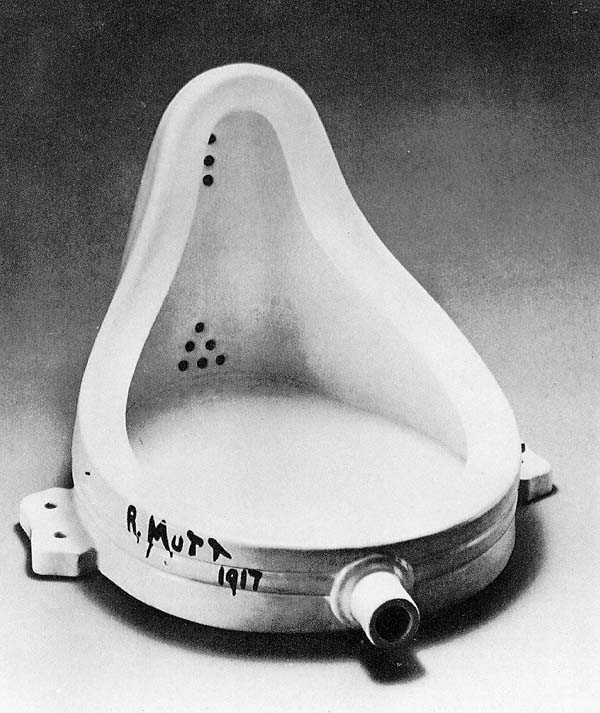
No more urinals

"21st Century Art Makes Its Escape From the Toilet," proclaims a wonderful piece by Daniel Henninger in the Wall Street Journal. Henninger writes:
It is time for both Modernism and Post-Modernism to go away. The 20th century is over. We don't need it anymore. We don't want it anymore.

What we need is an art, a culture, an aesthetic appropriate to the age in which we live--the 21st century, the Age of the Digital and the Age of September 11. Modern art isn't it.

The "urinal" in the title of this post, and the "toilet" of Henninger's, is, of course, Marcel Duchamp's "Fountain," that icon of modernism. The "cultural signifier" of our age, writes Henninger, might well be the iPod.

On a related note, though it's not quite about art, here's another piece I enjoyed immensely when I first read it: "Postmodernism Disrobed" by Richard Dawkins.

Marital squabbles are good for the heart

Please nobody show this to my wife.

Saturday, February 19, 2005

Ian "Baby" McEwan

The Booker international shortlist is out, and the youngest of the 18 nominated authors is Ian McEwan, at a cherubic 56. Yes, the lad shows promise.

On leaving Iraq

Fareed Zakaria writes in Newsweek that the Americans shouldn't think of leaving Iraq anytime soon. He writes:
Does anyone really believe that America's leaving Iraq will improve the situation there? It will create a power vacuum; the insurgency will get stronger; the Shia might retaliate against Sunni violence, setting off a civil war, and the Kurds could be tempted to secede. Iraq would then be exporting terror and instability. Some Americans might say, "That's fine, we'll be gone." But any withdrawal will take months, during which the violence will mount. The last American forces to leave under these conditions might not get a more ceremonious exit than they did off the embassy roof in Saigon in 1975.

[...]

Remember those often-cited studies that said having a large force to secure the peace is crucial in nation-building? Well, all of them point to another, perhaps even more important, requirement for success: don't leave. During the 1990s the places the United States and its allies left—Haiti, Somalia—were failures. The places where they stayed—Bosnia, Kosovo, East Timor—have been relative successes. Look at Afghanistan. It's faring decently today, but were foreigners to leave, it would almost certainly regress, probably into some kind of failing narco-state.

But why take Zakaria seriously, you ask, he's just an armchair-columnist. Well, ok. Let's take a head of state then. Hameed Karzai, in an interview with India Today, says:
The US presence is essential for Afghanistan's stability. The US helps us a lot to fulfil our desires. We visited the US for 5-6 years during the Taliban rule for their support. Now without the US or international presence, do you think three million refugees would come back? International presence in our country is extremely important. [...] Till Afghanistan stands on its feet and has its own economy and education capability, we will need help from the US and the rest of the world. [...] As for the outside forces, if they leave Afghanistan may go back to chaos.

Ditto Iraq, wouldn't you think?

(The India Today site is only accessible by print subscribers, and they require you to key in a four-digit code to enter. My advice: try out a few!)

Friday, February 18, 2005

What race would you like to be?

The options you are given include Afro-American, Caucasian, East Asian, West Asian, Manga and Modigliani. For more, check out the Face Transformer.

I got this link via Apul's post on Sepia Mutiny, where he gives us not one, not two, but five Aishwarya Rais to choose from. And five George W Bushes if you're, ahem, so inclined.

The meaning of the piece

The book I'm currently reading is a magnificent collection of essays by Jacques Barzun titled A Jacques Barzun Reader. Here's a thought from that, from an essay titled "Is Music Unspeakable?", which has some food for thought for critics of any of the art forms:
[W]e have all heard the anecdote of the composer who played his latest piece to his guests, after which one of them asked what its meaning was. The composer sat down at the piano again and played the piece through once more.

The composer's answer was entirely right. But it holds good not just for music. The meaning is inside any work of art and it cannot be decanted into a proposition.

And still we try in vain!

Thursday, February 17, 2005

Freedom envy, and persuasion bunches

Furious at having one of their own (Eason Jordan) brought down, and at being reduced to an acronym, MSM (mainstream media) has hit out at bloggers. As Peggy Noonan puts it in a piece in the Wall Street Journal titled "The Blogs Must Be Crazy":
"Salivating morons." "Scalp hunters." "Moon howlers." "Trophy hunters." "Sons of Sen. McCarthy." "Rabid." "Blogswarm." "These pseudo-journalist lynch mob people."

This is excellent invective. It must come from bloggers. But wait, it was the mainstream media and their maidservants in the elite journalism reviews, and they were talking about bloggers!

[...]

When you hear name-calling like what we've been hearing from the elite media this week, you know someone must be doing something right. The hysterical edge makes you wonder if writers for newspapers and magazines and professors in J-schools don't have a serious case of freedom envy.

The bloggers have that freedom. They have the still pent-up energy of a liberated citizenry, too. The MSM doesn't. It has lost its old monopoly on information. It is angry.

But MSM criticism of the blogosphere misses the point, or rather points.

Noonan goes on to list, comprehensively, the many different ways in which blogs provide a public service. It is one the finest pieces I've read on blogging, and I urge you to read it.

Accusations of being part of a mob aren't exactly new to me, and Eugene Volokh points out in a lovely post how misplaced the analogy of bloggers as a mob really is. He writes:
... I realize that "lynch mob" is figurative, and hyperbole at that. Still, figurative references and analogies (even hyperbolic ones) only make sense to the extent that the analogy is apt -- to the extent that the figurative usage, while literally false, reflects a deeper truth.

The trouble is that here the analogy is extremely weak. What's wrong with lynch mobs? It's that the mob itself has the power to kill. They could be completely wrong, and entirely unpersuasive to reasonable people or to the rest of the public. Yet by their physical power, they can impose their will without regard to the law.

But bloggers, or critics generally, have power only to the extent that they are persuasive. Jordan's resignation didn't come because he was afraid that bloggers will fire him. They can't fire him. I assume that to the extent the bloggers' speech led him to resign, it did so by persuading the public that he wasn't trustworthy.

So Jordan's critics (bloggers or not) aren't a lynch mob: If they're a mob, they're at most a "persuasion mob." What's more, since they're generally a very small group, they're really a "persuasion bunch."

I got the link to Volokh's post via Instapundit, who also has an excellent summary of the aftermath of Easongate at GlennReynolds.com.

Wednesday, February 16, 2005

Chocolate and gold coins

Since I’ve started blogging, every once in a while I have received an email that had made me wonder why I am doing the blogging and the person writing to me isn’t. Regular readers of this blog know my complaints about receiving abuse, but I also get fair amounts of intelligent, insightful, beautifully written mail that has resulted in dialogues and friendships that I have come to cherish.

One such is with Michael Higgins.

Michael lives in Fairfax County, Virginia, and he first wrote to me in the days when I wrote just one blog, the one on cricket, 23 Yards. We soon started exchanging mails, often disagreeing, especially over economic and political matters. But our disagreements were civil, always a reasoned exchange of facts and logic, with no empty rhetoric, shrill polemic or, the one thing I dread, ad hominem attack. I told him a couple of times that he must start a blog, and to my delight – as a reader as much as a friend – he has finally obliged. It is called Chocolate and Gold Coins.

He explains the reasoning behind the name:
Chocolate and gold coins are two of my favorite commodities. And naming a blog that deals with economic issues after commodities makes sense, especially commodities that symbolize consumption and income. However, the name “Chocolate and Gold Coins” refers to something else. It refers to types of writing you might find on this blog.

Gold coins are something with intrinsic value. You might find something like that here buried deep under the rubbish if you search long enough. Chocolate is another commodity altogether. It is something to be enjoyed briefly and soon forgotten, like a frivolous but fun piece of writing. There will be more chocolate than gold in this blog. In any case, I hope you find something you like here.

He hasn’t been at it for too long, but I have found both chocolate and gold. You can taste some chocolate here and here; and enjoy some gold here and here. Do visit his site, I’m sure you’ll like it.

Monday, February 14, 2005

Also a mighty superpower

BR Myers writes in the New York Times:
In the West, attention is almost exclusively focused on the official pronouncements released by Pyongyang's Central News Agency - statements that, for all their strange rhetoric, strive to present North Korea as a misunderstood country eager for more normal relations with Washington. Last week's announcement that North Korea has nuclear weapons, for example, said that while the country had "manufactured nukes for self-defense," it still sought only "peaceful coexistence" with the United States.

But the propaganda dinned every day into the North Korean people is of a different order. School textbooks, wall posters, literary works: all celebrate a cynical "attack diplomacy" that makes a frightened and uncertain world dance to the drum of Kim Jong Il. Again and again, comic effect is derived from stories of stammering American and international officials trying to placate the relentless "warriors" of the Foreign Ministry. Washington's refusal to follow through on veiled threats of military action is mocked as a failure of nerve.

The novel "Barrel of a Gun," for example, released in 2003, is an official "historical" work about how Mr. Kim's iron resolve forced the Clinton administration to its knees in 1998. "Excellency," the American negotiator says at the end of the book, groveling shamelessly before his North Korean counterpart, "you are also a mighty superpower."

Read the full thing. The Iraq conflict is getting resolved now, and North Korea will be more in the news during George W Bush's second term. Watch that space.

(Link courtesy Chandrahas.)

Sunday, February 13, 2005

Hating America

Dominic Hilton writes in openDemocracy:
Anti-Americanism, when not perpetrated by true haters, is often a stale mockery of America, born of our own fascination. This is our (the world’s) problem, not America’s. Jean-Francois Revel suggests that we “project our faults onto America so as to absolve ourselves”. As he says of his native France, and Barry Rubin and Judith Colp Rubin say of the last four hundred years, some of this “Hating America” is born of fear, some of plain old weakness, some of outright jealousy. The left, in particular, is green with envy. 20th-century Communism only served to augment belief in the American Dream. “The success of America was thus a devastating blow to the Left,” writes Michael Ledeen. “It wasn’t supposed to happen. And American success was particularly galling because it came at the expense of Europe itself, and of the embodiment of the Left’s most utopian dream: the Soviet Union.”

Read the full thing. And if you don't agree with the essay, check out openDemocracy's forum on this article, and join the debate if you wish to.

I've just finished a fascinating book on a related subject: Occidentalism, by Ian Buruma and Avishai Margalit. An excellent read, more on it later.

Saturday, February 12, 2005

The occupational hazard of being a blogger in Iran

The Houston Chronicle carries a scary piece by a blogger in Iran who spent 36 days in jail because she ... blogged. Farouz Farzami writes that after being arrested while exiting a bookstore, she was taken to one of the most notorious prisons of Iran. And there ... :
I was photographed and asked my height, weight, eye color and the number of children I have. "I am single," I said. All this was humiliating.

"That's why you are making trouble for our system," the woman said. "If you were married, you would not have time to write such nonsense."

After a Kafkaesque couple of days, Farzami is finally told what her charges are. This is how it goes:
"Do you accept the charges?" the interrogator asked.

"What charges?"

"That you have written things in your Web log that go against the Islamic system and that encourage people to topple the system," he said. "You are inviting corrupt American liberalism to rule Iran."

"I've tried to write my ideas and opinions in my Web log and to communicate with others in Farsi all over the world," I said.

He was displeased. "These answers will lead us nowhere, and you will stay here for years. Tell us the truth. How much have you received to write these offenses against the Islamic state? How are you and your fellow Web loggers organized?"

How should I respond? I knew my mother must be terribly worried about me. What could I say to make sure I got out? "We are not organized against the state," I said. "I write because I want to criticize the system. There are some things in our state that should be corrected."

"Why don't you write an e-mail directly to the supreme leader's office?" he asked. "The supreme leader considers all criticisms and takes corrective actions."

Indeed.

Friday, February 11, 2005

Rebranding the Democrats

Terry Michael feels that America's Democratic Party has lost its brand equity, and needs to reposition itself. The title of his article, "A Return to Liberalism's Jeffersonian Roots", indicates where he would like to take it. He explains:
Born in the agrarian era of its founder, Thomas Jefferson, the Democratic Party's original story was of a small central government serving self-sufficient "little people" (farmers, shop keepers, frontiersmen), prizing and preserving individual liberty -- juxtaposed against the elitist federalists, and their monarchical, big central government ambition.

The Democratic Party story was refashioned in the industrial era, particularly with arrival of the New Deal, when one-size-fits-all, central authority, wealth-redistributive policies were appealing to those little guys. Most of them had traded self-sufficiency for wage labor. Their economic lives revolved around big impersonal corporations, against which they were represented by big labor.

But in a post-industrial, information economy, the little guys, who Democrats have always claimed to represent, are again more self-sufficient, empowered to make -- tailor-make, in fact -- choices for themselves ... The "Central Authority Solutions" story offered by Democrats, from the mid-19th to mid-20th centuries, lost luster.

In contrast, he looks at the Republicans:
You could reduce the GOP brand to this: "Government bad. America good. The marketplace will provide. In God we trust. Equal opportunity, but not equal outcomes, for all."

The Democrats needs similar clarity. But what do they have? John Kerry.

Thursday, February 10, 2005

Tragic, and ironic

Sandeep points to a moving piece by David Sheff in the New York Times called "My Addicted Son", in which Sheff writes about his son Nick's struggle with drug addition. At one point, when he ponders on what his own culpability in his son's addiction might have been, he writes:
When I told Nick cautionary stories ... and warned him about crystal [methamphetamine], I thought that I might have some credibility. I have heard drug counselors tell parents of my generation to lie to our children about our past drug use. Famous athletes show up at school assemblies or on television and tell kids, "Man, don't do this stuff, I almost died," and yet there they stand, diamonds, gold, multimillion-dollar salaries and fame. The words: I barely survived. The message: I survived, thrived and you can, too. Kids see that their parents turned out all right in spite of the drugs. So maybe I should have lied, and maybe I'll try lying to Daisy and Jasper. Nick, however, knew the truth. I don't know how much it mattered. Part of me feels solely responsible -- if only his mother and I had stayed together; if only she and I had lived in the same city after the divorce and had a joint-custody arrangement that was easier on him; if only I had set stricter limits; if only I had been more consistent.

As Sheff writes later, drug-and-alcohol counsellors routinely console the parents of addicts that it is not their fault, citing the three Cs: "You didn't cause it, you can't control it, and you can't cure it." Indeed, reading Sheff's account, one gets the sense that he was a concerned, sensitive father who did everything he could to save his son.

Now consider the irony of this: Nick Sheff, the kid in question, once wrote an article which won a 1999 Hemingway Writing Awards for high school students, and his piece was titled "Parents Do Matter". It was essentially a review of Judith Rich Harris's groundbreaking book, The Nurture Assumption, which Sheff Jr misunderstood as being "a cop-out for parents who don't want to accept the responsibility for their children." Sheff argued that parents are responsible for how their kids turn out, and wrote:
Parents influence their children by what they say and what they do. By building an environment of equal respect, parents can prove themselves trustworthy so their children can talk to them. If children can be honest with their parents, they won't feel afraid to face their mistakes. Parents should love without strings attached in order to build the self-esteem that will help their children make the best choices in life.

A pity, then, that young Nick's life went on to become an illustration of the opposite of what he had written. It is fashionable to blame the parents when their kids go wrong, but as Nick's story and Harris's seminal book show, there's only so much that parents can do.

Wednesday, February 09, 2005

Confusing description with prescription

Steven Pinker writes on the Larry Summers controversy:
Summers's critics have repeatedly mangled his suggestion that innate differences might be one cause of gender disparities (a suggestion that he drew partly from a literature review in my book, The Blank Slate) into the claim that they must be the only cause. And they have converted his suggestion that the statistical distributions of men's and women's abilities are not identical to the claim that all men are talented and all women are not--as if someone heard that women typically live longer than men and concluded that every woman lives longer than every man. Just as depressing is an apparent unfamiliarity with the rationale behind political equality, as when Hopkins sarcastically remarked that, if Summers were right, Harvard should amend its admissions policy, presumably to accept fewer women. This is a classic confusion between the factual claim that men and women are not indistinguishable and the moral claim that we ought to judge people by their individual merits rather than the statistics of their group.

While you're at it, also read Ruth Marcus's view in the Washington Post.

The anti-Cassandras

Jaithirth Rao remembers what critics of the Iraq war were saying not long ago:
“The US will get stuck in a quagmire in Afghanistan. Look what happened to the British and the Soviets. This is a land war. You cannot rely on bombing as they did in Kosovo. Once the casualties start, public opinion in the US will turn against the war. Americans have no stomach for body-bags.”

“Kabul will never fall. The Pushtuns will resist. The northern insurgents will be of no help.”

“Kabul may have fallen, but Kandahar is another matter. They will fight so hard. American troops will be stuck there.”

“Afghanistan was easy. Iraq is another matter. Coalition troops will get trapped on the long, hot road to Baghdad. Supply lines will not hold.”

“Entry into Iraq may have been easy. But once they get to the outskirts of Baghdad, the Republican Guard will fight fiercely.”

“Once inside Baghdad, there will be door-to-door fighting. It will be an impossible trap.”

“The Shias will never agree to a constitution where they do not dominate. The Islamists will never agree to a constitution where women have the right to vote. The Sunnis will definitely sabotage any election where their pre-eminence is threatened.”

I think it is now time for the media pundits to apologise. They do not need to be very profuse. A simple “sorry” will suffice.

Um, Jerry, obese opportunity. Or, in other words, fat chance.

Tuesday, February 08, 2005

You're the king!

In a piece in the New Yorker titled "The Customer is King", that excellent writer, James Suroweicki, gives us some perspective on Procter & Gamble's mega-acquisition of Gillette. The deal happened, he writes, "to create a manufacturing giant with enough bargaining clout to stand up to Wal-Mart." He elaborates:
The story goes something like this: once upon a time, companies that made things had the whip hand in the American economy. They could charge premium prices for their goods, and raise prices when costs went up, without losing their customers. In other words, they had pricing power. But in recent decades the rise of retailers like Wal-Mart and Target has changed all that. Today, the companies that sell things dictate the terms. The P. & G.-Gillette deal, in this rendering, is an attempt by a pair of manufacturers to take back a little of the power that they’ve lost.

But, Suroweicki continues, manufacturers lost that power not to Wal-Mart and Target, but to you and me, the consumers. He writes:
The real transformation of the past thirty years is the rise not of the American retailer but of the American consumer. That’s why Wal-Mart is so tough to negotiate with, and so relentless in its quest for lower prices and lower costs. American consumers now consider it their due to have access to a wide variety of cheap, reliable goods. Their allegiances are fickle; brand loyalty is in fast decline. Wal-Mart is often spoken of as the most powerful company in the world, but it earns less than four cents on every dollar of sales, and its profit margins have stayed roughly the same year after year—which means that when it cuts costs with suppliers it passes along those savings to the customers, instead of padding its own bottom line. Wal-Mart can’t charge more; if it does, its customers will go elsewhere. The same is true of Target and Costco. In a sense, Wal-Mart is the elected representative of tens of millions of hard-bargaining shoppers, and, like any representative, it serves only at their pleasure.

That is, of course, exactly as capitalism is meant to work: at our pleasure.

Monday, February 07, 2005

The man who stood up for Iraqi freedom

No, not George W Bush, writes Glenn Reynolds, but Bill Clinton. Regime change in Iraq became US government objective because of the Iraq Liberation Act that Clinton signed in 1998, he points out, and Al Gore supported it wholeheartedly.

If it was Clinton's idea to begin with, why are Democrats like Ted Kennedy and John Kerry so vociferously in denial about how well the Iraqi elections went? Reynolds writes:
I think it's jealousy. Bush-hatred has become all-consuming among a large section of the Democratic Party, and they can't stand the thought of anything that reflects well on him, even if it's good for the country, and if it's something that was their idea originally.

The question is whether the Democratic Party -- which ought to be cheering events that vindicate Clinton's policies -- will do itself fatal damage by giving in to envy. Such small-mindedness doesn't suggest a party that's ready to govern.

(Link via Vinod.)

Self-portraits of a mirror

"How, you might wonder," wonders Peter Conrad in the Observer, "does a man without a self to portray turn into a compulsive, versatile self-portraitist? Andy Warhol was a mirror ... and, as he once remarked, when a mirror looks in the mirror there is nothing for it to see."

Conrad is writing about an exhibition of 85 self-portraits of Warhol that opens next week. So what do they reveal? Conrad writes:
[T]he more earnestly Warhol aspired to merge with everyone else, the more he stood out as an eccentric, complex self-creation, at once gormless and ghoulish, trivial and tragic, a ditzy socialite and a moralist who stoked up the bonfire of vanities and then consigned himself to the flames.

No comments

Crossposted at India Uncut.

I keep getting mails from people asking why I don’t have comments enabled, and to deflect any more questions on that subject, I am posting on it. I disabled comments not because I don’t want the kind of intelligent interaction that I see on so many other sites, but because, while writing my cricket blog on Cricinfo, 23 Yards, I got flamed too often for my liking. As some of that audience also follows my other blogs, I thought that it was safer to keep comments disabled, and avoid abuse on my site. I envy those bloggers whose readers provide civil discourse – as I’d written in an earlier post, comments can make a good blog stand out – but mine is read by all kinds.

Some of the queries I have received on this subject have been aggressive ones, with one gentleman asking me: “How dare you start a blog in the public domain and not have comments? This is the public space, and all blogs should have comments.”

Well, firstly, there is no convention that "all blogs should have comments". Instapundit and Andrew Sullivan, to name two of the most widely read bloggers, don’t have comments enabled. Secondly, this blog is not public property, but my space. As Bill Vallicella writes in his pithy post on why he disabled comments: “A man's blog is his castle.” And while I would be glad to let civil people wander into this particular castle, given my past experiences, I’d rather keep that drawbridge up.

Vallicella, interestingly, did eventually enable comments. But I don’t see myself doing that anytime soon. No disrespect is meant to you by this, and you are always welcome to write to me.

Sunday, February 06, 2005

Open source? Try a car pool

In a piece titled "The economics of sharing", the Economist examines whether social sharing, as seen in open-source software, can work outside the field of information technology. Read the full thing.

Saturday, February 05, 2005

The choices men make

Maureen Dowd has a complaint. In a piece titled “Men Just Want Mommy”, in the New York Times, she points out that successful women have a tough time finding a sucessful mate, because men who are high-achievers tend to marry below themselves. She writes:
I'd been noticing a trend along these lines, as famous and powerful men took up with the young women whose job was to tend to them and care for them in some way: their secretaries, assistants, nannies, caterers, flight attendants, researchers and fact-checkers.

Women in staff support are the new sirens because, as a guy I know put it, they look upon the men they work for as "the moon, the sun and the stars". It's all about orbiting, serving and salaaming their Sun Gods.

She gives a few examples of this from popular films – like Love Actually - and then quotes a couple of studies that are relevant to her subject:
As Dr Stephanie Brown, the lead author of the study, summed up: "Powerful women are at a disadvantage in the marriage market because men may prefer to marry less-accomplished women. Men think that women with important jobs are more likely to cheat on them. The hypothesis is that there are evolutionary pressures on males to take steps to minimise the risk of raising offspring that are not their own," Brown said. Women, by contrast, did not show a marked difference in their attraction to men who might work above or below them. Men did not show a preference with one-night stands.

A second study, by researchers at four British universities, suggested that smart men with demanding jobs would rather have old-fashioned wives, like their mums, than equals. The study found that a high IQ hampered a woman's chance of marrying, while it was a plus for men. The prospect for marriage increased by 35 per cent for guys for each 16-point increase in IQ; for women, there was a 40 per cent drop for each 16-point rise.

But why is Dowd complaining? Part of the reason for that comes because she is perhaps making the same mistake as the researcher she quotes, Stephanie Brown. She quotes Brown as saying: “Men think that women with important jobs are more likely to cheat on them. [My emphasis.]” Now, this is, at the very least, mixing up proximate causation with ultimate causation. Even if the tendency in men to avoid having accomplished women as their mates originated for the reason Brown puts forth, it is an ultimate cause for the tendency to exist, not a proximate one for the men to think that way. If men actually thought, as Brown surmises, that successful women would be more likely to cheat on them, then Dowd might be justified in castigating them for their sexism, or hypocrisy, or whatever. But people can’t help falling in love with whoever they fall in love with.

Even as ultimate causation, though, Brown’s hypothesis seems flawed to me. James Miller, writing in Tech Central Station, comes up with a more plausible one. He writes:
Although children are a blessing, they're also time sinks. Two married people can't both work jobs for 60+ hours a week and have enough time to raise a few kids properly. Realizing this, many men who intend to have several children and time-intensive jobs often seek women who are more child- than career-oriented.

Um, I’m not sure about the “realizing this” bit, and I think the tendency that draws successful men towards old-fashioned homemakers is at least as instinctive as reasoned out. Miller says that Dowd is wrong because “it's women, not men, who are at fault here.” He explains:
I teach at Smith College, an elite women's school. Almost all of my students would rather date a selfish investment banker than a nice, attractive administrative assistant. But for a Smithee who hopes to raise several children while making partner at a top-law firm, an administrative assistant might make a far better match than an investment banker. True, the investment banker would earn much more money, but what anyone with a time-consuming job and children really needs is a spouse who can devote much more effort to children than to career.

Much as I like Miller’s writing, I think he is on the wrong track here. He is criticising an instinctive choice – and the instinct is programmed by natural selection – by demonstrating that a rational choice would serve women better. Well, of course it would. But women cannot help who they fall in love with any more than men can, and judging such choices either in terms of morality, as Dowd is doing, or reasonableness, as Miller is doing, serves no purpose. We can only judge acts of volition in that manner, not who we fall in love with.

[Note: Dowd’s piece in NYT requires subscription, and in the likely event that you’re not a subscriber, you can view a syndicated copy of it here, at the Sydney Morning Herald. This would require free registration.]

Friday, February 04, 2005

Prince Harry's sensitivity journal

On Tuesday I explored people of color. Just by peering out of my palace window, I glimpsed so many wonderfully varying tonalities, rather like paint chips. And I pondered: Wouldn’t it be marvellous, and an ideal illustration of brotherhood, if we could just line up everyone in the world by gradation, with the English people right at the front? Immigration is simply a matter of every nation assembling a complete box of human crayons, and never forgetting even those shades which no one ever uses, not if it’s a picture of a bright sunny day.

Paul Rudnick has some fun in this week's Shouts and Murmurs.

The perils of exercise

Time to join a gym? The Guardian warns that in your quest to lose a few pounds you could, well, lose a few pounds. Read the small print.

Thursday, February 03, 2005

Monkey porn

Scientific American reports that monkeys like prurient pictures. Researchers at the Duke University Medical Center have just finished a study on male macaque monkeys, in which these monkeys "received juice rewards while looking at a variety of images of other macaques on a computer screen. The pictures included a neutral target, male monkeys that differed in social standing and the hindquarters of a female monkey, which reveal her sexual receptiveness."

Needless to say, the macaques were willing to sacrifice quite a lot of juice for the chance to view "female behinds". Or maybe they just didn't like the juice.

"Too much sugar in this darned orange juice," said Tog. "Why aren't they feeding us bananas today?"

"No idea," said Champ. "Hey, look, there's your mom's ass!"

Unnatural selection

The New York Times reports that in schools across the USA, teachers are skipping the chapter on evolution, "fearing protests from fundamentalists in their communities". And, apparently, principals of schools frequently discourage their teachers from discussing the subject in class.

This makes a mockery of education, of course, as Darwin's theory answers the most fundamental question humans can ask about themselves: How are we here? Besides natural selection, there is only one answer to that, and it is the wrong one.

Wednesday, February 02, 2005

Four more dictatorships

Mark Steyn concludes, in an essay titled "Bush means business", in the Spectator, that George W Bush will bring down four more dictatorships in his second term, including the one in Iran. On the way to reaching that conclusion, he bursts the myth of geopolitical stability, explicates the nature of vanishing penises, and compares the Shia parties, favourably, to Barbara Boxer. This man is a virtuoso writer, and his substance matches his style. Read it all.

Blogs, and Iraq

Glenn Reynolds, aka Instapundit, writes in Tech Central Station:
For some time, I've been predicting that the blogosphere would move more and more from punditry to newsgathering and reporting, in competition with (or at least in supplementation of) the traditional media. And that's been happening. We saw it with tsunami coverage, and now we're seeing it with reporting on the Iraqi elections.

Reynolds makes some important points about both Iraq and the failure of Big Media in their coverage of it. Read the full thing.

Returning from hell

"As I watched the images of Iraqis lining up to vote, even in the face of terrorists who threatened to wash the streets with blood, I couldn't help thinking of Whittaker Chambers," writes David Brooks in a moving piece in the New York Times titled "Stepping Out of the Tar Pit". Who is Whittaker Chambers? Read the full thing.

(Registration required for all NY Times content, but it's free, and worth the time.)

Tuesday, February 01, 2005

Gladiatorial combat

"Like acting, writing novels is a profession in which not to be very successful is to be very unsuccessful," writes John Sutherland in the Guardian, as he contemplates the effect of literary prizes on literature.