Friday, November 23, 2012

Fiction and poetry in The Caravan for November

Here are my selections for fiction and poetry in The Caravan for November: the Bengali writer Narendranath Mitra's story "Ras", translated by Arunava Sinha, and four poems by Anupama Raju: "The Time-Eater", "On Borders", "The Memory Maker", and "Nightless Night". Here is a paragraph about "Ras":
Marriage and economics have never been independent of one another. The relationship between the two in the affairs of men and women is memorably dramatized in this story by Narendranath Mitra, one of Bengal’s greatest short-story writers. And the narrative time of the story and the arc of the romances within it are marked, too, by the cycle of the seasons in a rural economy, as seen through the life of the protagonist, Motalef, a tapper of palm-trees. The “ras” of Mitra’s story is not just the juice of the palm trees which give Motalef his livelihood, but also the “ras” of human passion, that longing to possess what is beautiful that maddens human beings and leads them to singe the lives of those around them. In order that he may accumulate the bride-price to marry for love, Motalef can see no other way out than to marry first for wealth; within this marriage, he enjoys a devotion and companionship that he later spurns for the lure of youth and beauty. Mitra’s story has an irresistible force and amplitude, but perhaps it is never more beautiful than in the long interlude between the two winters, or palm-tree seasons, covered by the events of the tale. Here, Motalef is seen pampering his pretty new wife and burning himself out over numerous unremunerative tasks, waiting for the next high season to come along and his labours to yield riches again through the transformation of palm-tree syrup into jaggery by his wife’s hand. Mitra fills his story with symbols and metaphors rooted in the world that it describes; when, in the closing scenes, Motalef comes to a realisation of how he has been trumped by his own scheming, the two pots of ras he takes on a final journey stand unforgettably for his defeat as they once stood for his triumph. “Ras” was memorably adapted to film by Sudhendu Roy in 1973 called Saudagar, starring Amitabh Bachchan, Nutan, and Padma Khanna. 
Arunava Sinha's translation of Mitra extends a vast oeuvre of translations from Bengali literature by Sinha in the last decade, including fiction by Sankar, Sunil Gangopadhyay, Bankimchandra Chatterji, Banaphool, Dibyendu Palit, Buddhadeva Bose, and Anita Agnihotri.

And here are some notes on Raju's poems:
The poems of Anupama Raju enact a world of metamorphoses and secrets, and their movement is continually toward a blurring and breaking down of walls and boundaries, whether physical or conceptual ones. In poems like ‘The Memory Maker’, every line throbs with the forces of shape-shifting; as soon as one transformation has been absorbed, we are catapulted into the space of another. One of her poems here is called ‘The Time-Eater’, and its most memorable image, coiled into the final pair of lines, is that of the human being and time feeding off one another before the stronger side wins the battle. But Raju’s taut, aphoristic style shows us how a poem, too, might be thought to be a kind of time-eater, working nimbly with syntax, rhythm and space to deliver concentrated effects in small shots of time.‘Nightless Night’ and ‘The Memory Maker’ are from ‘Une Ville Un Lieu Une Personne’, a poetry-photography collaboration between Raju and the French photographer Pascal Bernard.
The Fiction & Poetry page for The Caravan is here. If you'd like to submit original, unpublished work to The Caravan, (short stories no more than 5000 words long, or five or six poems) please email me at chandrahas.choudhury@gmail.com.

Friday, October 19, 2012

On Mo Yan

Last week the Chinese novelist Mo Yan was awarded the Nobel Prize for Literature. Here is an old post from 2005 on his work: "Lush Life in Mo Yan".

And here are some sentences from a review of his novel Change that I wrote in 2010: "Mo Yan loves to play off communism’s vision of order, selflessness, discipline and ideological unanimity against its almost inevitable worldly expression as hierarchy, chaos, corruption and greed. Communism, in a way, is the enabling fiction of his own fiction."

Tuesday, September 25, 2012

A month in South Korea at the Toji Foundation for Culture

For the last month I've had the pleasure of living and working in the small village of Hoechon in South Korea, about three hours from Seoul, at the Toji Foundation for Culture, a center for Korean and foreign artists set up by the great Korean novelist Pak Kyung-ni (1926-2008).

The center takes its name from Pak Kyung-ni's greatest work, a sixteen-volume novel sequence, written between the years 1969-1994, called Toji or Land. Every year it hosts residencies for a diverse group of Korean artists, and  an annual residency sponsored by Sangam House, the Inko Centre, India, and the Arts Council, Korea, makes it possible for an Indian writer to join them. Indian writers who've come to Toji before me include the fiction writer Mridula Koshy and the playwright Manav Kaul.

Here at Toji I've been working on my new novel, wandering around the countryside and making occasional trips to the nearest town, Wonju, reading some Korean literature, and eating, drinking, talking, and playing ping-pong with a band of very sociable Korean writers, filmmakers, musicians and painters. The Foundation is set down in an uncommonly beautiful scene, ringed by tall pine-covered mountains that change colour in the varying light of the day and become obscured by clouds when it rains. All around us are lush fields of wild sesame, chilli, and corn, as well as apple and persimmon trees, and sudden surges of white, pink and red cosmos flowers.

Dawn and dusk are especially beautiful, and as I walk on streets so empty that my passing often sets off an entire alarm-chorus of  village dogs, whose barks, echoing off the mountains, give an air of extreme criminality to my small trespasses. There's great pleasure to be had in the sight of these mountains, their undulating shape matched on the ground by the roofs, uptilted at the edges like birds' wings, native to Korean architecture. While I contemplate my material and work out its moments of emphasis and stillness, I hear in my mind's ear the captivating sound, at once familiar and strange, of the Korean instruments -- the stringed gayageum, the flute-like piri, and the booming changu drums -- that I heard on my first weekend here, when I was taken by my hosts in Seoul to an exquisite musical, Miso.

At weekend gatherings of the writers and artists on the program to drink the Korean liquors makkoli and soju, I have had to contribute my small repertoire of Oriya folk songs as a complement to their Korean ditties. Meanwhile, I've tried to develop a working Korean vocabulary word by word, with the English-speaking Korean writers having to serve as go-betweens for my more complex sentiments. Since what small merits there may be to my prose style are remote to my companions, my main stratagem for winning their respect has been my topspin forehand at the table-tennis table and my Korean pronunciation at the dinner table; in turn, they are patiently teaching me how to eat with chopsticks in the correct manner, at once direct and delicate.

Meanwhile, I've also been trying to read some Korean literature in English translation, about which I knew very little when I arrived: mainly the excellent translations of a number of Korean poets by Brother Anthony of Taize, among them some by the poet Kim Sa-in that I had the pleasure to publish in The Caravan earlier this year. Here I've also become acquainted with other translations by Kevin O'Rourke, a long-time student of Korean literature, Don Mee Choi, and Bruce Fulton. I've also been able to lay my hands on the three large volumes of Pak Kyung-ni's Land that are currently available in an English translation by Agnita Tennant. The novel is set between the years 1897 and 1945, and  is imagined on a scale that dwarfs most of the sprawling realist novels of the world whose narrative techniques it adapts: it runs to 25 volumes, and has over a hundred prominent characters. Tennant writes in her introduction:
Land has been acclaimed as the most powerful and important work in modern Korean literature. While it is the greatest national novel, it has at the same time a universal appeal as it deals with fundamental, borderless and timeless themes of humanity such as love, treachery, the gap between the rich and the poor, fate, and deep-rooted traditions facing the tide of change.
The novel begins in 1897 on a night of the calendar of great significance in Korea: Chuseok (literally "autumn night") a harvest festival held on the full moon day of the eighth month of the lunar calendar. The festival is one of joy, abundance, plenty to eat and drink, and the scenes that unfold before us are marked by this mood. But shortly afterwards, a dissenting note is inserted into the story by the narrator, who sees that times when joy is an obligation and man for a moment feels wealthy are precisely the times when old sorrows spring up most powerfully:
The Harvest Moon Festival of the eighth lunar month -- doesn't it have something of the translucent and frosty pathos of the finest hemp? How can a festival associated with the moon, which crosses the river of darkness like a shadow of death, be regarded as a symbol of abundance? As it hangs coolly over the ridge of the mountain the twigs of trees cast lacy shadows and a young widow clad in white silk walks the night road alone. Isn't the harvest moon of the eighth month perhaps a festival that celebrates the closing of a sorrowful life, revealing the art of renunciation to all living things, and especially to the poor. [...]
This is when they reflect on their many separations: elderly parents who perished in years of bad harvest, unable to keep alive on grass roots and bark; children in epidemics, left to die without medication, rolled up in a straw mat and buried in the nearby hills; a husband during the uprising dragged into the governor's house and beaten to a resentful death; and those many neighbours now asleep underneath the earth. The breeze plays gently on the strings of these sorrowful memories.
"Perhaps they are better off in the other world?"
My visits to Pak Kyung-ni's former residence in the nearby town of Wonju and to a museum that houses her manuscripts, books, and pictures from her life, as well as what I've been able to read here about what writing meant to her, left me with a sense of someone absolutely and enviably committed to literature, and who took great pleasure in work and in creation. In an essay written late in her life called "The Dangerous Power of the Material", she writes:
I think that being alive -- life -- is the most beautiful thing of all. And it is this thought now that is most dear to me. [...] It's not just human life -- flowers or animals, all that lives is beautiful. The reason why life is beautiful is because it is active. Isn't that what life is? That which acts? The world is full of material things. But all of these are passive. To be a thing is to be passive. To live is to be active.
I leave Toji this weekend -- incidentally the weekend of Chuseok -- to go back home to Delhi with many happy memories, and closer both to my own work and Korean life and literature.

Friday, August 17, 2012

Fiction & Poetry in The Caravan, August

Here are my selections for the Fiction & Poetry section of The Caravan for the month of August: Dilip Kumar's short story "A Clerk's Story", in a translation from Tamil by Padma Narayanan, and Martin Figura's  long poem "Talking".

Friday, August 03, 2012

Friday, July 20, 2012

On Andrey Platonov's "No-Arms"

This month, The Caravan publishes "No-Arms", a story by the Russian writer Andrey Platonov.


Platonov (1899-1951) is now considered by many to be the greatest Russian writer of the 20th century. Like Boris Pasternak and Aleksandr Solzhenitsyn, the other, better-known names who might also be thought worthy of that title, Platonov was someone who for a time believed in the ideals of the Russian Revolution and the Communist Party before commencing a sceptical examination of the new reality it birthed, often by violence, in Russia. The individual and often mystifying emphases of his work and his utterly distinctive (and therefore unassimilable) style made it difficult for him to publish. Though Platonov published a number of great short stories during his lifetime, most of his longer works, along with his plays and screenplays, were published only long after his death. In his last years, he wrote a series of stories based on Russian folktales, infusing the material of these fairly well known stories with the spirit of his own metaphysics. 


In this tremendously powerful and wrenching story about a woman whose arms are cut off by her own brother, Platonov shows us both the ubiquity of human evil and the persistence of human grace in situations of extreme suffering. Although the story preserves the folktale’s clear distinctions between good and evil people, it is very complex in its understanding of guilt, redemption and justice. The recognition scene in which sundered lovers are reunited will remind Indian readers of a similar scene in Kalidasa’sShakuntalam, while the final act of violence (and the unforgettable image of a horse returning from the steppe) recalls Oedipus’s self-blinding when he finally perceives all the evil that has passed through him.

An interview with Platonov's main translator, Robert Chandler, is here.

Thursday, June 28, 2012

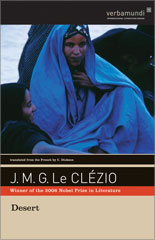
On JMG Le Clezio's Desert


A glimpse at the list of winners of the Nobel Prize in Literature in the last decade shows that the Swedish committee that adjudicates the prize is often willing to honour highly feted, widely read, and hotly tipped writers who for years have had “Nobel Prize” tagged to their names. VS Naipaul is one such case, and so are JM Coetzee, Orhan Pamuk and Mario Vargas Llosa.

But just as often the committee throws up a name that the vast majority of readers have never heard of, and to my mind this is the more interesting, exploratory side of its work. Who had heard of the Hungarian writer Imre Kertesz or the Austrian writer Elfriede Jelinek before they won the award in 2002 and 2004 respectively? Who indeed, at least in the Anglophone world, could claim at the time of announcement to have read anything by the 2008 winner, the Frenchman Jean-Marie Gustave Le Clézio? 
What the committee is saying, in effect, is that great literature, always being the work of an individual mind, can come from all kinds of unlikely places. Prizes like the Nobel can be a way of equalizing the iniquities of the literary market and the entrenched power of certain languages and cultures in the world today.

Le Clézio (many of whose works are now available once again in English translation after being out of print for some three decades), is an especially difficult writer to slot because, in addition to the difficulty and often wilful obscurity of his work, there is the difficulty and obscurity of his biography. Although he was born in France, and writes in French, he also claims allegiance to Mauritius, where one side of his family comes from, and where he still lives part of the year. 

A restless wanderer from the days of his youth, he seems not to have needed a “home” for his work, not to have cultivated a relationship with a single place or culture as most novelists do. Indeed, his itinerancy – he has spent time in and written books set in Mauritius, France, Mexico, Panama, and Africa, a world writer if there ever was one – might seem to resemble that of Naipaul, except that he mostly writes fiction, and his work is much more sympathetic to the marginalised people and cultures who are his subjects than Naipaul, with his glowering eye, is.

Among the distinctive emphases of Le Clézio’s writing is his engagement with what he has called cultures “broken by the modern world” – all the tribes and peoples thrown out of joint by the encounter with colonialism, Western rationalism, and the power of the nation-state (a good parallel in an Indian context might be someone like Mahasweta Devi or Gopinath Mohanty, both of whom have written extensively about the problems of Indian tribals). This willingness to move across a boundary, to invert a dominant power relationship, and to imagine the life of the “other” sympathetically from within is best seen in Le Clézio’s work in his novel Desert (1980), one the central novels in his oeuvre and now translated into English for the first time by C. Dickson.

Set in Morocco and in France, and spanning a century in time, Desert is the story of a warrior tribe of the desert, called “the blue men”, and their flight from French occupying forces in the early part of the twentieth century. Le Clézio depicts a group of people ceaselessly making their way forward like ants in the vast, arid and spirit-breaking desert, seeking a place of refuge where they can consolidate their resources and turn once again towards the lost homeland. In counterpoint, Le Clézio also tells the story, set in the present day, of a girl from the same tribe, Lalla, who flees the desert to escape a marriage she does not want and arrives in France, a vulnerable immigrant.

A great traveller himself, Le Clézio here produces a very close and painstaking description of human beings on the move across a landscape. His attention to the constantly shifting and turning shapes of the universe – no other novelist spends as much time detailing the changing colours of the sky, or the particularities of the light – turns his story into a cosmic drama. Le Clézio is also one of those writers who work absolutely on their own terms. His book is slow-moving and often difficult going, but the writing is frequently beautiful and alert, as when he speaks of the wind that “draws the yellow grasses aside like a hand passing over them”, or hears “the faint swish of sand running down the grooves in the rocks” on a cliff. If you consider yourself an ambitious reader, there’s no reason to deny yourself an encounter with this very independent-minded and distinctive sensibility.

Saturday, June 16, 2012

Susan Sontag and the stresses of reading


Books, the great American essayist and cultural critic Susan Sontag writes, “are a way of being fully human”. This is a point of view that this site is of course very sympathetic to. Without books, we are more likely to be without history, without memory, without imagination, without good language, without that kind of skepticism or doubt that stimulates reflection and an appreciation of complexity. Books expand inwardness: the experience of them, in a hyperkinetic age full of carefully plotted and speeded-up stimuli, is tantamount to a kind of meditation. Before there is a book, there must be a reader – a mind that has the space in it for the experience of extended connection with a book. 

“By books, I mean the conditions of reading that made possible literature and its soul effects,” Sontag writes in an essay, wondering if books will survive the assault of our “advertising-driven televisual reality”. Here, undoubtedly, is a combative and adversarial thinker with a very high-minded view of reading. But as the pieces in Sontag’s final collection of essays, WhereThe Stress Falls, demonstrate, the truly remarkable thing about Sontag (1933-2004) was not so much the gravity of her pronouncements as the range and catholicity of her interests. 

Where The Stress Falls contains essays on books, films, music, dance, art, photography, each one of them a felicitous combination of close interpretation of particular works and larger arguments about the history of the medium itself. This high view of multiple art-forms informs all of Sontag’s work, generating rapid cross-connections (“As the statue is entombed in he block of marble, the novel is inside your head. You try to liberate it.”) Like all the great critics, Sontag brought to her work a combination of perspicacity and personality: the erudition of a trained and subtle mind applying itself to a careful observation of its own highly individual reactions to art, and able to reproduce its journeys in lithe, allusive prose.

Among the forty or so essays collected here, surely the most widely circulated and discussed was Sontag’s essay from 1996, “A Century of Cinema”. For Sontag cinema was the greatest contribution of the twentieth century to the corpus of human art-forms, a form rooted first and foremost in a wonder “that reality can be transcribed with such magical immediacy”. There was something total about the cinematic experience. “Lovers of poetry or opera or dance  don’t think there is only poetry or opera or dance,” she writes. “But lovers of cinema could think there was only cinema.”

But much as Sontag’s essay was a reprisal and a stock-taking of where the movies had gone over a hundred years, there was also something deeply elegiac and pessimistic about it. For Sontag, the nineteen-sixties and seventies represented the peak of what she termed “cinephilia” – a highly informed, highly personal love of the movies held by a substantial number of aficionados committed not just to films but to film-watching in a darkened theatre, so that they might be overwhelmed “by the physical presence of the image”.

But over time this cine-system had been broken down, on the supply side, by the cynical formulae and simplifications of capitalist production, which had eliminated the tension between cinema as industry and cinema as art, and on the reception side, by the sheer proliferation of images in the modern world and the expansion of private home viewing. “The reduction of cinema to assaultive images,” Sontag writes, “and the unprincipled manipulation of images (faster and faster cutting) to be more attention-grabbing, have produced a disincarnated, lightweight cinema that doesn’t demand anyone’s full attention.”  These observations could profitably be applied to the story of Indian own popular cinema.

Perhaps the first skill of the good literary critic is knowing how to quote – that is, knowing how to supply the part that will rouse in the reader a need for the whole. Attention, in words, to a work of verbal art involves stepping back at times and letting the work speak for itself. This becomes especially important if the essay is an argument for the beauty of a novel or poem or play few have ever heard of, for then it is the excerpt that persuades as much as the analysis. Sontag was an especially adept practitioner of quoting, and there are wonderful passages here from the work of such masters as WG Sebald, Witold Gombrowicz, and Adam Zagajewski. Where The Stress Falls is not just eloquent invitation to the pleasures of reading, of watching, of inwardness, but itself an incarnation of some of these pleasures.

And here is a wonderful essay on Sontag – both admiring and mocking – by the writer Terry Castle: "Desperately Seeking Susan."

Sunday, June 03, 2012

On the poems of Joseph Furtado

One of the earliest, but least well-known, great Indian poets in English, Joseph Furtado (1872-1945) is now all but forgotten even in his native Goa. No edition of his poems is currently in print. This is a shame, because this self-professed “Goan fiddler”, who added cashew trees and tamarinds to the cornfields of English verse, could produce a beautifully weighted verbal music both melancholy and effervescent by turns. Furtado’s poetic subjects include landscape (“Land of palm and mango-tree/ Dear as life art thou to me.” he writes in one poem) and love, in which matter his speakers reveal a warmingly ecumenical taste (in one poem, the speaker professes a love for a mullah’s daughter; in another, he dreams of a lady who sits by his feet “And reads out stories/ Of Vedic glories”). 
But as poems like ‘The Secret’ reveal, the natural world was for Furtado heavy with human mysteries and silences; and his verse can be feminist, too, as when he sees women not just as objects of male desire but desiring subjects, in ‘The Neglected Wife’. Is the refrain of Furtado’s ‘Only Shy’ a pun on shayri, as Furtado suggests by his subtitle ‘An Urdu Song’? We shall never know for sure, but the best-known photograph of Furtado shows him late in life with a white beard even longer than Tagore’s—and as a creator of limpid verse effects he was in the same class. 
This month The Caravan publishes five poems by Furtado.

Sunday, May 27, 2012

Arzee the Dwarf in German

Arzee the Dwarf is published in Germany this month by Deutscher Taschenbuch Verlag in a translation by Kathrin Razum as Der kleine Konig von Bombay. 

A Youtube trailer for the book is here. I watched it several times as, what with all the other work I've had to do between 2009 and 2012, I'd almost forgotten the story.

It's also available as a German audiobook.

Send word to your German friends -- or use it to improve your German!

Tuesday, May 15, 2012

On Rajesh Parameswaran's I Am An Executioner

This review appeared yesterday in the New York Times Book Review.

A compulsive and infectious narrative restlessness marks Rajesh Parameswaran’s first collection of short fiction, I Am an Executioner. Although tagged by the generic subtitle “Love Stories,” Parameswaran’s work demonstrates about the same relationship to traditional literary debuts as the insects in his strange and beautiful story “On the Banks of Table River (Planet Lucina, Andromeda Galaxy, AD 2319)” do to the earthlings who have colonized their planet.
Parameswaran prefers first-person narration to the more detached third person, but his storytellers are also wedded to a 21st-century experimentalism, continually uncaging themselves from realist fiction. From tigers and elephants to a man in a yellowing photograph and, most simply and touchingly, just a “being” in “On the Banks of Table River,” they form an unpredictable and often charming cavalcade, revealing both the particularity of what they perceive and the extent of what they misunderstand or simply miss. Raptly attentive to their own narratives, they gradually paint us into corners. We must peer around and above them before we can escape.
“The Agent does not try to understand what he is seeing,” we are told in the story called “Narrative of Agent 97-4702.” “That is a job for the Analyst.” Here a fiercely committed spy presents her report of a fairly ordinary surveillance operation, a report that begins to crackle when it becomes clear that she is also pursuing a chilling self-interrogation.
Parameswaran’s decision to avoid the convention of naming many of his characters and places serves to make the Agent, like other figures in this collection, powerfully allegorical. When the Agent eventually pleads guilty to “entertaining a mental state conducive to forming an intention to disclose protected information,” she plunges us into that nightmare world in which people need never be brought to trial because they have already tried and convicted themselves.
The companion to this story is “Demons,” in which a harassed wife is also seen entertaining a mental state. Having idly wished her annoying husband would just die, she suddenly finds him felled by a heart attack. In the aftermath, she’s consumed by the notion, common in India, that wishing harm on another may activate such harm.
Elsewhere, Parameswaran’s characters, humans and animals both, find themselves puzzled by love and power, devotion and detachment. The speaking tiger in “The Infamous Bengal Ming” finds its attempts to love a human being bloodily thwarted by its own brute strength. The executioner in the finely mysterious title story insists that his is just a job like any other, even while revealing, in his disheveled English, that his bewildering power makes him “wonder the universe.”
Parameswaran’s desire to ground his speakers’ voices in syntactical and cultural tics sometimes has the effect of turning an individual into a type, as when the executioner supplies the registers — but also the clichés — of Indian-accented English, reporting that “people always marvel how I am maintaining cheerful demeanors and positive outlooks.” 
At their best, though, Parameswaran’s stories combine narrative brio, ringing ­voices and beguilingly looped plots. In the hilarious yet pathetic “Four ­Rajeshes,” the narrator, a man called Rajesh, confesses to homosexual passion as a railway-station manager in an early-20th-century south Indian village even as he berates a present-day man called Rajesh, presumably the “real” author of the story, for making the whole thing up, inspired by nothing more than an old photograph. Thus realist revelation and postmodern speculation proceed in parallel, like the very railway tracks the primal Rajesh supervises. Despite their occasional contrivances, these are very much stories that make us “wonder the universe.”

Wednesday, April 25, 2012

On Yashpal's Jhootha Sach (This Is Not That Dawn)


Any reader who has a feeling for the rigours and small miracles of novelistic composition is especially likely to be transported by the awesome narrative freedom and strength of the great long novels of world literature. Having broken through the walls of artistic and formal finitude over hundreds of pages of scene-setting, plot-threading and character tracking, such novels, or novel sequences – IB Singer’s The Family Moskat, Proust’s In Search of Lost Time, Naguib Mahfouz’s Cairo Trilogy, Orhan Pamuk’s The Museum of Innocence – seem almost to write themselves, continuously unspooling and ramifying in the same way as life. Indeed, it seems a diminution of life to have to break with their company.

On one level, of course, the great long novels represent nothing more than an especially massy story – a map of human motion and connection on a grand scale. But is that all? Their size would be (and sometimes is) worth very little if we did not also take away from them the extended experience of mind, of an encounter with not just a world but a subtle, disembodied intelligence – the narrator – observing and occasionally annotating its ferment. To observe a story-world for weeks, even months, in concert with a novelistic narrator is to return to the world outside the book to find something strangely absent, or limited, or silent about it. Sometimes when we find ourselves missing the characters of a novel, what we are actually missing is the narrator.

This is the experience we take away from the Indian novelist Yashpal’s massive novel Jhootha Sach (literally The False Truth), first published in Hindi in two volumes in 1958 and 1960, and now translated into English for the first time as This Is Not That Dawn. The novel is over 1,100 pages long, but it is long only in an absolute sense, not relative to the dozens of characters it describes, the ideas it explores, and the narrative time (and indeed geographical space) it traverses.

Following a family from their roots in a gali, or lane, in the great city of Lahore (now in Pakistan) to a new life in the cities of north India over the 1940s and 1950s, Yashpal’s novel takes as its central, world-changing event the partition in 1947 of colonial India into the nation states of India and Pakistan. The bloodbath that resulted from this massive, uncontrolled two-way migration of peoples across the new boundaries of what was formerly undivided Punjab – Hindus streaming east into India from what had now become Pakistan, Muslims west into Pakistan in the fear that they would have no place in a new Indian nation state – took at least a million lives. Partition left a gash on the psyche of the Indian subcontinent that has never quite healed, and that inflames the politics of both countries, as well as Bangladesh, to this day.

The novel’s central characters are two siblings, Jaidev and Tara Puri, who live in a small, tightly knit Hindu community in a lane called Bhola Pandhe’s Gali in the old walled city of Lahore. Among the ways in which Yashpal’s novel links the lives and loves of its middle-class characters to the great churning in the public sphere of Lahore and Delhi in the 1940s is by setting them within the overlapping worlds of journalism, literature and education in Lahore (no other Indian novel is so much in love with the idea of the newspaper, and the newspaper’s power as a voice of reason in the public sphere). Puri is an idealistic young writer and journalist who has already served a prison sentence for the cause of the freedom movement. Tara is a college student excited by the intellectual freedom of the university – one that is not available in the world of the gali, with its family and gender hierarchies – but troubled by her engagement to a man she hardly knows.

In the novel’s opening movement, we see Puri (as he is called by the narrator) vexed by his inability to find a job and the social obstacles in the way of his marrying Kanak, the daughter of a prosperous publisher. Tara, meanwhile, feels that her world will come to an end if she is made to marry Somraj Sahni, her loutish fiance. But these problems pale into insignificance compared to the crisis that suddenly appears like a dark cloud over Lahore, as the British prepare to leave India. The Hindus of Bhola Pandhe Gali fear that Lahore might be ceded, as part of the two-nation theory that has gained currency in undivided India, to the new, primarily Muslim nation state of Pakistan.

“What if there’s a Pakistan or there’s a Hindustan? We’re Lahorites, neighbours of Doongi Gali,” declares one of the family’s optimistic friends. But as the book shows, this cosmopolitan vision of history and community has little chance against the drumroll of nationalism, and the combustible fear of the other lying just beneath the surface of the subcontinent’s social life.

Yet the novel also shows us that, at the time, Partition was not imagined to be a complete sealing-off of two geographically and culturally contiguous territories from each other, as turned out to be the case eventually. People left behind their homes, families, cities and countries imagining that they would soon be back once things had settled. But often they never returned, or returned to find that everything they owned had been taken.

The paradox most strikingly explored by the novel is that the very (allegedly foundational) categories of Hinduism and Islam that were the basis of Partition proved powerless, despite their scriptural emphasis on peace and justice, to stop the cataclysms of violence visited by each side upon the other. People of both sides looted, killed and raped, “all in the name of God”, as one character sorrowfully observes.

Repeatedly in This Is Not That Dawn, characters are shown jettisoning their private moral compasses because they are convinced that blood must be spilled to avenge the spilling of blood. Yashpal’s novel, on a scale equal to the complexity of the matter at hand, shows us how the question of justice is rarely contemplated by human beings in the abstract, or outside the pressures of time or frame of history – and that in a crisis, this tendency can prove to be mortal while continuing to believe itself moral. These conceptions of “comparative justice” are still doing the rounds of the subcontinent to this day, as during the gruesome religious riots in the state of Gujarat in 2002.

If This Is Not That Dawn is nevertheless a deeply pleasurable book, it is because it offers a world so vividly imagined that the quotidian acquires the same significance as the apocalyptic. The novel is steeped in meaningful details that reveal the networks and pressures of space, gender (“the afternoons in the galis belonged to the women ... If a male had to come back to the gali for some reason, he would clear his throat loudly to warn the women”), family and tradition in the small, hermetic world of Bhola Pandhe’s Gali in Lahore, and then out across the fields of city and nation.

As both Puri and Tara are thrust out into the world – Puri when he leaves Lahore in search of a job; Tara when she is abducted by a Muslim man after escaping from Sahni’s house on the night of her wedding – they are forced to bear the violence and derangement of Partition upon their bodies and then, finding themselves still alive, decide what to make of their battered selves. Although it appears for the longest time that Puri, with his idealism, his love of language, his political vision and his diligence, is the book’s hero, we see him gradually sinking, over a thousand pages, under the weight of his own worldly power in the new Indian republic and somewhat insecure masculinity – an unforgettable narrative arc. Revealingly, it is his involvement with the Indian National Congress that gradually leaches the idealism from Puri.

Instead, it is Tara, the apparently helpless, brutalised victim, who slowly gathers strength and makes an independent life for herself in the Indian capital, Delhi, watching out not just for herself but for other women in trouble. The storyline reveals not just Yashpal’s feminism – once she has a modicum of power and agency, Tara repeatedly resists any attempts to return her back to a normative world of female deference and duty – but also his emphasis on the individual’s right to dissent from the collective.

This Is Not That Dawn was written just a few years after the Indian constitution offered a new vision of rights, responsibilities and secular freedom to Indian citizens – a vision of a political order more egalitarian and enabling than any previously held in the history of the subcontinent. It might be thought to be the narrative and novelistic companion to that document, all the more compelling because its worldview is implied – parcelled out into the experiences and reflections of dozens of characters, and across the novelistic timespan of nearly two decades – and not spelt out from above.

Ten years into the life of the new nation, Yashpal sat down to compose an epic story, scrubbed free of nationalist cant, about the passion and tragedy that attended its birth. In doing so, he produced the first great novel about the ideals and implications of a new view of Indianness, a novel whose mingled vision of realism and idealism rings true to this day.


Saturday, April 14, 2012

On Diana Eck's India: A Sacred Geography and Akash Kapur's India Becoming

This review appears today in The Washington Post.


It’s most unusual to see geography as primarily a construct of the human imagination, but that is precisely what the scholar of Hinduism Diana Eck attempts in her massive new book, India: A Sacred Geography. Thousands of years before India was a nation-state (1947), a colony of Britain (the 18th century), or a cartographic vision on a map (1782), it was, in Eck’s view, conceived as a geographical unit in the hearts and minds of the faithful, and particularly in the religious imagination of Hinduism.
Pilgrims thought of India as the land of the seven great rivers, as a space marked by the benediction and caprice of the gods who resided in the great northern peaks of the Himalayas, as woven into unity by the great centers of pilgrimage, or dhams, in the north, south, east and west. Seeking the marks and manifestations of the sacred, they fashioned with their footprints a map of a vast subcontinent suffused with the presence of the gods and stories of their appearances in different incarnations.
Eck’s perspective has significant political implications. It arguably refutes the widely held notion that India was merely a confusion of diverse kingdoms, cultures and languages until it was politically integrated by the British Empire. Some scholars hold that the idea of Hinduism, too, is the modern tracing of a circle around a diversity of ancient religious beliefs never self-consciously systematized into a whole. This idea struggles to hold up against the layered evidence supplied by Eck’s book, the synthesis of three decades of work on the myths, rituals, cosmology and everyday life of Hinduism.
But the appeal of the book lies in the fact that its emphasis is not political, but aggregative and connective, making a forest out of a mass of trees. Eck offers an exceptionally rich account of how, throughout India, the cosmic is mapped onto the local in a tradition formed, revised and renewed over the centuries by thousands of discrete phenomena and often anonymous actors.
This map of myth, as it were, radiates a worldview very different from the assumptions of modern cartography. Cartography invests each place on a map with a name and an unassailable specificity. But sacral maps, Eck notes, are marked continuously by “patterns of duplication and condensation,” demonstrating an ability “to see a world in a grain of sand,” in William Blake’s unforgettable formulation. For instance, thousands of rivers and water bodies across the country are said to be linked to or fed by the holiest river of Hinduism, the Ganga. The Ganga is, depending on what lens one brings to it, both somewhere and everywhere.
“As arcane as lingas of light . . . and sacred rivers falling from heaven may seem to those who wish to get on with the real politics of today’s world,” Eck writes, “these very patterns of sanctification continue to anchor millions of people in the imagined landscape of their country.”
She devotes entire chapters to regional variations in the worship of the great generative god Shiva, the creator of the universe, or the myth of the Mother Goddess, who is consecrated and remembered in thousands of local incarnations as “the goddesses of earth and village, glade and river, hilltop and mountaintop.” In doing so Eck demonstrates how, just as novels are fully realized only in the minds of their readers, gods are made present in the world by the stories and footsteps of the faithful.
The two main currents of contemporary nonfiction about India might be said to be a broadbrush view animated by strong particulars (such as Patrick French’s recent India: A Portrait) and an attempt to fully realize a fascinating local world (such as two recent books about discrete realms in the megalopolis of Mumbai, Katherine Boo’s Behind The Beautiful Forevers and Sonia Faleiro’s Beautiful Thing). Eck’s book might be said to stand at the sangam, or junction (a site of great religious power in Hinduism), of these currents.
Its ideas reverberate forcefully, too, against other recent works about geography as informed by the human imagination, such as Rebecca Solnit’s book about San Francisco, Infinite City, or Graham Robb’s The Discovery of France. (Robb and Eck also resemble each other in never writing an uninteresting or flat sentence.) All these writers would be fundamentally in agreement with Eck’s assertion that “every story has a place and every place a story.”
Eck’s book is so dense with detail that one might think of its 500 pages as a distillation of a world. In Akash Kapur’s India Becoming,” on the other hand, an idea that might be written up in a few sentences is stretched out, through the conceit of an autobiographical narrative, into an entire book.
In 2003 Kapur returns, after many years in America, to India, the country of his childhood, and finds the sleepy, unmoving world of old dramatically refashioned by new energies — especially the energies of capital — and ambitions. Fascinated by “that sense of newness, of perpetual reinvention and forward momentum that I had felt when I first moved to America,” Kapur beds down in Auroville, a small south Indian town, to take stock of this dramatic historical moment.
He explores the new India through a variety of conversations with, among others, a landlord who sees the old feudal world falling away around him, a young gay man riding the wave of the IT revolution and an activist in Mumbai fighting for the rights of those who have been marginalized or dispossessed by ruthlessness of the new economy. The Hegelian triad of thesis, antithesis and synthesis slowly emerges from his narration, but only as cliche, reverse cliche and all-encompassing cliche.
Dazzled in the beginning by the rumbling of a society of a billion people (“India, I felt, had started to dream”), Kapur soon begins to feel disillusionment with the spectacle of rising crime, pollution and poverty, and a “culture of not caring.” Finally he decides that he has been too hasty in both his elation and his despair, and settles for the comfort of realizing that “the central fact . . . of modern India was change” and the mystification “ineluctably, if at times haltingly, a new world was rising.”
If this were a novel, one might surmise that the writer was deliberately setting the narrator up as a naif. Anyone who reads it as straight-up reportage, though, will probably find the banality and contrivance of this self-indulgent “journey” exasperating. It is not just that Kapur does not take any strong positions (“I welcomed the progress. But all the destruction seemed a heavy price to pay”). What is worse is that his language groans with superfluity (“It was evening, a time between night and day, and the lights of the city were starting to come on”) and lazy allusion (“India, the author Nirad Chaudhuri reportedly once wrote, is a nation of a million exceptions”).
If Eck’s book reveals the relevance of the local, the unfamiliar and the seemingly obscure to the deep structure of a civilization, Kapur’s proves conversely the great gulf between taking up a relevant subject and writing a relevant book.

Monday, April 02, 2012

Some thoughts on novels, especially Indian novels

Last weekend I gave my talk "Ten Ways In Which Novels Can Change My Life" in Panjim, Goa (and this Friday I'm giving it in Pune, details in the image below). The Navhind Times of Goa generously ran a long interview with me on the subject of novels that I reproduce here.
Life is not a novel. How does a piece of literature factor in the 'unpredictable' human streak?
Life is not a novel, but it is a story, and so is a novel. Both kinds of stories have a lot to give each other. Literature is interested in precisely what is unsystematic and unpredictable about human beings. But the next challenge is to find a way of portraying this unpredictability, persuasively.
There is the good, the bad and the ugly in literature. How would you classify literature into each of these categories and what according to you is the purpose of 'the ugly'?
To my mind there are two kinds of "ugly" in literature. There is that literature which tries to portray or understand or criticise all that is ugly about human nature, human institutions -- for example communal violence, violence in man-woman relations, the urge to think some human beings inferior to others. And of course there is some literature or art which is to my mind ugly in itself -- cynically or manipulatively written, perpetrating stereotypes of its own (for instance the stereotypes of Goans in Hindi movies), or full of other kinds of clichés of thought and language.

The present age has seen the emergence of Chick Lit in India. Is this devaluing literature?
I wouldn't say so. Literature has value not in an a priori kind of way (such as, for instance, money) but only in terms of what it achieves between the time the first sentence of the book begins and the last line ends. In this space, whether it is literary novels, science fiction, or Chick Lit, a work may do something tremendously interesting and original. Some of what we think of now as great novels by women writers were considered Chick Lit when they came out. More important than the genre in which a book is written is the mind of the writer writing it.

What does modern Indian literature reflect of these times in India?
I think modern Indian literature is tremendously interesting and diverse. It reflects a society that is changing very fast, interrogating (or trapped within) old ways of living and interrogating new ones. But it is the responsibility of the reader (and to my mind, also bookshops) to experience the full diversity of Indian literature by seeking (or displaying) literature in translation, books published by small presses, books by writers who are no longer alive to do publicity events for themselves! To make just a short list, I would say that if you were seriously interested in say, just the Indian novel today, you would have to have read at least one work each by Amitav Ghosh, Vikram Seth, Vikram Chandra, UR Ananthamurthy, Aravind Adiga, Kalpana Swaminathan, Bibhutibhushan Bandyopadhyay, Fakir Mohan Senapati, Qurratulain Hyder, Yashpal, Salma, Bankimchandra Chatterjee, Sankar, and Mahasweta Devi. From a list like this you would be able to piece together a tremendously interesting picture of modern India.

Compare Indian writing qualitatively (including use of language) vis-à-vis the early trio of Indian authors -- Mulk Raj Anand, R K Narayan and Raja Rao.
Narayan was of course a very original prose stylist, as was Raj Rao. I don't like Anand's work so much. Even so, I think contemporary writers are less self-conscious in their use of English today than many of their predecessors, and the best of them produce a more interesting sound that brings the rhythms of Indian life to English. I think older Indian writers tended to write more British "English" English. The work of my generation has a freer sound rooted in multiple influences across world literature.

Your take on regional literature.
As I said earlier (and as I demonstrate with the short list of necessary Indian novels I offered), one cannot think of any map of Indian literature, whether as a writer or as a reader, without thinking about Indian writing in translation. I would not call writing in translation "regional" any more than writing in English is "regional".

Hollywood and European cinema draws heavily from literature. Why do we not see this same trend in India besides the few odd incidences like Chetan Bhagat claiming that 3 Idiots was based on his Five Point Someone.
I think an older tradition of Hindi films did borrow stories heavily from Indian literature. I'm thinking, for instance, of one of my favourite Amitabh Bachchan films, Saudagar (1973), in which he plays the role of a trader of cane sugar. The film was based on a story called "Ras" by the Bengali writer Narendranath Mitra. Or Shyam Benegal's Suraj Ka Satvaan Ghoda, based on a novel by Dharamvir Bharati. As films have become more generic and more calculated, they have drifted away from literature, which is in its very spirit very individual and very specific. I don't know that there are that many serious readers in Hindi cinema any more - someone like Shyam Benegal or Ketan Mehta. But I do know that Mira Nair is currently making The Reluctant Fundamentalist from Mohsin Hamid's novel by the same name. I'd be very interested in seeing that because the book is a very interior one.

What aspect of human nature fascinates you the most and in which piece of literature according to you is this best showcased.
I guess of all human relationships, I'm most interested in man-woman ones. The subject of how one can love (and give oneself away to) someone else over a period of time while also keeping to an independent trajectory -- to be both committed and single, as it were -- is an eternal question for adult human beings. One could make a small survey of the pleasures and problems of romantic attachment, for example, by reading Orhan Pamuk's The Museum of Innocence, Yashpal's Jhootha Sach, Irene Nemirovsky's All Our Worldly Goods, and Aamer Hussein's recent novel The Cloud Messenger.

Monday, March 12, 2012

Literary Days at the Norwich Showcase

Some days of one's life one feels grateful for nothing more than the simple pleasure of being alive, and among people tuned not just to the same frequency (principally the wavelength answering to a love of language, jokes, and coffee), but also the same forms -- the old and new ones of literature, literary debate, production, and transmission.

I've been thinking these unoriginal, but nevertheless compelling, thoughts particularly strongly over the last four days as I attend, from morning to night, a set of readings and discussions in England at the Norwich Showcase, an event organised by the British Council. The festival brings together 40 of the best contemporary British writers working in a diversity of forms and languages (across fiction, poetry, drama, performance poetry, nature writing, translation) with a set of representatives from literary organizations, periodicals and festivals from Britain and around the world from Brazil to Uganda to Malaysia to Canada. I'm in Norwich to speak about contemporary Indian literature, and my own work as the Fiction & Poetry editor of The Caravan.

Very often the pleasures of a text are enhanced by the voice of the mind that composed them. Over the last four days I've heard verse by Hannah Lowe, several of them about her father, a professional gambler (a recording of which you can hear here; the texts of some of the poems are here), Tom Warner (here's his very funny and acute poem "Day Thirty-Two", about a survivor of an air crash on a desert island looking at life around him, and here are two others called "Magician" and "Under Natural History"), Kei Miller (who read his excellent "12 Notes For a Light Song of Light"), and Lavinia Greenlaw. If you'd like to listen to Miller and Warner reading one after the other, a podcast of their readings alongside the poet Emily Berry is here.

Yesterday I also enjoyed the writers Robert Macfarlane, whose work I admire greatly, and Adam Foulds talking about new directions in writing about landscape. Macfarlane spoke illuminatingly about the centrality in literature of "the connection of aesthetics to ethics -- the idea that if you learn to see the world differently you'll probably behave differently" and turned the idea into an image by describing it as "a fairly reliable two-stroke engine".

Later, the novelist Adam Thirlwell delivered a razor-sharp talk about the idea of translation not as a substitute for the original but rather a match for it, involving a number of subjective choices made by the individual translator that can never be worked up into a replicable theory or system. Here's is Thirlwell's essay "The Joyful Side of Translation". There was also an astonishing session of performance poetry last night by Luke Wright, who compressed dozens of verbal riffs, jabs, jests and grumbles into a quarter of an hour of pure energy -- a bit like a verbal equivalent of a surging and dipping run downfield by Gareth Bale, the left-winger of the most romantic football team on the planet, Tottenham Hotspur. (Wright cracked everyone up with his line "Some of my best women are friends".)

But there's also been a chance to learn about a host of strategies being employed in our shapeshifting literary world to bring new readers to literature, use new media in the service of literature, and link up the private and the social sides of literature. The marvellously funny and articulate writer Damian Barr is also the salonniere for the Shoreditch House Literary Salon, which hosts an evening, free to all, of readings and bookchat among writers selected by Barr in London every few weeks (the Facebook page for the Salon is here; I'm going to the next event, "Faith and Doubt", on Wednesday the 14th). This isn't your standard meet-the-celebrity event: no books are available for sale, and there are no signings either -- it's all about the written word and the conversation during and after.

The Ugandan writer Doreen Baingana spoke of her work setting up support networks for women writers with her group Femrite, and the writer Jorge Antonio Marques of Brazil (who has, among other things, written a book about the history of tattoos) described his efforts to set up a most unusual literary festival, Flupp, to be held in Rio de Janeiro later this year, to be held on a hilltop in a favela. Samantha Schnee spoke about the work she and her colleagues have done over the last decade publishing over a thousand writers from over a hundred countries in English translation in the marvellous webzine Words Without Borders. Recent issues include a special on the Arab Spring, and an older one focussed on Urdu fiction from India. (An old Middlestage review  from 2007 of a Words Without Borders anthology is here.)

And with that I'm off to shop, during our lunch break, at a little secondhand bookstore opposite the Norwich Cathedral, where all of today's events are being held against the background of the cathedral's steepling spire. My little jaunt there during the morning's coffee break has already yielded two quite rare books, which further intensifies my conviction that there's no university in the world quite as useful as a good secondhand bookshop.

Saturday, March 03, 2012

The Caravan's Fiction and Poetry for March

Here are my selections of fiction and poetry for The Caravan's March issue, with little notes on each piece:

The Virgins by Irene Némirovsky, translated by Sandra Smith

ABOUT THE STORY The French filmmaker Jacques Becker once said: “In my work I don’t want to prove anything except that life is stronger than everything else.” He might have taken this thought from the French novelist Irène Némirovsky (1903-1942). Némirovsky’s great theme is the continuous oscillation of human beings between passion and peace. Her protagonists, alive to all the pleasures this world can offer, are memorably marked by what Nemirovsky calls “fire in the blood”.

In
this many-sided story, whose ambiguities begin with its very title, a group of women are seen interpreting selfhood, and its relationship to love, marriage and motherhood, through the prisms of their own lives and each other’s. The virgins of the story have much wisdom to offer. In their judgments of the protagonist, there is no hint of jealousy. Even so, might it be that they are trumped finally by “the inimitable prestige of experience”? Might it be that we are most fully human through the intelligence of hindsight, not foresight? The values attached to the word “life” in Nemirovsky—freedom, experience, passion, connection, a particular kind of strength rooted in vulnerability—suddenly surface alongside other competing and persuasive visions of the good life, the whole structure so delicately constructed and balanced it could only be found in the work of a great storyteller.

Némirovsky
was Jewish. Her own life was tragically snuffed out in a concentration camp in Auschwitz in 1942, while she was halfway through her masterwork, Suite Française. The manuscript was discovered in a suitcase many decades later and became a worldwide bestseller when first published in 2004. Sandra Smith, the translator of this story, is also the translator of all of Némirovsky’s novels currently available in English.

Four Poems by Salma: "A Midnight Tale", "Perspective", "Evil" and "Home"
ABOUT THE POEMS In the poems of the acclaimed Tamil poet Salma, there appears the same layered and thoughtful attention to the power and pitfalls of female subjectivity that animates this month’s fiction selection. But they are relayed in a voice that is heavier, more burdened, speaking under the weight of the entrenched structures of patriarchy. Repeatedly in these poems, we sense a speaker having to argue with the world before she can be allowed to argue with herself. Yet the modern Indian writer is much more frank than the older European writer about the particulars of the female body—a contrast that shows how much feminism has opened up the language of female self-witnessing, to be sure, but one that also reveals the extent of Salma’s directness and daring. We find that even if the speaker of the poems decides never to leave “the courtyard of my own house”, her unforgettable voice locks us up, too, into that courtyard.

Salma is also the author of one of the great modern Indian novels, The Hour Past Midnight (Zubaan, 2009, translated by Lakshmi Holmstrom).

Sunday, February 19, 2012

What Would Dickens Write Today?

This essay appears this weekend on the British Council India website as part of its Dickens Bicentenary special, alongside essays on the same theme by other Indian novelists (Sudeep Chakravarti, Neel Mukherjee, Anjum Hasan, and Anita Nair)

Charles Dickens and the modern industrialized city both came of age around the same time. Dickens’s descriptions of both the beauty and the horror of urban life remain intensely apposite today, and are part of the permanent inheritance of the human race.

“A metropolis,” the German writer Robert Walser wrote early in the twentieth century, “is a giant spider web of squares, streets, bridges, buildings, gardens, and wide, long avenues […], a wave-filled ocean that for the most part is still largely unknown to its own inhabitants, an impenetrable forest, an opulent, overgrown, huge, forgotten, or half-forgotten park, a thing that has been built up too extensively for it to ever again be oriented within itself.” This is a very Dickensian description, with its metaphors of webs, oceans and forests, and the suggestion of both knowledge and bewilderment.

The London in which Dickens lived, thrived, and  — especially as a child and a young man — suffered was in his day the greatest and most populous metropolis the world had ever seen. The journalist Henry Mayhew, a contemporary of Dickens, wrote, “In every thousand of the aggregate composing the immense human family, two at least are Londoners.” The many new implications of what it meant to belong to, and take sustenance from, a human family of this enormous size, with its variety, instability, grotesquerie, anonymity, interconnection, anarchy, and forms of community and exchange were explored intimately by Dickens in his novels and his journalism.

But Dickens’s achievement is not just one of empathy, of a surpassing range of perception and powers of connection. It is also one of style. Dickens invented a prose style that was equal, on the page, to the speed of urban life, the explosion of sense perceptions available within it. Just as, within the city, previously inanimate matter was now brought to life by steam and electrical energy, so too in Dickens, characters, scenes and conversations are animated by an extraordinary energy and clarity. The familiar is made unfamiliar; the unfamiliar familiar.

Here is Dickens describing the construction site for a new railway line in Dombey and Son: “There were a hundred thousand shapes and substances of incompleteness, wildly mingled out of their places, upside down, burrowing in the earth, aspiring in the air, mouldering in the water and unintelligible as any dream.” Such sentences don’t just describe a new world, but resemble it in their collage of different perspectives.

As the half-finishedness of this landscape suggests, in many ways the modern urban cities closest to Dickens’s London no long belong to Europe, but to Asia and Africa. For better or for worse, cities like Mumbai (where I live) have the same narrative energy. They exist permanently suspended between need and satiation, wakefulness and sleep, impoverished by the city and yet unable to imagine a life outside it, mixing a thousand different tongues and accents into one jumbled-up patois.

Every construction site leaves behind a permanent fund of debris; every line of progress, whether physical or mental, is interrupted by the movement or will of another. For every kind of activity that is organized and regulated, there exists a shadow world where those in need and those who have something to offer find a way of coming together. Now that I don’t live in Mumbai all year round any more, I find that I can return to it just by opening to any page in Dickens’s work. Under the surface differences of names, streets, and manners, it is a similar world.

What I like most about Dickens are the absence of hierarchies in his narrative world, the way in which each character, whether high or low, major or minor, is given a distinct language and accent. A recent study showed that over 16,000 characters appear in Dickens’s work. That is, Dickens invented more people than we meet over the course of a lifetime. Perhaps we love Dickens so much because the world he gives us is bigger than any world we know.

What would Dickens write today? I think he would be greatly fascinated by the Internet: what it does to human selfhood and to relationships, how it is both a means to something and an end in itself. He would be struck, too, by the new forms of capitalism in place today: the financial bubbles of mortgages, derivatives and real estate, the networks of economic connection propelled by globalization and the field of economic desire that trails us wherever we go (he could stay with the titles Great Expectations and Hard Times).

He would delight in making ironic use of the jargon of advertising and PR, and mocking the construction (and indeed constriction) of the human being as primarily a consumer and of the measurement of human progress primarily by economic indicators. And he would love to stand on the elevators of the Tube stations of London, looking at the vast array of human types from all around the world before him and listening to the sounds and stresses of their English and thinking of the images and transcriptions that would make them live again in his work.

Or -- to think about the question in another way -- perhaps Dickens would walk into a bookstore and find that he wouldn’t need to lift a finger. He could pick up one of his books and find that, more than a hundred years after his heyday, he was still in tune with the world.