Wednesday, September 13, 2006

Krishna Kripalani's faith and frivolity

The journalist and writer Krishna Kripalani is remembered today, if he is remembered at all, for a biography of Rabindranath Tagore he published in 1962. I have not read this, but last week I happened to discover in a secondhand bookshop a collection of his essays, also published in 1962, called Faith and Frivolity. I must confess I bought it primarily because it was only thirty-five rupees, but now I have read it as well, and I have to report that it is a volume of almost boundless charm.

"Without faith it is difficult to live a good life," announces the blurb on the inside cover (which I have no doubt Kripalani wrote himself; would that more writers wrote their own jacket copy, and put an end to empty hyperbole and gratuitous phrasemaking), "but faith itself may become oppressive if not occasionally relieved by frivolity. Our ancestors understood this psychological need well, for they were adepts at mixing the divine with the obscene and had no compunction in making up most frivolous tales about the gods they worshipped."

Faith and Frivolity is divided into three sections: Personalities (with essays on Gandhi, Nehru, Tagore, S.Radhakrishnan, Romain Rolland and others), Trivialities (a title proposed with a broad wink, for it has essays like "Who is a Gandhi-ite?" and "Does Civilisation make for Happiness?") and Frivolities, a collection of diary-style tidbits that Kripalani composed over 1950-51 while he was editing the political weekly Vigil. But whichever mode Kripalani is working in, he is almost evenly dashing, witty and perceptive. Every page of this book carries traces of what must have been a most forceful personality.

Kripalani had that priceless gift without which no essayist can do justice to his form: the gift of succinct and memorable expression, of a rhetorical power that can pack into a paragraph that for which others may require pages. Here, from an essay written in 1945, when the career of Jawaharlal Nehru had not yet reached its peak, is a portrait of the man in two paragraphs:

Nehru occupies a unique position in the world of Indian politics. As a leader he has achieved more eminence than power, and commands more adulation than allegiance. As a politician he is more admirable than effective. He dominates but does not direct events and is more the beloved of the people than their master. His strength lies in the strategic position he occupies between divergent forces. Though not a Gandhi-ite, he enjoys the love and confidence of the Mahatma as perhaps no one else does. The elder politicians value his loyalty, their younger rivals applaud his audacity. The Rightists find him indispensable, the Leftists amenable. He is aggressive enough for the nationalists and international enough for the communists, reasonable enough for the capitalists and radical enough for the socialists. He is identified with no group in Congress. All groups may therefore partially claim him as their own.

What is the secret of this popularity without power, this adoration without allegiance? The secret lies in his personality at once dynamic and stable, revolutionary and rational, rebellious and disciplined. He challenges Gandhism and follows Gandhi, he is aggressive in speech and restrained in action, critical in analysis and compromising in decision, radical in outlook and conservative in loyalties. His revolutionary ardour in challenged by none, his disinterestedness and the innate magmanimity of spirit are trusted by all. He is capable of indiscretion but incapable of meanness, of betraying the larger interest for the sake of a narrow, personal end. He may be betrayed but he will not betray. He thinks for himself, and though he may yield to the superior wisdom of Gandhi or to the discipline of corporate action, he will not use language not his own. He is ready to see another's point of view, a virtue rare in a revolutionary. He tolerates dissent and obliges enemies, virtues rare in a politician.
Note how every sentence builds upon the next by laying out opposing groups or qualities, and demonstrating gradually how Nehru not only seems to bridge them but himself embodies them. All kinds of precise distinctions are made (Nehru "commands more adulation than allegiance"; he is "critical in analysis but compromising in decision") and there is not a word which is superfluous - put together the two paragraphs amount to just about three hundred words, which is how much a person might just as easily take to describe how he was feeling at breakfast. A ringing close is supplied by the final two sentences in each paragraph.

The same powers of concentrated scrutiny and pellucid expression are seen everywhere in the book. Here we find Kripalani noting how science has so demystified the transcendent in human affairs that love is now viewed by serious men as mainly as "a mischief of the libido" and genius "a kind of neurosis". There he is poking gentle fun at intellectuals: "[A]n intellectual is not always one who has a finer intellect than others but one who, whatever his cerebral equipment, believes in it alone and strives to live by it, repudiating more or less the validity of the rest of his being" - an umimproveable formulation. Now we find him giving voice in a lighter vein to something all wives instinctively know: "All married men are envious of bachelors. Having halved their rights and doubled their obligations by marriage, they hate to see bachelors flaunting their freedom." And in another example of happy phrasing he notes in a diary item:
A public meeting in Shradhananda Park in Calcutta ended in a pandemonium following a quarrel between two sections of the followers of Subhas Bose as to whether Netaji is alive or dead. This proves that at any rate his followers are very much alive.
I struggle to articulate what exactly is so funny about that last sentence, but I laughed a great deal when I read it - there is something very droll about it. Of Indian columnists today I can think only of Ramachandra Guha who has the same facility for marrying wit to wisdom. And so I'd like to nominate Faith and Frivolity for republication as the second book of a Library of India series - which I imagine as a series of short, pithy works by both well-known and neglected Indian thinkers, expressing some original point of view but noteworthy also for their style, with introductions by contemporary Indian writers -, the first being a work by Minoo Masani which I wrote about last September.

Thursday, September 07, 2006

English and Hindi in Vikram Chandra's Sacred Games

Vikram Chandra's novel Sacred Games is written in English, but it is an English that meets its characters halfway we find in it a sediment of the Hindi in which they really think and speak. Here, for example, is inspector Sartaj Singh threatening a man: "Don't argue with me, gaandu. You want me to take your izzat in front of your family? In front of your daughter?" This is the gangster Ganesh Gaitonde: "Under the grey sky they walked up and down, counting, and while this ginti was going, I discussed my plan with my two controllers."

Even the narrator in the Sartaj sections (the Gaitonde sections are narrated in the first person) often makes this move across tongues. Here is Sartaj at Katekar's funeral: "A man, another constable, carried a matka full of water. Sartaj could hear the rhythmic gulp of the water as he walked. The thali full of flowers and gulal was carried by another constable, close behind... They entered the shamshan through a tall black metal gate." The Hindi is always unitalicised, not marked out as foreign.

As Indian readers we take this quite calmly, and think of it as a judicious and even necessary blend the language allows us through to the characters by appropriating some of their speech in the original. By annexing a part, Chandra suggests the whole: we can readily imagine how the characters might sound in the Hindi.

Of course, Chandra's characters are themselves attracted by the allure and promise of English. In one of the book's most charming passages, revelatory of the struggle of tens of thousands in our country "born far from English", Gaitonde speaks of how his inadequacy in English stings him, and recounts his agonising struggles to master the language (a trivial paradox here is that his lament about English is actually in English):
I closed my door when I studied English because I didn't want anyone seeing me squatting on the floor, one uncertain and slow finger on the letters….It was humiliating, but necessary. I knew that much of the real business of the country was done in English. People like me, my boys, we used English, there were certain words we used with fluency in our sentences, without hesitation, "Bole to voh ekdum danger aadmi hai!" and "Yaar, abhi ek matter ko settle karna hai" and "Us side se wire de, chutiya." But unless you could rattle off whole sentences without having to stop and struggle and go back and build them bit by bitter bit, unless you could make jokes, there were whole parts of your own life that were invisible to you yourself, gone from you. You could live in a Marathi world, or a Hindi colony, or a Tamil lane, but what were those hoardings speaking…?…What were they laughing about, the people who skimmed by smoothly in their cushiony Pajeros? There were many like me, born far from English, who were content to live in ignorance. Most were too lazy, too afraid to ask how, why, what. But I had to know. So I took English, I wrestled it and made it give itself to me, piece by piece.
Like Gaitonde's boys, Chandra has created a serviceable alloy of two languages, in which the smallest dabs of Hindi keep the language close to the ground, and allow Chandra to take off on the most lyrical flights of English and not sound as if he is talking above the characters. This is Gaitonde taking his bride back home during the Bombay riots to the colony he has built, Gopalmath, which he finds ravaged by conflict. Of the two words of Hindi in this passage one is the resonant 'vatan':
Then I looked about, at the homes of Gopalmath. During a lull in my own war I had left my home, and came back to find my home the battleground for a larger conflict. They, somebody, had drawn borders through my vatan. Here was my Gopalmath, the habitation of my heart, the town that I had caused to be built, brick by brick, where I had walked with my friends, arms on shoulders, with the smell of gajras and falling water in the air, where I had found my manhood, my life. Here was the bright quilt of its roofs, stretching from the bowl of the valley up the hill, this vibrant spread of brown and blue and red knit together by the arcing threadlike lanes, here were the numerous angular reachings of the television antennas, catching their fierce glints from the hovering sun. All of it lay desolate. And at the very edge of the horizon, to the south, a smudge of smoke. Under that unbearably bright sky I took my bride home.
Here the gajras and the vatan with which the English is flavoured might be seen as transforming our reading of such phrases as 'the arcing threadlike lanes' or 'the numerous angular reachings of the television antennas'. The apotheosis of this method, in which the burnished lyricism of the English is steadied and Indianised by deposits from the vocabulary of the character, appears to my mind, in the chapter in which Gaitonde is arrested for the first time. In one long, long sentence, which proceeds as if miming the slow progression of the hours, he describes the routine of life in jail:
In three weeks I was able to execute my plan. And in those three weeks, I learnt the rhythms of this new life: the whistle at five in the morning; the drowsy rows outside for the ginti; the rattling of alumunium plates and bowls and the crackling of the tari on the dal, for which tari you paid extra; the long hours of the morning, and then the smell of cooking from the bissi where they kneaded the atta with their feet and threw rotting vegetables into huge bowls; after lunch at ten, the murmur of conversation and the snores and the smell of hundreds of men sweating; the smokers with their precious little balls of charas and their long rituals of burning and crumbling and rolling; the shifting games of chess, and teen-patti, and Ludo, and the curses and the laughter over the rattle of the dice; my boys ranged around the only two carromboards in the barracks, feeding their passionate following of the championship league they had set up, complete with blackboards for singles and doubles ladders; the tussles and sudden enmities that flared between men packed together, that spread like winding fire through the rows of beds; the shouting and threats as two men faced each other under the eyes of a hundred, each too afraid of shame to back down; the brawny kalias from Nigeria selling tiny fifty-rupee packets of brown sugar in the yard; and their clients, hunched knee to knee in tight little circles over their chaser-pannis, breathing in the smoke with the devout expression of men who had seen another, better world. And the long wait for five o'clock and the dinner of the same watery dal, and the lumpy coarse rice, and the rubbery chappatis, and then sleep at eight.
Here is another piece by Jeet Thayil dealing in some detail with the language of Sacred Games. My review of the novel is here.

Tuesday, September 05, 2006

Interviewed on Bloggasm

I'm interviewed today on Bloggasm, a media website featuring interviews "from the most interesting blogs around". I've talked a bit about literary blogging and all the good things it allows, and confessed to many things, including never having read any of the books my friends have recommended or gifted to me.

Saturday, August 26, 2006

On Vikram Chandra's Sacred Games

[A slightly different version of this review of Vikram Chandra's novel Sacred Games appears today in the Scotsman.]

THE CITY OF BOMBAY (or Mumbai, as it is now called, and even there lies a story) is a case study both in dysfunctionality and the power of the human will. Almost everything about it is made to break the spirit, and yet it pulses alarmingly with life. Its 15 million citizens know it well - indeed, they are never allowed to forget it - as both dreamland and shanty town, a hustler pushing them ever closer and hurrying them on ever quicker, and a theatre of stirring scenes and nightmare grotesquerie. Like all great cities it has a distinctive social and moral temper, mores that bewilder the uninitiated, air smoggy as if with milling human hopes, a colourful bastardised tongue, and a secret order behind the chaos. Nothing is as it appears at first glance, and this is one reason it is so attractive to writers.

"If you want to live in this city you have to think ahead three turns, and look behind a lie to see the truth, and then behind that truth to see the lie," declares a character in Vikram Chandra's Sacred Games. Chandra's novel itself might be thought of as an attempt, through the entirely appropriate genre of the cops-and-robbers tale, to explore what it means to survive and succeed in India's great metropolis, and to unravel its elaborate network of truths and lies.

Sacred Games is set in the Bombay of the 1990s, when the city's underworld and police played out intricate games of war and peace. It throws together the stories of the notorious gangster Ganesh Gaitonde, one of the city's self-appointed potentates, and the dashing police inspector Sartaj Singh, who, although he works in a police force full of preening egos and greedy dreams, thinks of himself as only a small player. Some readers will remember Sartaj from Chandra's 1997 book Love and Longing in Bombay; he appears there in "Kama", a story in which his collapsing inner life as he faces a divorce is revealed with astonishing richness. The Sartaj who appears here is older and more weary, his self-image shrunken, and his language coarser, as if from the snuffing out of his family life.

Chandra is very curious, and very thorough. In its documentary impulse - its continuous mapping of links and connections, and its curiosity about the methods and motivations of people inhabiting a liminal world - Sacred Games is reminiscent of a recent work of non-fiction about Bombay, Suketu Mehta's wide-ranging and widely praised Maximum City. (Indeed, Chandra appears in one scene in Mehta's book as "my friend Vikram, who is writing a novel about the underworld".) For instance, both books have a long description of the code words Bombay gangsters use, rich with metaphorical associations, for guns, cash and women. But in Sacred Games the journalistic is a pathway to the novelistic. The book's wealth of real-world detail is always refracted through the consciousness of the two protagonists, Gaitonde and Sartaj.

The Gaitonde sections are the brightest flares in this book: there is a continuous hum in the air of these long passages. Gaitonde's story can in fact be read as a classic Bildungsroman, the story of an individual's development and his gradual integration into society. He recounts how, as an alienated youth, he began as hired help to a small-time gangster, bumped him off and stole his gold, set out in business himself, full of doubts and fears, and moved upwards step by step, knocking each new obstacle out of his way, noting and learning all the time. "I felt my force extending across Bombay like electricity," he exults, "because of me women and men were talking, running moving in patterns I had set in motion, I had thrown the net of my self wide."

Gaitonde's account records, as powerfully as anything in contemporary fiction, the excited surge of the self, its growing awareness of its power and strength, the heat given off by its clenched resolve and adversarial hunger. When he is caught and jailed, Chandra is inspired to provide a magnificent account of life in prison and its memories of lost freedom.

And juxtaposed against Gaitonde's swelling self is a crumbling self: the figure of Sartaj, in physical decline, lonely, weary of his burdens, and rueful as he contemplates the past. Gaitonde thrills at the prospect of power: "The truth is that human beings like to be ruled. They will talk and talk about freedom, but they are afraid of it. Overpowered by me, they were safe, and happy." For Sartaj, all things spill out of control: "Every action flew down the tangled web of links, reverberating and amplifying itself and disappearing only to reappear again. There was no escaping the reactions to your actions, and no respite from the responsibility."

"I am quite useless, Sartaj thought, and felt very bleak." That is the characteristic register of Chandra's precisely tuned English (in his sentences the word "and" always does a great deal of work, serving often to build, not merely to connect). But that register, the narrator's register, is supplemented in Sacred Games by the more novel sound of languages casually mixing, which is supplied by the protagonists and is often revelatory of character. "Under the grey sky they walked up and down, counting, and while this ginti was going, I discussed my plan with my two controllers." Readers tired of the familiar cusses of gangster-speak will also be relieved to find that, here, Chandra has chosen instead to deploy Hindi's sonorous roster of swear words. Some sections of this novel - especially the "Insets" that fan out into the lives of secondary characters, as if in search of an even greater amplitude - can be heavy going, and some plot turns are not entirely persuasive. But the book is rooted in something unmistakably powerful.

At one point Gaitonde watches a gangster movie by one of India's top directors and declares, "It was true, just like life" (notice that he does not simply say that it was true to life). Sacred Games might be said through its great labours to have earned just that very compliment.

And here is Chandra's long essay in the Boston Review early in 2000, "The Cult of Authenticity", which touches on several important issues relating to Indian writing in English. Chandra talks about the writing of Sacred Games in a good long interview with Jai Arjun Singh here.

Thursday, August 17, 2006

The zany fictions of Etgar Keret

The short stories of the Israeli writer Etgar Keret are among the more unusual pleasures in contemporary fiction. They really are short, often no more than two or three pages, and while writers from Keret's land are supposed always to be dealing with Serious Things, Keret's characters are more likely to be found playing cards with dwarfs, getting stuck onto ceilings with Superglue, or buying their fathers gold-plated navel cleaners on their birthdays.

Mostly Keret's stories are triumphs of "voice". The film writer Rick Groen once wrote of the Finnish director Aki Kaurismaki (The Man Without a Past, Drifting Clouds) that a Kaurismaki film was "invariably a whole lot easier to appreciate than to describe", and that is what made it so intrinsically a film - its power could not be experienced except by seeing it. The same could be said of Keret's stories - the pleasure lies not so much in any summarisable content, or plotline, as in a quirky attitude towards life expressed sentence by sentence through the individual details of the narration.

So here, in its entirety, is the Keret story "Pipes", in Miriam Shlesinger's translation from the Hebrew:

Pipes

When I got to seventh grade, they had a psychologist come to school and put us through a bunch of adjustment tests. He showed me twenty different flashcards, one by one, and asked me what was wrong with the pictures. They all seemed fine to me, but he insisted and showed me the first picture again—the one with the kid in it. “What’s wrong with this picture?” he asked in a tired voice. I told him the picture seemed fine. He got really mad and said, “Can’t you see the boy in the picture doesn’t have any ears?” The truth is that when I looked at the picture again, I did see that the kid had no ears. But the picture still seemed fine to me. The psychologist classed me as “suffering from severe perceptual disorders,” and had me transferred to carpentry school. When I got there, it turned out I was allergic to sawdust, so they transferred me to metalworking class. I was pretty good at it, but I didn’t really enjoy it. To tell the truth, I didn’t really enjoy anything in particular. When I finished school, I started working in a factory that made pipes. My boss was an engineer with a diploma from a top technical college. A brilliant guy. If you showed him a picture of a kid without ears or something like that, he’d figure it out in no time.

After work I’d stay on at the factory and make myself odd-shaped pipes, winding ones that looked like curled-up snakes, and I’d roll marbles through them. I know it sounds like a dumb thing to do, and I didn’t even enjoy it, but I went on doing it anyway.

One night I made a pipe that was really complicated, with lots of twists and turns in it, and when I rolled a marble in, it didn’t come out at the other end. At first I thought it was just stuck in the middle, but after I tried it with about twenty more marbles, I realized they were simply disappearing. I know that everything I say sounds kind of stupid. I mean everyone knows that marbles don’t just disappear, but when I saw the marbles go in at one end of the pipe and not come out at the other end, it didn’t even strike me as strange. It seemed perfectly ok actually. That was when I decided to make myself a bigger pipe, in the same shape, and to crawl into it until I disappeared. When the idea came to me, I was so happy that I started laughing out loud. I think it was the first time in my entire life that I laughed.

From that day on, I worked on my giant pipe. Every evening I’d work on it, and in the morning I’d hide the parts in the storeroom. It took me twenty days to finish making it. On the last night it took me five hours to assemble it, and it took up about half the shop floor.

When I saw it all in one piece, waiting for me, I remembered my social studies teacher who said once that the first human being to use a club wasn’t the strongest person in his tribe or the smartest. It’s just that the others didn’t need club, while he did. He needed a club more than anyone, to survive and to make up for being weak. I don’t think there was another human being in the whole world who wanted to disappear more than I did, and that’s why it was me that invented the pipe. Me, and not that brilliant engineer with his technical college degree who runs the factory.

I started crawling inside the pipe, with no idea about what to expect at the other end. Maybe there would be kids there without ears, sitting on mounds of marbles. Could be. I don’t know exactly what happened after I passed a certain point in the pipe. All I know is that I’m here.

I think I’m an angel now. I mean, I’ve got wings, and this circle over my head and there are hundreds more here like me. When I got here they were sitting around playing with the marbles I’d rolled through the pipe a few weeks earlier.

I always used to think that Heaven is a place for people who’ve spent their whole life being good, but it isn’t. God is too merciful and kind to make a decision like that. Heaven is simply a place for people who were genuinely unable to be happy on earth. They told me here that people who kill themselves return to live their life all over again, because the fact that they didn’t like it the first time doesn’t mean they won’t fit in the second time. But the ones who really don’t fit in the world wind up here. They each have their own way of getting to Heaven.

There are pilots who got here by performing a loop at one precise point in the Bermuda Triangle. There are housewives who went through the back of their kitchen cabinets to get here, and mathematicians who found topological distortions in space and had to squeeze through them to get here. So if you’re really unhappy down there, and if all kinds of people are telling you that you’re suffering from severe perceptual disorders, look for your own way of getting here, and when you find it, could you please bring some cards, cause we’re getting pretty tired of the marbles.
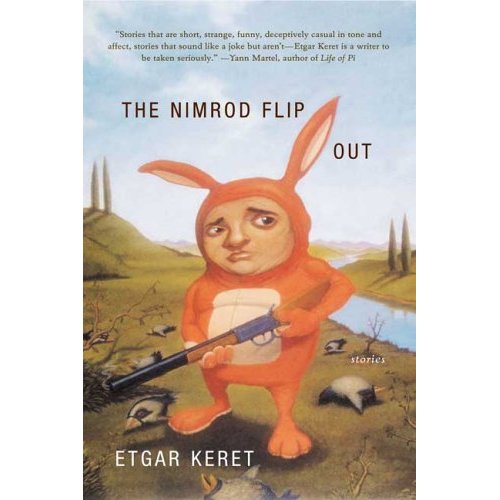
"…cause we're getting pretty tired of the marbles" - there's the Keret voice at its most typical (Note also that "Could be." in paragraph six). Most of Keret's stories work in this fashion. People are stressed-out and long for diversion or escape, reality melts seamlessly into the fantastical, and everything proceeds swiftly in a inexorable fashion like a dream, held together by the rise and fall of the speaking voice. If there are deeper meanings to be found in these bagatelles, then it is we who have to do the work of finding them. Here are some more brilliant Keret stories: "Shooting Clint", "My Lamented Sister", "Island Getaway", "The Nimrod Flip-Out", "Stupor In Our Time", and one curious tale in which we find the writer, or character, Etgar Keret in Moscow, being plied with drink by his hosts till he passes out.

But Keret's not just a sophisticated joker, a miner of the absurd. That is just his fictional persona, the vantage from which he opens out the world in his books. While his characters may long to escape from a troublesome reality, Keret himself has demonstrated a willingness to engage with that reality in all its complexity, especially the intractable Israel-Palestine problem and its many repercussions. Reading his essays, I was struck by the lucidity, moral force and breadth of reference of pieces like "The Sins of the Few", in which he protests against a decision by academics in England to boycott Israeli institutions over the Palestine issue, and "The Way We War", a recent essay in the New York Times on the Israeli government's strikes on Lebanon. Keret writes of Israel's new war:

Suddenly, the first salvo of missiles returned us to that familiar feeling of a war fought against a ruthless enemy who attacks our borders, a truly vicious enemy, not one fighting for its freedom and self-determination, not the kind that makes us stammer and throws us into confusion. Once again we’re confident about the rightness of our cause and we return with lightning speed to the bosom of the patriotism we had almost abandoned. Once again, we’re a small country surrounded by enemies, fighting for our lives, not a strong, occupying country forced to fight daily against a civilian population.
Keret's new book of stories The Nimrod Flip-Out appeared earlier this year. An archive of his pieces for the journal LA Weekly can be found here. He speaks at length about his stories in a very good interview conducted by the radio-show host Ramona Koval here. The blogger Lisa Goldman has a post on meeting Keret here. A review of Gaza Blues, a literary collaboration between Keret and the Palestinian writer Samir El-youssef, follows soon.

Wednesday, August 09, 2006

Uncertain time in Javier Marias

The work of the Spanish writer Javier Marias is notable for its attention to the nature of the temporal, to our experience of time and our puzzlement with time, thoughts that all of us spend a great deal of time thinking. This has earned him comparisions with Proust, though, as Stephen Mitchelmore points out in this recent piece, these are often very perfunctory comparisions, simply presented rather than argued.

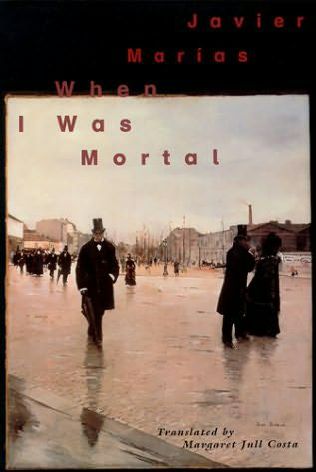
In Marias we feel the pressure of time upon us in two ways. His narrators often not only think, wittily and cogently, about time, but they are also shown thinking in time. That is, their thoughts are presented to us as if in real time - it is not thought recollected in tranquillity and presented in cleanly grammatical sentences, but thought picked up as it is generated, in run-on sentences that swell with clause upon clause. We feel we are watching thought taking a walk without knowing where it will go and what associations it will bring up, which is of course how thought operates, often taking its own thinker by surprise. Some of Marias's signature moves can be found in a story, "In Uncertain Time", that both replicates the trancelike patter of thought in narrative time and deals explicitly with a curious moment in time in the life of the protagonist, a Hungarian footballer called Szentkuthy playing for the club side Real Madrid in Spain.

The story (which appears in the 1999 collection When I Was Mortal) begins with the narrator, an unnamed man, recalling the first time he met Szentkuthy, in a discotheque:
It was in the Joy discotheque, very late at night, especially for him, you imagine that a footballer should go to bed really early, always thinking about the next game, or just training and sleeping, watching videos of other teams or their own, watching themselves, their successes and failures and the missed opportunities that go on being missed for all eternity in those films, sleeping and training and eating, living the life of married babies, it's good if they have a wife who can be a mother to them and supervise their timetable. Most take no notice, they hate sleeping and hate training, and the really great players only think about the game when they actually run out onto the pitch and realize that they had better win because there are a hundred thousand people who have spent the whole week thinking about the confrontation or wanting vengeance against their hated rivals.
Note already: the missed opportunities that go on being missed for all eternity in those films, the players's resistance to a timetable, and their sudden awareness of responsibility and obligation as they run on to the pitch, an alarm bell rung by the awareness of other people's perception of the moment and how long they have been anticipating it. The narrator, who admires Szentkuthy's style of play greatly, engages the player in casual conversation, but avoids the subject of football. Like many successful athletes Szentkuthy is openly boastful about his sexual conquests, joking that, "A different woman for every goal, that's my way of celebrating". But he reveals that he is still pursued by an old girlfriend in Hungary, who seems to have taken literally the promises of fidelity he had once made to her: "As far she is concerned, I will always be hers, always". Szentkuthy resents that 'always'. For him time is a cavalcade of different treats and there is a pleasure in not knowing what will come next. But the woman appears to want only one thing from time, and seems sure she will gain it.

The narrator speculates that the woman will eventually win, because - and here we are witness Marias's acute powers of generalisation - people who know what they want "will always have the edge over those who don't know what they want or only know what they don't want. Those of us in the latter group are defenceless, we are afflicted with an extraordinary weakness of which we are not always aware and so we can easily be destroyed by a stronger force that has chosen us, and from which we only temporarily escape…" His guess is later confirmed.

But the core of the story comes later, in the description of a fantastic incident - soon to become the defining image of his career - in which Szentkuthy "stops" time in an important European Cup game, by delaying and holding off what is an absolute certainty, a thing already taken for granted as having happened. His team requires a goal to win the game, and with a few minutes remaining Szentkuthy, rallying forward on his own, shakes off two defenders and rounds the advancing goalkeeper. Now all he must do is slot the ball into the empty net, but even as the whole stadium rises to respond to the goal, he refuses to shoot. Instead, he advances, and stops the ball right on the goal-line. Then, we are told, as the goalkeeper and the two defenders throw themselves at him, "Szentkuthy rolled the ball an inch or so forward and then stopped it again once it was over the goal line".

What is all this? Szentkuthy displays the arrogance that people feel, very rarely in life, when they have absolute control over a result and over time. "He had thwarted imminence," says the narrator, "and it was not so much that he had stopped time as that he had set a mark on it and made it uncertain, as if he were saying, 'I am the instigator and it will happen when I say it will happen, not when you want it. If it does happen, it is because I have decided that it should.'" Certain of his power over the moment, Szentkuthy exercises it by perversely making that moment uncertain for the thousands of people just as certain as him: "I can't remember," recounts the narrator, "a more suffocating silence inside a stadium." Szentkuthy's action is somehow intensely disturbing, for "it pointed out the gulf between what is unavoidable and what has not been avoided, between what is still future and what is already past, between 'might be' and 'was', a palpable transition which we only rarely witness".

And Marias's curious story, in which even that which appears totally certain is halted and made uncertain by a human being transformed almost into a god, beams a ray of light over our lives that seems to expose to us how fragile our hold over circumstances is - how the experience of the present and of life, for each one of us, is that of perpetually living "in uncertain time". It is only in the past, in memory, that time appears to take on a solidity and a kind of arc of inevitability, and all our lives we attempt, often erroneously, to extrapolate from the "certain time" of the past to help us confront the uncertain time in which we are perpetually wading.

Marias's novel Dance and Dream, the second highly lauded work of what is to be a trilogy called Your Face Tomorrow, has just been published in a English translation by Margaret Jull Costa (who is also the translator of "In Uncertain Time"). A good profile of Marias by Aida Edemariam can be found here, and an old Middle Stage post about his own collection of literary profiles Written Lives can be found here, with links to other pieces by Marias.

And in this recent interview with Christina Patterson, Marias remarks of the novel that it is "the genre, or even the art, in which you can do more unlikely things with time. What interests me in a novel is to make exist the time in life that life doesn't allow to exist at all".

Wednesday, August 02, 2006

The heresies of John Gray

In a recent essay the British philosopher John Gray writes, about the new series brought out by Atlantic Books, "Books that shook the world":
Drawing up a list of books that have changed the world is a tricky business. We see in the past what engages us in the present, and many books that were once hugely influential are now almost forgotten. In the history of ideas as in history as a whole, our view of the past is prone to a kind of optical illusion in which we mistake what is closest to us for the dominant feature of the landscape. There is a powerful tendency to imagine that if a book has disappeared from view then it can never have had much of an impact. In fact, many books that once shook the world are today unread.
And, going on to consider the first set of titles in this series, on works by Plato, Marx, Paine, Darwin and on the Qur'an, he concludes:
The return of religion as a pivotal factor in politics and war is one of the defining features of the age, and it is time Paine, Marx and other secular prophets were gently shelved in the stacks. The writings of these Enlightenment savants have stirred events for a very brief period in history, now clearly coming to an end. Against this background it is good to have Bruce Lawrence's admirably balanced and informative volume on the Qur'an, and to look forward to Karen Armstrong's volume on the Bible appearing in the Atlantic series next spring. A few great books of science have altered history, as have some works of clairvoyant speculation, such as Freud's Interpretation of Dreams. But the books that have most formed the past, and which are sure also to shape the future, are the central texts of the world religions. Future volumes in the series must surely include Confucius's Analects and the Tao Te Ching, the Bhagavadgita and the Buddha's Fire Sermon - texts that have never ceased to shake the world and, as far as anyone can tell, always will.
This is an extreme claim - the "secular prophets" still have a great deal to say to us, and probably always will. And one hopes there is - or at least there should be - room enough within the worldviews of most people for both the great religious and the great secular works. This essay is an example of what I feel when I read the work of Gray - I never feel in total agreement with him, and I certainly feel a great deal more hopeful than him, but I am always curious to hear what he has to say. For some years now his essays and reviews in the New Statesman have been attracting a wide audience, and some of those pieces are available in a book with a characteristically provocative title, Heresies: Against Progress and Other Illusions.

Reading Gray is like taking a bitter pill with no water to wash it down - he is a relentless skeptic, though never a nihilist. None of the thought systems in which most people find some kind of positive meaning - whether religion, the humanist belief in progress and in a better world, free-market economics or of communism, left-wing or conservative politics, rationalism - are of much use to him, perhaps because he has done time in many of these camps. One writer has described him as a "postideological pilgrim", and that may be a good way of seeing him. His work is full of sobering thoughts and curious formulations that pinch sharply.

For example, from Heresies, "In science progress is a fact, in ethics and politics it is a superstition.[…] The human animal may yearn for peace and freedom, but it is no less fond of war and tyranny. No scientific advance can alter the contradictions of human needs. On the contrary, they can only be intensified as science increases human power." Or, "To think that democratic values will ever be universally accepted is a basic error.[…] Today, as in all previous times, regimes are legitimate to the exent that they meet vital human needs - needs such as security from violence, economic subsistence and protection of cherished ways of life."

Some have read such observations as arguments for political passivity, although Gray's intention perhaps is only to be a cautionary voice - among the inevitable things about human nature that he is always pointing out is surely its need to embrace what he thinks of illusions. Gray is not even prepared to accept that what we think of as the self is a stable, understandable entity. In a piece on Peter Watson's Ideas: a history from fire to Freud, he writes:
[Watson] concludes with some interesting thoughts on the failure of scientific research to find anything resembling the human self, as understood in western traditions. He asks whether the very idea of an "inner self" may not be misconceived, and concludes: "Looking 'in', we have found nothing - nothing stable anyway, nothing enduring, nothing we can all agree upon, nothing conclusive - because there is nothing to find."

This conclusion is also mine, but it was anticipated more than 2,000 years ago in the Buddhist doctrine of anatman, or no-soul. The thoroughgoing rejection of any idea of the soul was one of the ideas through which Buddhism distinguished itself from orthodox Vedic traditions, which also viewed personal identity as an illusion but affirmed an impersonal world soul: an idea that Buddhists have always rejected. For them, human beings are like other natural processes, in that they are devoid of substance and have no inherent identity.

The view of the human subject suggested by recent scientific research seems less strange when one notes how closely it resembles this ancient Buddhist view. Modern science seems to be replicating an account of the insubstantiality of the person that has been central to other intellectual traditions for millennia.
Gray's talents are exhibited best in his book reviews, an archive of which is available on the website of the New Statesman. As a sampler of his work one might read his pieces on Amartya Sen's Identity and Violence ("...while freedom may be a universal value, it is far from being an overriding human need. Humans want freedom but they also fear it, and in times of insecurity they tend to retreat into closed, hostile groups. Reason can help us understand this process, but it cannot be reasoned away."), on Terry McDermott's book on the 9/11 hijackers ("For these men, becoming jihadists - not in the sense in which jihad refers to the believer's struggle for his own soul, but rather that in which it enjoins incessant struggle against unbelievers - resolved a chronic existential crisis. From being drifters, they became warriors." This is also the sense advanced by the good early section of Kiran Nagarkar's God's Little Soldier, in my opinion the only valuable portion of that book.), and on Francis Fukuyama's State Building ("In State Building, Fukuyama approaches weak states as soluble problems in institutional engineering.[…]Legal and educational systems are not pieces of machinery that can be programmed to deliver results approved by international banks or development agencies. They are human practices shaped by diverse ethical and religious beliefs. One large reason why the attempt to re-engineer the world's economies on the model of the Anglo-Saxon free market is bound to fail is that economic life is not a system of rational exchange that can be installed anywhere. It is a tissue of meaning that grows locally. The same is true of law and education - and of the state.") There are many things here worth thinking about.

And here are two other essays by Gray: "The Global Delusion", on three recent books on globalisation, and "Will Humanity Be Left Home Alone?". An account of Gray's life and work can be found here in this piece by Andrew Brown, and a long interview with him posted by Jonathan Derbyshire here. A critique of Gray's thought can be found in this piece by Danny Postel, "Gray's Anatomy".

Wednesday, July 26, 2006

Edward Said, late style, and Orientalism

On Late Style, the second book by Edward Said to be published posthumously (after Humanism and Democratic Criticism in 2004), is a book about an intriguing subject - one that Said, although he left behind an unfinished manuscript tidied up in this book by his friend Michael Wood, had been thinking about for many years before his death - "the relationship between bodily condition and aesthetic style."

"Does one grow wiser with age," asks Said, "and are there unique qualities of perception and form that artists acquire as a result of age in the late phase of their career?" In his introduction Wood - himself a critic of exceptional powers, and a writer in my opinion of more exciting prose than Said - elucidates what the awareness of impending death does to human beings. "[D]eath does sometimes wait for us, and it is possible to become deeply aware of its waiting. The quality of time alters then, like a change in the light, because the present is so thoroughly shadowed by other seasons: the revived or receding past, the newly unmeasurable future, the unimaginable time beyond time."

Said's idea is to show how the work and thought of some artists near the end of their lives "acquires a new idiom, what I shall be calling a late style." It is an intriguing project with a powerful central thesis, and certainly Said finds some good approaches towards his material in his long introduction. He says, for instance, that while some late works reflect "a special maturity, a new spirit of reconciliation and serenity" (Shakespeare's romances are the paradigmatic example), there are also striking examples of artistic lateness "not as harmony and resolution but as intransigence, difficulty, and unresolved contradiction". In late Beethoven, for instance, there is a eccentricity that speaks "of a self-imposed exile from what is generally acceptable" that appears to derive from his own awareness of an exile soon to come.

These are good, persuasive thoughts, but overall this is a somewhat clunky book. Some of this of course owes to the fact that it was unfinished at the time of Said's death (many reviews therefore felt compelled, somewhat pointlessly, to consider the book itself as an example of the subject it dealt with). My guess is that while it was not quite manuscript standard, nor could it be denied to Said's considerable audience both among university audiences and lay readers worldwide. But I found it hard to derive much pleasure from this book. Even the introduction, where some of the best writing is to be found, is bogged down by a long and circling discussion, not always germane to the subject, of the life and work of the German theorist Theodor Adorno, whom Said admired immensely - indeed, in this bit of the book Adorno seems alarmingly to be almost a lens through which Said sees the world, and some of the praise dished out seems decidedly peculiar ("He opposed the very notion of productivity by being himself the author of an overabundance of material…").

Some of the individual figures Said deals with are from the world of Western classical music (Said himself was an accomplished pianist), and as my knowledge of this area is poor I shall not comment on this part of the book. But the sections that deal with writers often expend a great deal of time and energy over simple points, and feature some of the contorted thinking and phrasing for which academic style is commonly excoriated. There are some excellent paragraphs on the utterly distinctive work of the Greek poet Constantine Cavafy, whose work often concerns separation and exile ("One of Cavafy's greatest achievements is to render the extremes of lateness, physical crisis, and exile in forms and situations and above all in a style of remarkable inventiveness and lapidary calm.") But the chapter on Lampedusa's novel The Leopard and the film by the same name by Visconti is unexceptional, and the chapter on Jean Genet, another man whom Said revered, is perhaps the worst in the whole book. It consists mostly of personal reminiscences of meetings with Genet, a man who lived for some time among the Arabs and who supported the Palestine cause, and which shuttles back and forth between the puzzling and the preposterous. For instance:

Much more important that commitment to a cause, much more beautiful and true, he says, is betraying it, which I read as another version of his unceasing search for the silence that reduces all language to empty posturing, all action to theatrics….[H]e entered the Arab space and lived in it not as an investigator of exoticism but as someone for whom the Arabs had actuality and a present that he enjoyed and felt comfortable in, even though he was, and remained, different. In the context of a dominant Orientalism that commanded, codified and articulated virtually all Western knowledge and experience of the Arab/Islamic world, there is something quietly but heroically subversive about Genet's extraordinary relationship with the Arabs.
"Orientalism" - that word appears in this paragraph almost as a slur, and perhaps Said's most permanent contribution to scholarship is that he should have changed almost singlehandedly, with his 1978 book by the same name, the established meaning of a word which had been in use for centuries to refer to an academic discipline that centred around the study of Oriental cultures and languages. Said charged, instead, that Orientalist scholarship was for the most part a discourse that reinforced established stereotypes of "the Orient", and was thus indirectly complicit with Western colonialism, which was based on an assumption of Western superiority and a contempt towards "the other". The book attracted sharp criticism almost from the very beginning, but its influence within the academy was so huge that it soon generated a mini-industry of scholarship advancing Saidian ideas.

"Whatever its flaws," the scholar Malise Ruthven wrote in an obituary for Said in 2003, "Orientalism appeared at an opportune time, enabling upwardly mobile academics from non-western countries (many of whom came from families who had benefited from colonialism) to take advantage of the mood of political correctness it helped to engender by associating themselves with 'narratives of oppression', creating successful careers out of transmitting, interpreting and debating representations of the non-western 'other'." From my personal experience of six years studying the humanities at two different universities, I would say this is correct, and it is my opinion that Said's influence was mostly for the bad, not least in the field of literary criticism, where (although Said was himself a critic of the highest class) it has generated a great deal of obtuse, tendentious work. But the revisionary sense attached by Said to the word has now become pervasive. Understood as part of a larger imperialist project, "orientalism" has, in a decolonized age, now become an attack word for the other side, as it were.

Readers interested in understanding this debate in greater detail might want to turn not only to Orientalism but also to a good recent book, For Lust of Knowing: The Orientalists and their Enemies, by the scholar Robert Irwin. Irwin's book takes issue with Said's thesis, and supplies an account of the great wealth of valuable scholarship done by the Orientalist scholars - Edward Pococke, Silvestre de Sacy, Hamilton Gibb - of the nineteenth and twentieth centuries. It is, writes Irwin, "mostly a story of individual scholars, often lonely and eccentric men" working without institutional backing. "Since there was no overarching and constraining discourse of Orientalism, there were many competing agendas and styles of thought. Therefore this book contains many sketches of individual Orientalists - dabblers, obsessives, evangelists, freethinkers, madmen, charlatans, pedants, romantics."

Irwin's work on the subject is not easily available online, but here are some essays on Said and Orientalism by other good writers: Christopher de Bellaigue's review-essay "Where Edward Said was wrong", the Australian academic Keith Windschuttle's essay "Orientalism revisited" some years ago in the New Criterion, and Charles Paul Freund in "The end of the Orientalist Critique" in Reason. Said's 2003 essay on the 25th anniversary of the publication of Orientalism can be found here.

To return to late style and Said's own work, here is an essay by Said, "The Rage of the Old", that advances some of the ideas in On Late Style. Said, Ruthven writes, "was better at elucidating distinctions than formulating systems", and some of this facility can be seen at work in a feisty essay from 2002, "Why The Many Islams Cannot Be Simplified" (this piece continued Said's long-running battle with the scholar of Islam Bernard Lewis). Two affectionate accounts of the enormous range of Said's life and work can be found in these obituary essays from 2003 by Michael Wood and Christopher Hitchens.

Irwin is also the editor of a very good anthology of classical Arabic literature, Night and Horses in the Desert. An essay by him on Kahlil Gibran can be found here.

And finally, an old Middle Stage essay about the sense of dimming life force and impending death in the work of two early twentieth-century novelists: "Life winding down in Cather and in Saratchandra".

Tuesday, July 18, 2006

"I've Forgotten Myself Yet Again"

I've forgotten myself yet again,
I've made myself hard to find,
I've hopped aboard a different train,
And left myself behind.

Now I trawl my memories up and down,
Searching for my colour, my stamp,
But for every month and in every town,
There moved a different man.

I wished a question and a puzzle to be,
To all those whom I met,
But now a question and a puzzle I am to me,
I realized this when...I forget.

I pounce on this and seize on that,
And of these things form a shape,
But there's no rest or peace to be had,
In my ill-fitting, guesswork drape.

I see that people's lives are baskets which,
They stock up from bottom to top,
My zigs and zags have made a hole,
From which everything did drop.

Now I'm a self-forgotten, unsteady man,
At least now that can't change,
Or can it? - it can't! - or perhaps it can
I feel - I feel so strange.

O friends! you say you know me well,
You can tell when I am near,
You hide the food behind the fridge,
And stow away the beer.

You know my essence, my quiddity,
Help piece me together once more,
Let me not an unmanned frigate be,
Drifting from bank to bank, shore to shore.

Friday, July 14, 2006

Books That Shook The World, and our shaken world

In a week in which Mumbai was badly shaken up by a series of heinous bomb blasts (I got off a train on the Western line just half an hour before the blasts, and thus narrowly avoided being sent up to that special enclosure in hell for the souls of departed literary bloggers, bereft of any books but full of copies of the Times of India and the Hindu), here is a set of not bombs but books that shook the world - works that have served for hundreds of years to open people's minds and fruitfully complicate their worldviews. This month Atlantic Books brings out a series of short "biographies" of some of the most influential books in history, each written by a distinguished writer. The first few volumes include Christopher Hitchens on Thomas Paine's The Rights of Man, Francis Wheen on Marx's Das Kapital, Simon Blackburn on Plato's Republic, and Bruce Lawrence on The Qur'an. A slightly later release is the American satirist P.J. O'Rourke on Adam Smith's The Wealth of Nations.

Already some bits and pieces of work found in these books is available online: Wheen's excellent essay on Das Kapital in the Guardian last weekend argues that we should look at Marx's opus not as a work in the tradition of classical economics but more as a piece of literature, and O'Rourke argues in a recent issue of the Weekly Standard that Smith's The Theory of Moral Sentiments, which almost nobody has ever read, is a vital to an understanding of The Wealth of Nations. People hold very different opinions of who was the greater thinker, Marx or Smith, according to temperament or political persuasion, but a piece in the Economist from 2002 notes that "titles in print about Marx outnumber books about Adam Smith by a factor of between five and ten". And certainly, while our universities and large swathes of India have a great many people who call themselves Marxists, I've never in my life come across a Smithist, which suggests paradoxically that Smith may have been the harder man to emulate. An edited extract from Hitchens's book on Tom Paine appears here.

About the blasts: they were a nasty shock, but not particularly a surprise. We live in what history may later call the age of terrorism, and Mumbai's trains are easy and tempting targets. We need much better security systems for our train coaches (which are really not much more than boxes on wheels), and perhaps a special vigilance force, to man entrances and exits of stations and to travel on trains themselves. Multiple entrances and exits to stations, often created by people breaking down walls and jumping over fences, must be sealed off, and walking on the tracks made a punishable offence. (This would also root out an almost daily tragedy of the city, that of people being run over while crossing the tracks. The yearly toll of this - 3500 by this estimate - far outstrips the toll of Tuesday's dead.) Thus, the one positive of this disaster is that it may enforce a long-needed modernisation of our creaking systems, as also a better enforcement of the rules already in existence but blithely ignored by both the public and the authorities.

Clearly all this will not be cheap, but life should not be so cheap either. I can think of a simple measure to raise the money. Mumbai's citizens would gladly pay a safety surcharge of 50 paise on every local train ticket bought, and perhaps an extra Rs.5-10 on their season tickets. At about 60 lakh passengers a day, that should raise the necessary funds simply enough, and soon enough, for our 2000-odd trains going up and down every day. The world has changed for good, and the enemies of our open society lurk within our ranks - it is possible we pass them every day on the street. It is hard to pull out such threats by the roots. We need to take all the steps needed just to survive in these new uncertain times, before Tuesday's disaster is revisited upon us.

Friday, July 07, 2006

Dnyaneshwar Kulkarni Changes His Name

My story "Dnyaneshwar Kulkarni Changes His Name" appears this month in First Proof 2, Penguin's yearly anthology of new Indian writing. Here is the first paragraph:

Dnyaneshwar Kulkarni had endured a wretched morning. It was the month of October; the sun came out early, hot and fierce, and Dnyaneshwar was rather frail of constitution. Five minutes at the bus stop was enough to make him feel faint. Inside the crowded bus it was, if anything, more uncomfortable. The journey from the suburbs to the city sapped his energies even before his work for the day had properly begun; by the time he got off at Girgaum he felt he was running a temperature. Then, as he was crossing the road, the strap of his sandal abruptly gave way. How strange that, when he had been wearing it for a good eight months without complaint, it should give way on just this day! Dnyaneshwar broiled in the heat for another five minutes while an indolent cobbler ran some stitches through it. Next, as he was taking the railway bridge over Charni Road to get to Marine Drive, who should appear all of a sudden but a ticket checker. Dnyaneshwar protested that he had no intention of taking a train, and that all he wanted to do was to get to the other side, but the TC said he’d heard that story a million times before, and fined him a hundred rupees for travelling without a proper ticket. Furthermore, the TC was one of those people who insists on making out a receipt for every wallet they lighten; not satisfied with plain ‘D. Kulkarni’, he elicited Dnyaneshwar’s full name and wrote it out in bold letters—DNYANESHWAR KULKARNI—as Dnyaneshwar watched horrified, grasping the extent to which unseen malevolent powers surround man on all sides, subtly directing the workings of the visible world towards their own ends. By the time he entered the Directorate of Records, Dnyaneshwar’s head was throbbing like a cement mixer. Who would have thought it would be such an ordeal just to get to his destination?
Dnyaneshwar only goes this far here, but he goes much further in the book: into the Directorate of Records, back to the railway station, to a Gomantak restaurant, and finally to watch one of the greatest Hindi films of all time.

Sunday, July 02, 2006

The acid thoughts of Sasthi Brata

A recurring figure in modern literature is that of the Questioning or Dissatisfied man - distanced, for this or that reason, from the customs and codes of his own society, but also rendered strangely immobile, apathetic, rootless by his rebellion, and almost chronically discontented and splenetic, ill at ease wherever he goes and whatever he does - the figure, in other words, of an alienated human being. But this condition, while never pleasant, is nevertheless a fashionable attitude towards life, which is why it is the task of readers coming across this predicament in literature, whether in autobiography or even fiction (for fiction can be untruthful), to judge whether it is genuine or merely a pose - fruitful dissatisfaction with fossilised ways of life, or merely the caterwauling of a selfish being.

Reading, in fits and bursts over the last month, Sasthi Brata's My God Died Young, a flaming autobiographical work in English first published in 1968, I judge it to be six parts solid, worthy, caustic writing to three parts romantic angst and egotistical flailing (consider the very title of his book) to one part flab. The best parts are very powerful, but that even when Brata is on less solid ground he sometimes searches out his own egotism and immaturity. "I wrote this book to try and understand myself," he says at the beginning (he was not even thirty when he wrote it), and autobiography, he knows, "demands honesty". One feels that the two sides of Brata are somehow intertwined, and that we must learn to take the good with the bad. Nearly four decades after it was first published, there is still something for the contemporary reader in Brata's journey towards self-understanding. If his ideas and language have dated slightly, the kinds of pressures and predicaments he describes have not - he still speaks to our times.

Brata was born in 1939, the youngest child of a prosperous Bengali business family. A late and probably unexpected arrival, he "was not awaited with any sense of excitement" at his birth, and wonders if this has anything to do with his lifelong attitude "of strained resentment with the world". A spoilt child, doted upon by his mother, he received a traditional Brahminical upbringing, strewn with constraints, boundaries and taboos, and an education at a stern Catholic school that imbued in him feelings of guilt at any kind of perceived transgression, such as his awakening sexuality (He rightly remarks of this type of complacent writhing moralizing Christianity, still commonly found in Indian convent schools, "Adolescence is the most impressionable period of life. We were taught values which were obviously perverse at a time when we were defenceless.").

"Thanks to the twin pressures of a Brahmin home and a nonconformist upbringing," Brata notes, "most of the time I move around in the steel braces of subconscious inhibitions." Most Indians will be conversant with this feeling. Indeed, one of the arguments advanced by Brata's book is the extent to which our adult lives are in thrall to conceptions and attitudes formed in childhood. University at Presidency College in Kolkata, and a love of debating, freed him somewhat of these shackles. He studied science, flirted with fashionable Marxist ideas, believed he was a young genius and prophet, fell in love, agonised about religion, and contemplated his place in the world. Later, unhappy in enclosed, stratified India, he moved West, and decided to pursue a path as a writer. Everywhere he found that obstacles to his dreams lay not just in the conventions of society and the shape of his personal destiny - as some people like to believe - but also in something marshy and tortured in his own nature, even more generally human nature.

Brata's confessional language has a powerfully persuasive air. " "I hated my family and since I was a part of them, I hated myself too." "My outward actions were frenzied and daring because the inner man was so tame and ordinary." "Even the most genuine emotion [I felt] was centripetal, tending towards myself in the centre, with the other person as an incidental circumference. I don't believe I had any real feelings. I sometimes wonder if I do now." "I move about in a thick viscous cloud, always looking over my shoulder to see if anyone is watching." "I was the shadow of a shadow. It is always hard to build a life on such foundations."

Many readers will perceive that is not that some of Brata's feelings, particularly about his pervasive egotism, denote an abnormal man, but rather that most people manage to go through life without realising these things. The effect of Brata's work, even its more extreme formulations, is to point us towards greater self-knowledge. As when he observes, thinking about the failure of his relationship with a girl he loved deeply and in particular about his callous and hurtful behaviour towards her:

'Love' is an exposition of personality, essentially against the grain of ordinary experience. To be viable, we have to conceal. Sophistication, manners, tact, in a word all the qualifications of civilized living, insist on our ability to appear different from what we really are. To love someone else, we have to reverse the processes of our conditioning. We have to be naked, giving, non self-possessed. This is hard. There must always be a fight. Few people win. At best it is an uneasy truce, with the ego forever ready to stage an unexpected ambush.

Some of Brata's phrases - fusty Britishisms, and curious analogies to English examples rather than native ones of the kind one can still find in, say, a professor of English in Kolkata - are a mark of his time and place and his education. The old midwife who delivered him "looked as close to the Witches in Macbeth as Shakespeare could have imagined them to be." How could Brata know how Shakespeare had imagined his witches? "A great gulf had come between [my father and me] and not even a risen Lazarus could hope to bring us together again." Lazarus? Even if he did manage to rise, it is hard to imagine him doing so to reunite a Bengali youth and his father.

But a great many of these pages bear the strong stamp of Brata's personality and experience - it is not just his thoughts that are of interest, but also the power of his language (this at a time when, I think, there was no great respect anywhere for Indian writing in English). "The years of childhood are slow and timid; the transition to youth comes in a sudden rush." On Kolkata's College Street: "Bookshops cling like running sores all along its sides; bazaar notes, made-easies, a-pass-in-half-an-hour, sure-predictions, stare at the passer-by from the shelves." The only poor word in that exciting sentence is "stare".

Brata's restlessness and dissatisfaction are infectious. "I believe there is a basic contradiction," he writes of his unwillingness to live in India, "between the premises of Indian society and the kind in which I wish to live." That is a contradiction which - in an age of matter-of-fact corruption and easy bad faith, intellectual sterility, and petty moral censoriousness to go with our traditional smugness and hypocrisy, our willingness to abide in self-made prisons - a great many Indians are feeling as, in our opening-out world, we all become more and more different from each other. Brata is unembarrassed about writing a sentence like, "How [does] Man achieve dignity other than by asserting the freedom of his will?" No contemporary writer would capitalise that word 'man' unless he was being ironic.

Brata can be pleasurably caustic. "I am often reminded of the 'great Indian heritage' and of 'an Indian sensibility'. I am aware some people have made professions of exploiting these myths….Such a vision possibly exists. It does not consist in the mere fact of destitution, hunger, famine, and superstition." Or, of his decision to move West, "It is the obsequious, cringing facet of Indian personality that I despise. Hosts of explanations are given for this aspect of Indian character. But I have only one life to live. I would rather have an 'essay in failure' on my epitaph than die in the comfortable niche of mediocrity."

My God Died Young culminates in a beautifully realised scene in which Brata, having returned to India for a visit, is persuaded by his parents to "view" a potential bride. Reluctant but also curious, he submits to all the rituals of the arranged-marriage experience, driving to the would-be bride's home with his parents, listening patiently to her father reeling off a list of her achievements, scrutinising and being scrutinised by the gathered women of the girl's family. He asks the shy, veiled girl a couple of questions in front of the entire company, and hears her sing a song at his mother's request. Despite his reservations he is impressed with, even entranced by, the girl. At the same time the curious scene in which he is the chief player arouses in him a strange horror and repulsion expressed in these beautiful sentences that simultaneously evoke both a burgeoning, thriving life and and a kind of moral blindness:

The girl sat there like a Goddess. And for a moment I felt that no one but a Goddess could have her forbearance, her beauty, the sweet maddening melody of her voice. Restively, my eyes swung round to her, so calm, so removed, so enchantingly graceful like the swift green curves of spring. Then over the rest of those hard deadening faces, severe and resolute, presiding over the closing cries of an auction mart.
My God Died Young is a pensive, cranky book - the kind of work that results when the narrator is both impatient with the hypocrisy of the world and despairing of himself. Readers may find in it echoes of Naipaul or Nirad Chaudhuri - like them, Brata is always asking the question: "Why do we live in this way and not in any other?". There must be more writers like Brata in other Indian languages, but even so he remains the kind of discontented, questioning figure of whom we do not have enough - it seems clear to me we do not have enough.

Other posts on Indian writers of splendid English prose: Ramachandra Guha, Attia Hosain, Pankaj Mishra, Altaf Tyrewala, Siddharth Chowdhury and Minoo Masani.

Sunday, June 25, 2006

"My Legs They Are Two Creaking Things"

My legs they are two creaking things,
Battered, bruised and spotted sticks,
Before the matters of head and heart,
My leg problem I need to fix.

My joints are hinges in need of oil,
My shins pillars with chips and cracks,
My heels the surface of the pitted moon,
My toenails gnarled as a tortoise's back.

Just as the green boughs of flowering trees,
Give pleasure to the gazing eye,
While the aging roots stay out of sight
That's the story of my body, say I.

As the farmer his plough or the sun its course,
I drive my two feet on and on,
Running, walking, moving, moving
Till the day is spent and my strength is gone.

The head is the centre of the human being,
The legs that empire's last outpost,
Like cavalry, they figure the least,
When for their monarch they do the most.

Animals have paws and birds have wings,
And we our legs, so heavy and slow.
My legs they are two creaking things,
O legs! stay strong, we have far to go.

Tuesday, June 20, 2006

Dunya Mikhail's war against war

Almost all modern poems about war are some fashion anti-war; while they cannot be faulted for this stance, war poems do not become better, as some poets seem to be believe, in direct proportion to the outrage that they voice about violence, bloodshed and injustice; in fact such poems sometimes voice no more than the author's politics, and thus really amount to a kind of low-grade sniping themselves.


But "The War Works Hard", a poem by the Iraqi poet Dunya Mikhail in the New Directions anthology of poetry World Beat, strikes me as the real thing. It is written, like many war poems, in an ironical mode, but its precise achievement is its skillful evocation of war as a kind of everpresent secret force or agent, working quietly and serenely, like a powerful leader or tycoon, and keeping long hours in its effort towards achieving its goals. Here it is in Elizabeth Winslow's translation:

The War Works Hard

How magnificent the war is!
How eager
and efficient!
Early in the morning
it wakes up the sirens
and dispatches ambulances
to various places
swings corpses through the air
rolls stretchers to the wounded
summons rain
from the eyes of mothers
digs into the earth
dislodging many things
from under the ruins..
Some are lifeless and glistening
others are pale and still throbbing..
It produces the most questions
in the minds of children
entertains the gods
by shooting fireworks and missiles
into the sky
sows mines in the fields
and reaps punctures and blisters
urges families to emigrate
stands beside the clergymen
as they curse the devil
(poor devil, he remains
with one hand in the searing fire)..
The war continues working, day and night.
It inspires tyrants
to deliver long speeches
awards medals to generals
and themes to poets
it contributes to the industry
of artificial limbs
provides food for flies
adds pages to the history books
achieves equality
between killer and killed
teaches lovers to write letters
accustoms young women to waiting
fills the newspapers
with articles and pictures
builds new houses
for the orphans
invigorates the coffin makers
gives grave diggers
a pat on the back
and paints a smile on the leader’s face.
It works with unparalleled diligence!
Yet no one gives it
a word of praise.

All the moves and gambits of combat, the scattered consequences of battle, the tremors felt in distant places and faraway hearts, the machinery of war support systems, the rhetoric and the propaganda, are traced back not to different sides and to individual players but to War itself, seemingly a force as insistent and powerful as life, in fact the very motor of human history. In fact Mikhail's verbs ("works" "sows", "reaps", "teaches", "paints") work rhetorically to normalise war, make it seem like any other worthwhile human activity. The speaking voice, clear-eyed and forceful, exhibits not the slighest trace of shock, but in doing so it forces us into shock. One could read the poem as being about both a specific war and all modern-day wars. It may be that a later generation judges it to be one of the great poems of our age.

More poems by Mikhail, who fled Iraq in the nineties after harassment by Saddam Hussein's regime and now lives in America, can be found here (note especially "The Prisoner") and here. "The War Works Hard" is also the title poem of a collection of Mikhail's poems brought out last year by New Directions, and named as one of the New York Public Library's 25 notable books of the year.

And as a sort of counterpoint, here are two very good essays by Stephen Romer and Robert Chandler on Guillaume Apollinaire, the French poet who in his youth, about a hundred years ago, just before the First World War inaugurated the great killing fields of the twentieth century, found himself wildly excited, even enchanted, by the experience of war ("The sky is starred by the Boche's shells/The marvellous forest where I live is giving a ball/The machine gun plays a tune in three-fourths time ...") but who would later, bruised and jolted, write in a letter to his fiancee: "Imagine to what extent one is deprived in trench life of everything that joins you to the universe. One is simply a breast offering itself to the enemy".

Other posts on poets: Constantine Cavafy, Jorge Luis Borges, Nazim Hikmet, Attila Jozsef, Antonio Machado, and Osip Mandelstam.

Monday, June 12, 2006

Pankaj Mishra's resistance to temptation

In a piece written to coincide with the launch of his new book Temptations of the West: How to Be Modern in India, Pakistan and Beyond, Pankaj Mishra argues that large sections of opinion in India and China have been persuaded of the virtues of the free-market model of development without scrutinising sufficiently the pitfalls attendant on this way forward. Western elites, for their part, are happy to flag us as emerging superpowers. Mishra (like another perceptive Indian thinker with whom he shares certain affinities, Ashis Nandy) argues:

As India and China rise with their consumerist middle classes in a world of finite energy resources, it is easy to imagine that this century will be ravaged by the kind of economic rivalries and military conflicts that made the last century so violent. In any case, the hope that fuels the pursuit of endless economic growth - that billions of customers in India and China will one day enjoy the lifestyles of Europeans and Americans - is an absurd and dangerous fantasy. It condemns the global environment to early destruction, and looks set to create reservoirs of nihilistic rage and disappointment among hundreds of millions of have-nots.
As the piece continues I find Mishra to be less persuasive than usual: some of his interpretations of facts are problematic, and his subject is so large as to probably defeat comprehensive treatment in a short essay. But in general I find him to be a thoughtful cautionary voice running counter to many of the currents of our times.

Indeed, the launch of his new book is an occasion to revisit some of Mishra's brilliant work over the last decade, in which he has emerged both as a modern master of the personal essay and an unusual and highly articulate commentator on modern Indian politics and literature. I feel great admiration for the dedication with which Mishra has taken himself to all kinds of places, and tried to experience different kinds of things.

The two Mishra essays I like the best - they are worth reading several times over, both for pleasure and for instruction about such matters as composition, style and balance in prose writing - are "Edmund Wilson in Banaras", an essay from 1998 about his university education in Banaras and his admiration for the American critic Edmund Wilson, and "The East Was Red", a recent essay harking back to his years of "Sovietophilia" as a boy in small-town India:


For boys like me, in north Indian railway towns in the 70s and 80s, where nothing much happened apart from the arrival and departure of trains from big cities, the Soviet Union alone appeared to promise an escape from our limited, dusty world.

It is hard now, in these days of visual excess, to recall the sensuous poverty of the towns I lived in: the white light falling all day from the sky upon a flat land only slightly relieved by bare rock and the occasional tree, and houses of mud or grimy brick, among which any trace of colour - shop signs, painted government posters for family planning, or garish posters for Bollywood films - could provoke a sense of wonder. It explains the eagerness with which I awaited Soviet Life, the first magazine I subscribed to, which was really an illustrated press release boasting of Soviet achievements in science, agriculture, industrial production, sports, and literature.

When a new issue slipped through the mail slot, I would smell its glossy pages and run my fingers across them. Alone in my room, I gazed for a long time at colour pictures of young Soviet women raising production levels on the Ukrainian steppe, in the Fergana valley and Siberian oilfields. I lingered longest over the pages with pictures of Young Pioneers, and then cut them out carefully and wrapped them around my school notebooks, obscuring the calendar-art images of the young Lord Krishna. I did not outgrow Soviet Life even after I got my parents to subscribe to Soviet Literature, and cajoled my younger sister, who had won a small school scholarship, into giving me a subscription to the news magazine New Times. The magazines cost less than the stamps on the brown envelopes in which they arrived - indeed, my parents declined to support my pen pal-ship with a Young Pioneer girl because airmail letters were too expensive.
This one essay must have restored for many Indians an essential part of their childhood - I remember myself going to book fairs as a boy in the late eighties and being captivated by the wealth of beautiful Soviet books on offer at cheap prices. In fact, while browsing on the streets of Flora Fountain a few weeks ago, I myself came across a few works of Chekhov and Dostoevsky in English translation published by Raduga Publishers and Progress Publishers, two prominent Soviet publishers that Mishra mentions. The physical appearance of these spare, white-covered, hardbound volumes and the impress of these two names on my memory instantly took me back to the spare stagnant world of small-town Indian social life, enlivened by books from remote locations one could never visit, in which I, along with millions of others, grew up. Oh generous Soviet Union, where did you go - were you always a dream?

Here are two more beautiful essays by Mishra: "The Great Narayan", a tribute to RK Narayan, and "The Art of Inquisition", a sympathetic portrait of the much-derided Nirad Chaudhuri. I came across Chaudhuri's polemical book about the deadness of Indian customs and current ways of life, To Live or Not to Live, recently, and found in it a very trenchant, almost Thoreauvian, questioning ("Do we live at all? This would seem an absurd question, for none of us commit suicide, though to be honest, I would confess that I have come to feel that a large majority of the persons I know should do so, because I cannot see any point in their remaining alive.") That question - do we live at all? - is one that every writer must think about, and sometimes plainly ask.

I note with some curiosity Mishra's observation that Chaudhuri "generalised far too recklessly" and calls this "the autodidact's vice". Some of this vice is occasionally visible in Mishra's essays on politics and economics, though to my eye not on literature.

An archive of Mishra's recent reviews can be found here, and another archive of pieces for Outlook, containing several good tough-minded essays from the late nineties, is here.

"Edmund Wilson in Banaras" is not available online, but it can be found in at least two anthologies of Indian writing: the Picador Book of Modern Indian Literature, and India: A Mosaic edited by Robert Silvers and published by the New York Review of Books.

Update, June 15: Salil Tripathi takes issue with Mishra's Guardian piece here in "Escaping the 'Hindu rate of growth'", and Mishra composes a reply to him here.

Tuesday, June 06, 2006

And now if you'll...

...excuse me for a few days, I'll enjoy the last part of my hard-earned (and so far extremely pleasant) vacation, and eat, drink, walk, talk, meet, smoke, look at the sky, at beauties passing on the street, play cricket, buy books, and cook my special prawn curry for friends.

I shall be back on Sunday.

Thursday, June 01, 2006

Hamid's Ismailov's Railway

My short review of the Uzbek writer Hamid Ismailov's novel The Railway appeared last weekend in the Sunday Telegraph.

Hamid Ismailov's careering, widely peopled, digressive The Railway is, in the writer's own phrase, a "folkloric novel", a book about the history and fate of peoples as much as individual characters. Ismailov's collage of the lives of the Uzbeks, Kazakhs, Jews, Russians, Chechens, and Tatars who inhabit his fictional town of Gilas features an ensemble of some one hundred and fifty characters - bright blots of personality who doggedly persist in airing out their essences, and who both exploit and fall foul of the prevailing Soviet party line, a line "as clear and undeviating as the railway that cut through Gilas".

Ismailov's jagged narration, spanning a large swathe of the twentieth century, is held together by certain reappearing characters (such as the one only referred to as "the boy"), the writer's own sly, irreverent comic voice, and the image of the railway, "the iron road". Ismailov's description of the railway - "a never-ending ladder with wooden rungs and iron rails that lay stretched across the earth from horizon to horizon" - evokes both a journey and an ascent. He has a gift for arresting metaphors. When some inhabitants of Gilas are arrested by the Soviet authorities and sent to a distant camp, the prisoners see the railway line with its crossbars through a hole in the floor of the wagon, "and it seemed as if the earth herself had been put behind bars, framed, bound, confined, arrested".

The Railway continually shifts between different registers. Its main key is that of a comedy that itself shuttles from the exuberant to the deadpan, from bright wordplay to the jargon of Soviet-speak. Every now and then there comes a chapter or a passage written at the raised pitch of poetry, rich in imagery and sound patterns and repetitions. A character named Oyimcha sits spinning cotton: "In their broad white line sleeves her arms were like fluttering wings and the cotton wool clinging to the slow, slow, slow switches flew high into the air, into the air, like celestial clouds…clouds…." Ismailov's sentences are in fact never far from the realm of the mystical: "Is there another way in the world, or is that just a dream people dream?"

Robert Chandler has translated several other writers from the Russian, including Pushkin, Vasily Grossman, and Nikolai Leskov. His tenderly attentive rendering of The Railway perfectly captures the dreamy, circling music of Ismailov's prose.

In an interview with Marcus Dysch, Ismailov speaks of being exiled from Uzbekistan in the early nineties, and of the feeling that animates The Railway. ("Toska is a longing, a nostalgia, an eternal sadness. When you go to countries like Uzbekistan it is a desert mostly, so there is a longing in the very nature. The sand is so ruthless. We are close to Jerusalem and the biblical parts of the world and that longing is toska.")

A good interview with Chandler can be found here at the excellent literary website ReadySteadyBook, and a piece by him comparing different translations of Pushkin's Eugene Onegin is here.