Saturday, March 05, 2005


Friday, March 04, 2005
Beethoven in Guantanamo
Norman Lebrecht wonders why people don't listen to classical music any more. He writes:
Price isn't a factor either, writes Lebrecht. So what keeps the crowds away? The atmosphere. Read the full piece.
(Link via Arts & Letters Daily.)
Why the world has gone off classical concerts is a conundrum in which almost every reasonable assertion is disputable. Take the attention-span thesis. Many in the concert world believe that its decline stems from the public’s flickering tolerance for prolonged concentration. If politicians speak in soundbites, how can we expect voters to sit through a Bruckner symphony?
It is a persuasive argument but one that I have come to find both fatuous and patronising. Around me I see people of all ages who sit gripped through four hours of King Lear, Lord of the Rings or a grand-slam tennis final but who, ten minutes into a classical concert, are squirming in their seats and wondering what crime they had committed to be held captive, silent and legroom-restrained, in such Guantanamo conditions.
Price isn't a factor either, writes Lebrecht. So what keeps the crowds away? The atmosphere. Read the full piece.
(Link via Arts & Letters Daily.)
Thursday, March 03, 2005
The strange little boy
Dennis Overbye writes in the New York Times:
That's the first Einstein, of course. Overbye's article is about the search for the next one.
He didn't look like much at first. He was too fat and his head was so big his mother feared it was misshapen or damaged. He didn't speak until he was well past 2, and even then with a strange echolalia that reinforced his parents' fears. He threw a small bowling ball at his little sister and chased his first violin teacher from the house by throwing a chair at her.
That's the first Einstein, of course. Overbye's article is about the search for the next one.
Wednesday, March 02, 2005
The late flower on the shrub
Louis Menand writes in the New Yorker:
Read the full thing.
“To live outside the law, you must be honest.” [Hunter] Thompson, like a lot of people in the sixties and seventies, interpreted Dylan’s famous apothegm to mean that in order to be honest you must live outside the law. By the time the fallacy in this reading became obvious, his persona, thanks in part to the Uncle Duke figure in Garry Trudeau’s comic strip, but largely because of his own efforts, was engraved in pop-culture stone. It’s an occupational hazard: if you construct a career raging against the system, you can’t stop raging just because the system has accepted you, or has ceased to care or to pay attention. The anger needs someplace to go. At its best, in the Nixon era, Thompson’s anger, in writing, was a beautiful thing, fearless and funny and, after all, not wrong about the shabbiness and hypocrisy of American officialdom. It belonged to a time when journalists believed that fearlessness and humor and honesty could make a difference; and it’s sad to be reminded that the time in which such a faith was possible has probably passed.
Read the full thing.
Tuesday, March 01, 2005
Libertarians, statists, terrorists
Neal Stephenson says in an interview with Mike Godwin:
Stephenson, the writer of novels such as Cryptonomicon and The Baroque Cycle, is one of the most exhilarating modern novelists, and one of the most unusual as well. Read the interview; then read the books.
Speaking as an observer who has many friends with libertarian instincts, I would point out that terrorism is a much more formidable opponent of political liberty than government. Government acts almost as a recruiting station for libertarians. Anyone who pays taxes or has to fill out government paperwork develops libertarian impulses almost as a knee-jerk reaction. But terrorism acts as a recruiting station for statists. So it looks to me as though we are headed for a triangular system in which libertarians and statists and terrorists interact with each other in a way that I’m afraid might turn out to be quite stable.
Stephenson, the writer of novels such as Cryptonomicon and The Baroque Cycle, is one of the most exhilarating modern novelists, and one of the most unusual as well. Read the interview; then read the books.
Monday, February 28, 2005
"You're not even a nigger. You're African"
James Glassman is moved by Hotel Rwanda to write about how badly Africa is treated by the US, Europe and the UN. It's a marvellous, edifying piece. Read it.
Sunday, February 27, 2005
The first time
How does it feel to have written your first novel? The Guardian speaks to six debutants, who tell all.
Saturday, February 26, 2005
Friday, February 25, 2005
Thursday, February 24, 2005
Whee, I'm a rocket!
The LA Times reports that scientists have discovered that a key component in rocket fuel, perchlorate, which is a toxic substance, has been found to be present in breast milk. Human breast milk apparently contains five times as much of the substance as cow's milk. The chemical inhibits thyroid hormones, and can cause neurological defects.
In other words, you could grow up thinking that you're a rocket.
In other words, you could grow up thinking that you're a rocket.
Wednesday, February 23, 2005
The good, the bad and the forgotten
From the Washington Post Magazine:
This is from "What Might Have Been", Michael Leahy's marvellous feature on people who have lost presidential races, with George McGovern as its prime focus. An evocative and moving piece, it contains some delightful snippets from McGovern's life, such as this one:
Read the full thing.
He puts on a brown overcoat, shuffling toward the door, then stops abruptly. Over his shoulder, hung in a hallway, is a framed photo of himself on the cover of what appears to be the November 13, 1972, issue of Newsweek magazine -- or a News-week from a parallel universe. The headline says, "THE GREAT UPSET." Beneath those words, alongside the candidate's beaming visage at age 50, is the cover's subtitle: "President-Elect McGovern." Newsweek prepared the cover, [George] McGovern explains, just in case he beat the odds and won the '72 race. It is one more reminder for him of what might have been.
He lost in a landslide to Richard Nixon, who in turn fell to Watergate but whose name is immortal, synonymous with scandal and savvy despoiled, whereas McGovern's notoriety recedes with each passing year. Like most presidential nominees who never won the big prize, he has become less a major figure than an intriguing footnote for all but the most passionate political junkies, another answer to a set of trivia questions whose correct responses include the names Dukakis, Mondale, Humphrey, Goldwater, Stevenson, Dewey, Willkie, Landon, Smith, Davis, Cox, Parker, Bryan, Blaine and McClellan -- the good, the bad, the forgotten.
This is from "What Might Have Been", Michael Leahy's marvellous feature on people who have lost presidential races, with George McGovern as its prime focus. An evocative and moving piece, it contains some delightful snippets from McGovern's life, such as this one:
He [McGovern] occasionally saw [Barry] Goldwater, who, nearly a decade removed from his own landslide loss, had discovered a new perspective on defeat, marveling over how dreadful it would have been to lose a close election. McGovern recalls: "Barry said to me, 'You and I got beat badly. Just imagine how awful it must have been for that son-ofabitch Nixon [in 1960], getting so close to the White House but losing to Kennedy by a hundred thousand votes."
Read the full thing.
Tuesday, February 22, 2005
Iraq, Iran and ...
Niall Ferguson writes in the Guardian that there are three essential areas of difference between the USA and Europe. One, Iraq. Two, Iran. And three, China.
Why China? Ferguson explains:
And how do they do this? Why, by turning to Europe and the euro. Ferguson posits that French president Jacques Chirac's visit to China a few months ago was "to woo China from the American embrace."
George W Bush must be thinking, "darn, I know I can handle Iraq, and Iran and North Korea. But how the hell do we beat these Europeans?"
Why China? Ferguson explains:
It is not widely recognised that the US is currently being subsidised by foreign monetary authorities, mostly Asian. Central banks, led by the People's Bank of China, are financing about 75%-85% of the US current account deficit. In essence, the Chinese are buying dollars and US bonds to prevent their own currency appreciating against the dollar, which would in turn hurt exports.
Not only are the returns on these dollar holdings miserably low, but as the US "twin deficits" grow, the exposure of China's central bank to a dollar devaluation grows. According to a recent estimate, if the yuan appreciated by 33% against the dollar, it would inflict a capital loss on the People's Bank equivalent to 10% of GDP.
From an American perspective, this arrangement is just fine. American consumption and foreign policy are effectively being paid for with low-interest loans from Asia, allowing the Bush administration to give American voters both butter (tax cuts) and guns (the occupation of Iraq). And economic interdependence notionally reduces the risk of Sino-American disagreements on strategic matters, notably North Korea but also Taiwan. Yet the Chinese must be feeling nervous. It clearly makes sense for them to reduce their economic dependence on the US export market and their exposure to the dollar.
And how do they do this? Why, by turning to Europe and the euro. Ferguson posits that French president Jacques Chirac's visit to China a few months ago was "to woo China from the American embrace."
George W Bush must be thinking, "darn, I know I can handle Iraq, and Iran and North Korea. But how the hell do we beat these Europeans?"
Monday, February 21, 2005
How do you fight sludge?
With sludge, says Anthony dePalma in the New York Times.
There's a nice comic book in this somewhere.
There's a nice comic book in this somewhere.
Toffee for France, Candy for Germany
Mark Steyn writes in the Telegraph:
Read the full thing.
[T]his month in Washington is Be Nice To Europe month. For weeks now, the Administration's hardline Zionist Christian fundamentalist neocon unilateralist warmongers have been coming into the office to find smiley-face reminders from the White House pinned to the desk: "Have you hugged a European foreign minister today?" And they've been doing their best to comply: Condi Rice flew in to the heart of "old Europe" and launched a big charm offensive. Then Donald Rumsfeld flew in and launched what felt like a faintly parodic charm offensive, insisting that the disparaging remarks about "old Europe" had been made by the "old Rumsfeld".
And now the President himself is on his way...
Read the full thing.
Sunday, February 20, 2005
No more urinals
"21st Century Art Makes Its Escape From the Toilet," proclaims a wonderful piece by Daniel Henninger in the Wall Street Journal. Henninger writes:
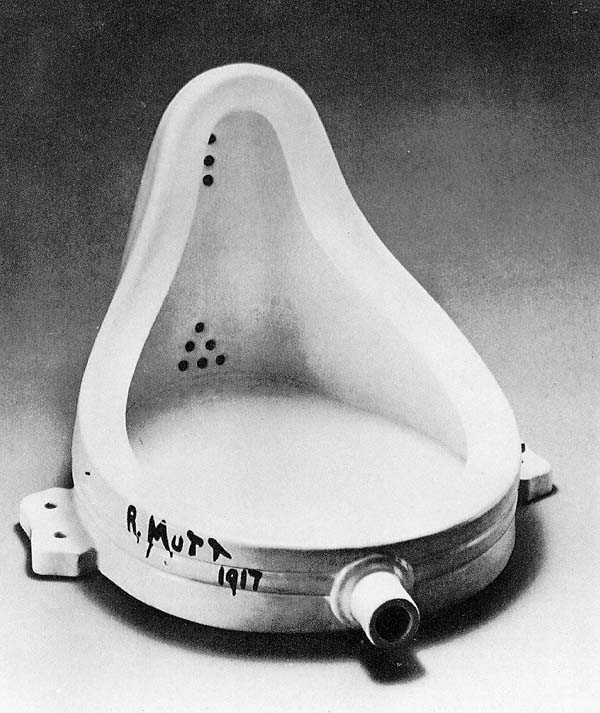
The "urinal" in the title of this post, and the "toilet" of Henninger's, is, of course, Marcel Duchamp's "Fountain," that icon of modernism. The "cultural signifier" of our age, writes Henninger, might well be the iPod.
On a related note, though it's not quite about art, here's another piece I enjoyed immensely when I first read it: "Postmodernism Disrobed" by Richard Dawkins.
It is time for both Modernism and Post-Modernism to go away. The 20th century is over. We don't need it anymore. We don't want it anymore.
What we need is an art, a culture, an aesthetic appropriate to the age in which we live--the 21st century, the Age of the Digital and the Age of September 11. Modern art isn't it.
The "urinal" in the title of this post, and the "toilet" of Henninger's, is, of course, Marcel Duchamp's "Fountain," that icon of modernism. The "cultural signifier" of our age, writes Henninger, might well be the iPod.
On a related note, though it's not quite about art, here's another piece I enjoyed immensely when I first read it: "Postmodernism Disrobed" by Richard Dawkins.
Saturday, February 19, 2005
Ian "Baby" McEwan
The Booker international shortlist is out, and the youngest of the 18 nominated authors is Ian McEwan, at a cherubic 56. Yes, the lad shows promise.
On leaving Iraq
Fareed Zakaria writes in Newsweek that the Americans shouldn't think of leaving Iraq anytime soon. He writes:
But why take Zakaria seriously, you ask, he's just an armchair-columnist. Well, ok. Let's take a head of state then. Hameed Karzai, in an interview with India Today, says:
Ditto Iraq, wouldn't you think?
(The India Today site is only accessible by print subscribers, and they require you to key in a four-digit code to enter. My advice: try out a few!)
Does anyone really believe that America's leaving Iraq will improve the situation there? It will create a power vacuum; the insurgency will get stronger; the Shia might retaliate against Sunni violence, setting off a civil war, and the Kurds could be tempted to secede. Iraq would then be exporting terror and instability. Some Americans might say, "That's fine, we'll be gone." But any withdrawal will take months, during which the violence will mount. The last American forces to leave under these conditions might not get a more ceremonious exit than they did off the embassy roof in Saigon in 1975.
[...]
Remember those often-cited studies that said having a large force to secure the peace is crucial in nation-building? Well, all of them point to another, perhaps even more important, requirement for success: don't leave. During the 1990s the places the United States and its allies left—Haiti, Somalia—were failures. The places where they stayed—Bosnia, Kosovo, East Timor—have been relative successes. Look at Afghanistan. It's faring decently today, but were foreigners to leave, it would almost certainly regress, probably into some kind of failing narco-state.
But why take Zakaria seriously, you ask, he's just an armchair-columnist. Well, ok. Let's take a head of state then. Hameed Karzai, in an interview with India Today, says:
The US presence is essential for Afghanistan's stability. The US helps us a lot to fulfil our desires. We visited the US for 5-6 years during the Taliban rule for their support. Now without the US or international presence, do you think three million refugees would come back? International presence in our country is extremely important. [...] Till Afghanistan stands on its feet and has its own economy and education capability, we will need help from the US and the rest of the world. [...] As for the outside forces, if they leave Afghanistan may go back to chaos.
Ditto Iraq, wouldn't you think?
(The India Today site is only accessible by print subscribers, and they require you to key in a four-digit code to enter. My advice: try out a few!)
Friday, February 18, 2005
What race would you like to be?
The options you are given include Afro-American, Caucasian, East Asian, West Asian, Manga and Modigliani. For more, check out the Face Transformer.
I got this link via Apul's post on Sepia Mutiny, where he gives us not one, not two, but five Aishwarya Rais to choose from. And five George W Bushes if you're, ahem, so inclined.
I got this link via Apul's post on Sepia Mutiny, where he gives us not one, not two, but five Aishwarya Rais to choose from. And five George W Bushes if you're, ahem, so inclined.
The meaning of the piece
The book I'm currently reading is a magnificent collection of essays by Jacques Barzun titled A Jacques Barzun Reader. Here's a thought from that, from an essay titled "Is Music Unspeakable?", which has some food for thought for critics of any of the art forms:
And still we try in vain!
[W]e have all heard the anecdote of the composer who played his latest piece to his guests, after which one of them asked what its meaning was. The composer sat down at the piano again and played the piece through once more.
The composer's answer was entirely right. But it holds good not just for music. The meaning is inside any work of art and it cannot be decanted into a proposition.
And still we try in vain!
Subscribe to:
Posts (Atom)