Monday, February 05, 2007

The Books Interview: Christopher Kremmer

Christopher Kremmer's Inhaling the Mahatma, published last month, is a very rich, luminous account of India in the tumultous nineties. The title refers to the immersion of some of Mahatma Gandhi's ashes in the Ganga in 1997, nearly half a century after his death. Much of the book is about the reverberations of 6 December, 1992 in India, but Kremmer's is not a narrowly political account: returning on more than one occasion to Ayodhya in the decade after the desecration of the Babri Masjid, he also searches for the heterodox, liberal Hinduism obscured by the politics of Hindutva. Reportage is not often noteworthy stylistically, but I found Kremmer's book, on a purely sentence-by-sentence level, to be a thing of "beauty and pleasure". Kremmer kindly agreed to answer some questions on his book and on the craft of nonfiction.


Your book draws upon your experiences of Indian life as a foreign correspondent based here for most of the nineties. Many of the events described in your book - the assassination of Rajiv Gandhi, the destruction of the Babri Masjid, the controversy after the implementation of the Mandal Commission's recommendations - are reported in great detail, but you also manage to take a long view of them, as it were, to look at their effects as they slowly worked themselves out over time. When did you realise that you wanted to write a book about these matters?
The result of the national election of 2004 was significant because, once again, Indian voters proved smarter than politicians and pundits. Nobody was predicting that the BJP would lose, but they did, and it marked the end of a dramatic period of change in the country. It seemed the right time to pause and reflect on a decisive decade when not just the economy, but Indian democracy became more competitive. I realised that India should be judged not by its problems alone, but by its achievements, and by the incredible challenges it has survived.

Traditionally, print journalism was thought to be "the first draft of history". But some of the traditional functions of a daily newspaper have now been usurped by television and the Internet. Do you think then that the role of newspapers is going to change gradually, and that we will turn to them less for the what than for the why?
I would like to think so, because explaining our complex world, rather than merely following television and the web in reporting it, really is the only way forward for newspapers. Books too are filling this important niche—explaining our complex world in a way that deepens readers’ understanding. The Indian media market is showing a dynamism that is very encouraging. When I first came to India there was a single broadcaster—Doordarshan—and the I&B minister was able to influence what news went to air. Here too, the '90s changed everything.

Would you like to say something about your two previous works of narrative nonfiction, The Carpet Wars and Bamboo Palace, and the circumstances in which you wrote them? Also what they may have taught you that you could bring to Inhaling The Mahatma.
Well, in the beginning I was really just experimenting with a different style. I had read the work of Tom Wolfe and others, and some really inspiring work by Indian writers—Vikram Seth’s From Heaven Lake, for example—and loved the way travel, and history, and contemporary politics could be woven into a pleasurable but educative experience for readers. So my quest to discover the fate of the missing royal family of Laos became Bamboo Palace. Then, in Afghanistan, I wanted to paint a picture of the tragic plight of so many people, but do it in a way that showed what a magical place it was. So I made a list of things I loved about Afghanistan, and things I’d experienced there that changed me - carpets(which I collected), refugees (most of my Afghan friends have fled the wars) Islam (which I believe has been a civilising force in Muslim society overall) and war (which terrified me, and forced me to come to terms with life’s less pleasant realities). That became The Carpet Wars, which did very well because I finished the manuscript just before 9/11. Inhaling the Mahatma is the third book in a kind of trilogy of Asian non-fiction books. The style of blending reportage and personal stories is consistent throughout, but the mood of each book is quite different. The India book is the deepest, the most personal, and most reflective of the three.

Which nonfiction writers do you like reading best?
Peter Robb’s Midnight in Sicily and John Berendt’s The City of Falling Angels, which is about Venice, are examples of how good non-fiction writing should be—as gripping and enjoyable as any novel. I was talking to Suketu Mehta recently and he put it very well. He said ‘The reader is entitled to pleasure, to derive pleasure from each individual sentence in a book”. I couldn’t agree more. My aim is to hook the reader from the first page, and then hang onto them for a solid 400 pages, telling stories that make them laugh and make them cry, but importantly, telling true stories and giving them the context and background to understand a person or place in greater depth. So, you know, if I’m talking to Amar Singh, and he is sitting on a sofa in a five-star hotel massaging his feet, I’m going to include that detail. Or, in Inhaling..., in the scene where Rahul Gandhi washes his hands in disinfectant after shaking hands with people at a rally, that’s definitely going in, because you see the real person in such episodes, not just the political hype.

Many of your descriptions of locale and landscape in Inhaling the Mahatma are so rich and beautiful they seem almost out of a novelist's cupboard. Does the nonfiction writer have anything to learn from the reading of fiction?
I started my writing career in short stories, which won prizes, and that encouraged me to keep writing. But I couldn’t make a living from short stories, so I turned to journalism, not just to survive, but to gain the sorts of life experiences that I felt would help me mature and have something interesting to say. Whether we write fiction or non-fiction, we’re all writers with stories to tell, and we can learn from each other. Non-fiction writers are definitely leading the way at the moment, but the novel is not dead. I hope not anyway, because I would certainly like to write one.

I've always been curious about how the best nonfiction writers convey not just what they saw and heard - things which can be attributed to careful on-site note-taking - but also the moment-by-moment sense of an experience - which, it seems to me, one can miss if one is too fixed on taking notes. Can you cast any light on this?
I use notes, memory, tape recordings, and articles that I and others have written to piece together these books. But the most valuable thing I find is, where possible, to revisit people and places I am writing about. Inhaling the Mahatma would have been nothing more than a memoir, but the yatra I undertake [Kremmer returned to India in 2004 to revisit some of the sites he'd described] turns the book into a living, breathing experience. When I started that journey in the summer of 2004 I had no idea where it would take me, physically, intellectually or spiritually. I wanted to open myself to the possibility of being changed by the experience, and the book has changed my life in so many ways that are positive. It became an excuse to break down the walls that separate people on the basis of nationality, language and religion. It became a very moving and beneficial journey through hard times to hope.

You sometimes conduct workshops on nonfiction writing. Could you distill what you say in them for readers of this site?
Well, the first thing I tell people is that it’s not rocket science. I get them to read examples of fine narrative non-fiction and then we deconstruct it, and see how it is put together. It’s a very post-modern form, and the writer needs to be open to the multi-faceted nature of truth. A building might look beautiful from outside, but at the back it could be a garbage heap. Look at people and things from different angles. Another thing is that you have to be prepared to reveal who you are. These are not objective books, in the traditional sense, so we need to know who is this person who is taking us through northern Afghanistan, or northern India. What’s their background? Why should be trust them? Because the books sometimes don’t have a strictly defined plot, the voice of the narrator is very important in holding it all together and making the reader turn the page. And characters. Don’t forget the absolute necessity for bringing people alive on the page. There has never been a good book that lacked humanity.

Were you at all interested in, and do you have any strong opinions about, the work of the legendary Polish journalist Ryszard Kapuscinski, who died recently?
I haven’t read his work, but people speak highly of him. We both met and wrote about the late Afghan mujahideen leader Ahmed Shah Massoud in the last years of his life.

Every reader has some favourite passage from literature, something that seems to him or her inexpressibly sharp or subtle? Is there such a passage like you'd like to cite, explaining what you like about it?
As a youth I was besotten with the Russian classics. The black humour of Gogol, the intensity of Dostoyevsky, the romance and historical drama of a book like Doctor Zhivago, and the gritty realism of Gorky. I could go on and on about those Russians. I remember reading War and Peace, which is a very fat book, 1500 pages from memory. And in the midst of this great epic, Tolstoy takes the trouble to describe in great detail a boy climbing down from a fence. And it’s just such a close piece of observation, you can almost feel the boy’s toes searching for a grip on the wall, that I was blown away by that. It taught me that seemingly minor details can be very important in drawing a reader into the world the author wants them to experience.

You've got closer to Mahatma Gandhi than most Indians now alive, by inhaling his ashes. Let's say you were hosting a dinner, and you could invite to it five personages from the entire sweep of history. Who do you think you'd like to encounter in the flesh?
What a great dinner that would be! Gandhiji would be at the head of the table. He was a great talker and doer, and had a wonderful way with words and a sense of humour. Above all, he was wise. Wisdom is divine. Next to him I’d put Jesus Christ. No questions for him. I’d just listen and watch his body language. Also it would be very nice to know what he actually looked like. Beside him I’d put Hitler, because it would be good to see how they got on. Would sparks fly? Then, of course, a writer. Maybe someone no-nonsense like Ernest Hemingway, or an intellectual like George Orwell to keep the conversation interesting. Then, there would have to be an Australian, of course, so maybe Steve Waugh, who was the most Zen sportsman I ever saw play.

Do you have any ideas for what your next book is going to be?
I always have about ten books rattling around in my brain. What gets done is really a matter of priority and ranking. I talk a lot to my agents and publishers about my next move. So yes, I have been doing preliminary research and having discussions about it, and have pretty much settled on a subject. But there’s a superstition among writers that if you talk too much about what you are doing next, it will never happen, so I can’t go into the detail. Let’s just say that I’m a person who needs to keep changing in order not to get bored, so the next book could be something totally unexpected and different.

These interviews always end with a question about the good life outside of books. I notice, both from your sentences as well as from passages in Inhaling The Mahatma like the one about Neemrana, that you like things of "beauty and pleasure". You have a choice: either to describe your favourite meal, or to talk about the most beautiful living space you've seen in all your years of travel.
I have two homes—one in India and one in Australia. The Indian home is in pulsating, crowded Delhi, but the Australian home is in a quiet village of 400 people, situated in the Southern Highlands between Sydney and Canberra. We get bushfires in summer, and winters are cold enough for the occasional snowfall. The air is scented by pine trees. The village dates back to the early days of the convict colony of New South Wales, and still has many buildings from the Georgian period. It’s ten kilometres to the nearest town, and the drive you takes across rolling green hills through farmland and sheep and cattle stations. There are kangaroos and wombats and platypuses and black cockatoos and all kinds of other wildlife around, and many beautiful valleys, rivers and hills to explore. This is where I go to escape the world, to think and write, and I love it very much. All that and a broadband internet connection! In India, lots of people are moving to the cities, but in Australia it’s the other way around. My dream is that by the end of the 21st century cities will be fewer and smaller, and most people will live with the best of both worlds - the web-wired semi-rural community.

Previous books interviews: with Altaf Tyrewala and Samrat Upadhyay.

Saturday, February 03, 2007

An Announcemint

Starting today, I shall be reviewing a new book every Saturday on the books page of Mint, the new business newspaper started by the Hindustan Times group in partnership with the Wall Street Journal.

As on the Middle Stage, I'm going to write about books with an Indian focus and also work by writers from around the world. I expect that weekly reviewing will impact my blogging slightly - how much work can a man with runs to run, friends to meet, drinks to drink and thoughts to think do after all? - but there should still be a fair share of blog-only pieces on this site.

My first piece is on Christopher Kremmer's superb account of India in the nineties, Inhaling The Mahatma. To read it you'll have to go through a one-time registration, which is free. You can register here.

And Kremmer himself should be on the Middle Stage next week for a books interview.

Thursday, January 25, 2007

Tigers in the poetry of Salabega and William Blake

The sights and sounds of the world are noted by us not just in their particularity, but because of the mind's capacity for imaginative association, they are full of the echoes of other things, and of our own memories. And it is poetry, above all other arts, in which we can see best this free play of the imagination - it is poetry which invites us, in the words of the eighteenth-century English poet and painter William Blake, "To see the world in a grain of sand,/And a heaven in a wild flower-/Hold infinity in the palm of your hand,/And eternity in an hour." In two poems - one by the seventeenth-century Oriya devotional poet Salabega, and the other a well-known work by Blake himself - we find the feral beauty and prowling menace of the tiger leading to two very different images of god.

Salabega was born to a Muslim father - Lalbeg, a trusted lieutenant of the Mughal emperor Jahangir - and a Hindu widow whom Lalbeg had abducted on one of his expeditions. The legend of Salabega says that he was raised as a Muslim, but after a dream seen in his youth he became a devotee of Krishna and his distinctively Oriya incarnation, Lord Jagannath. He spent the rest of his life in Puri, the site of the famous Jagannath temple (into which he was not allowed because he was a "lowborn"), composing beautiful lyrics in praise of Jagannath, the "dark and round-eyed lord", and the love of Radha and Krishna.

The novelty of Salabega's love poems is the way he takes on the voice of either Radha or Krishna: in his poems these figures from Hindu legend are not transcendent gods, their concerns far above the realm of mortals, but are instead wholly, vulnerably human, maddened by desire. It is possible to read in them the thrills and tensions of any adulterous love affair.

In one poem Radha speaks of how she is "a sane and chaste and married woman" who has fallen victim to the "blue mischiefs" of Krishna's flute, the flute that "won the green garden of my body". In another, she notes on his skin the marks of "bewildered bangles" and fires a volley of questions at him: "With whom did you sleep? Who shared your warmth?" "This fuming instant eats me away," she sulks in another poem. "He lifts me to the skies, and now drops me to the earth,/All men are alike, wearing a honey-bee's mirth." At such moments Salabega appears very much a modern, as close to us as Sylvia Plath.

"In the Wood's Desolation, the Tiger is Wild" is one of a minority of Salabega's poems in which the speaker is an external observer and not an actor. In it the tiger's bloodthirsty leap metamorphoses into Krishna's ferocious and passionate pursuit of the gopis. The translation and title are by Niranjan Mohanty; Salabega did not title his poems.

In the Wood's Desolation, the Tiger is Wild

In the wood's desolation, the tiger is wild.
Hungrier it goes without prey.
Whoevergoes to the Yamuna for water,

waiting and watching, He carries her away.
Into the womb of the wood, fast he flees.
Child-like, the tiger, yet it is wild.

It spreads fast the snares of its vigil
to all the serpentine bylanes
leading to the lyric bend of the river.

Into the waters deep He dives
at the sight of bathing gopis.
And softly he tears out the sheath

of their ululant hearts with His nails
obstinate, gleaming and sharp.
His wide gape wears moon-like glitter.

His lips are pretty and aquiver.
His body dark and the broad forehead
speckled and sprinkled with sandalwood;

and his eyes so rare, huge and globe-like.
No one knows whence came this tiger, Kanhai.
Thus sings Salabega, the lowborn.
Salabega's poem is full of assertions, bright details; he confidently identifies the tiger with a god he loves, and even his one negative formulation is an affectionate one: "No one knows whence came this tiger, Kanhai".

William Blake's poem "The Tyger" appears in his collection Songs of Experience (1793). The son of a haberdasher, Blake's training was as a painter and engraver. He was a man out of kilter with his times, self-publishing his poetry in handmade volumes with beautiful illustrations, but enjoying only the smallest readership. As he grew older his work grew more complex and esoteric, and some of his contemporaries thought him a lunatic; now he is thought of as the quintessential "Poet of London". He is best approached through his two early collections, now usually taken as a group, The Songs of Innocence and Experience, in which direct language, simple metres and striking symbolism produce a poetry of great lyrical force.

Blake's tiger, we find, is a more ambivalent creature than Salabega's - forbidding, inscrutable, a figure of fearful perfection. Even the archaic spelling of "tyger" with a "y" seems calculated to emphasise its menace. "No one knows whence came this tiger", a passing remark in Salabega's poem, is in fact the predominant sentiment of Blake's poem - every stanza but one ends with a question. The creator he imagines is not personified, easily accessible, as with Salabega's Krishna, but nebulous and awe-inspiring. Note how Blake repeatedly uses the word "what" and not "who" to refer to the tyger's maker, and the verb "dare" to refer to its making:

The Tyger

Tyger! Tyger! burning bright
In the forests of the night,
What immortal hand or eye
Could frame thy fearful symmetry?

In what distant deeps or skies
Burnt the fire of thine eyes?
On what wings dare he aspire?
What the hand dare sieze the fire?

And what shoulder, & what art.
Could twist the sinews of thy heart?
And when thy heart began to beat,
What dread hand? & what dread feet?

What the hammer? what the chain?
In what furnace was thy brain?
What the anvil? what dread grasp
Dare its deadly terrors clasp?

When the stars threw down their spears,
And watered heaven with their tears,
Did he smile his work to see?
Did he who made the Lamb make thee?

Tyger! Tyger! burning bright
In the forests of the night,
What immortal hand or eye
Dare frame thy fearful symmetry?
The line "Did he who made the Lamb make thee?" is a reference to Blake's poem "The Lamb", a contrasting poem in which the gentle lamb is identified with Christ.

Niranjan Mohanty's translations of Salabega's poems can be found in a collection called White Whispers, published by the Sahitya Akademi. A couple of translations of Salabega by Subas Pani can be found here.

And in this marvellous interview, the American poet Stanley Kunitz speaks at length about the life, work and times of Blake, and provides readings of several of the best-known poems of Songs of Innocence and Experience ("It is believed he had only thirty orders for Songs of Innocence, of which there are only twenty-six in existence today. But each was individually produced, and so no two copies could be identical."). And the translator Burton Raffel has some illuminating thoughts on the poem("Is it the tiger's eyes that burn? or his presence, his fierceness, his passionate hunting? Blake is of course speaking of all of these, and more, but of none directly") in an essay on translating "The Tyger" into French.

To celebrate the 250th anniversary of Blake's birth, The British Library is currently hosting an exhibition called William Blake: Under The Influence, featuring items loaned or donated by writers and artists inspired by Blake's work. Among the items on display (and available online here) is Blake's notebook, in which are visible 30 years' worth of notes and sketches. Take a look.

And here are two favourite Blake poems: the doom-laden "London", ("I wander through each chartered street,/Near where the chartered Thames does flow,/And mark in every face I meet,/Marks of weakness, marks of woe.") and the equally dark "The Human Abstract" ("Pity would be no more/If we did not make somebody poor,/And Mercy no more could be/If all were as happy as we.").

And an old post: "Some thoughts on artistic time and real time".

Update, March 3: And the British poet Tom Paulin discusses "The Tyger" and other Blake poems an essay called "The Invisible Worm".

Wednesday, January 24, 2007

Thursday, January 18, 2007

Away this week

I'm travelling this week through Delhi and then on to the Jaipur Literary Festival, so there won't be a post this week. I'll be back next week.

Tuesday, January 09, 2007

Irrelevant detail in the fiction of Raj Kamal Jha

The good-ness or bad-ness of a work of fiction lies, among other things, in the choice of details that the writer chooses to present to us. And the test of those details is their relevance, the way in which each thing noted seems to become an essential part of a larger picture.

When a reader picks up a novel, he or she signs an implicit contract with the writer. Irrelevant detail in fiction is a breach of that contract: when description seems gratuitous or self-indulgent, we have a right to complain about why our time is being wasted. I thought of these things while reading - in some parts suffering - Raj Kamal Jha's new novel Fireproof, a book which somehow manages to be both tedious and profound.

Fireproof is a novel about the tragedy and the horror of Gujarat, 2002. A reasonable question to ask is what a novel can tell us about this cataclysm that all the newspaper reports, journal articles, and books on the subject have not. To this Jha's good answer is: nonfiction and reportage cannot present the voices of the dead, only fiction can. Of the many narrators in Fireproof, most speak to us from the afterlife, where they have "discovered gifts we never knew we had". Many of these voices speak for no more than the length of a page: they are admirably concise and powerful. The plot itself turns on the interventions made by the departed in the world of the living.

One of these interventions involves the protagonist, Mr.Jay, who, even as people are being massacred by the dozen, waits in the hospital for the birth of his first child - in this way Jha juxtaposes the "newborn" and the "newdead". The baby turns out to be grotesquely deformed; Jay is appalled, but is forced to take it home, and slowly he begins to feel for it what every parent feels for a child. Much of the novel is told from Jay's perspective. Like the narrator of Jha's first novel, The Blue Bedspread (whom we also find in the company of a newborn child), Jay has some guilty secrets which the action of the novel slowly reveals.

Jha's prose has many faults. In fact, if one were to go by Fireproof alone, he would appear a much worse writer than he actually is. He has a liking for lushness that is often not far off from cliché: "Outside, the sky was beginning to stain the colour of ink, the purple blue that forms when night begins to grow old, a colour that softens the edges of this hard city, washes the washed-out yellows and the whites and the greys of the houses" (my italics). Or, "He sees her mouth move, as if she were gulping the night down, chewing it, drinking it, as if she had been emptied and needs the darkness to fill her up once again."

Jha loves what his narrator in one place calls "adjectival neons". Some of his descriptions sound like he is preparing a chart of the universe for the colourblind, and his two favourite words are "soft" and "smooth": "This time I began peeling her skin off, pink skin, soft skin, smooth skin." Or, "I feel her hair against my hands, between my fingers, I can feel its soft, smooth rustle". This kind of detail sometimes borders on the pointless, and sometimes it clearly crosses that border: "There are always flies on the bananas. Buzzing, flying in circles, triangles, straight lines, ellipses." Jha's tendency to state, even belabour, the obvious, brought to my mind JK Stephen's very funny sonnet about Wordsworth, in which he chides the poet for that aspect of his work "Which bleats articulate monotony,/And indicates that two and one are three,/That grass is green, lakes damp, and mountains steep".

At the opposite end of the spectrum, Jha also likes the urgent sound, the sense of great significance, intimated by laconic one-sentence paragraphs. This is a perfectly legitimate way of working, but Jha employs this device without discretion. His work has many bits which go like this:
The telephone rang.
Once.
Twice.

Or,

Ithim was with me now, his father.
Father and son.
He also likes - I think we can call this the Arundhati Roy effect in Indian fiction - another hokey move, which is to capitalize words and phrases in mid-sentence.

The Blue Bedspread had some of these faults, but at least it was an admirably spare book. Some of its sections are no more than a paragraph long, and by virtue of this discipline they move the story forward very swiftly. In Fireproof, by contrast, there are many parts where we are presented with a paragraph when only a sentence would do, and a page when a paragraph would serve just as well. Great swathes of Jay's narration are bogged down by the most excruciating point-by-point, sensation-by-sensation, moment-by-moment detail. An egregious instance appears at the close of one chapter, when at the end of a long day Jay receives a puzzling phone call from a woman he only seen once in mysterious circumstances.


But before I could think through what she had said and what I had heard, before I could try to look beyond those walls around her, I knew I was fighting another battle, this one more immediate: a battle with sleep that came like water rising, rushing upwards, in a wave. Beginning with my feet, rippling in and out between my toes, rising to my ankles, then to my chest, lapping against my shoulders, climbing over my jacket, gurgling as I breathed through my nose, reaching my eyes, filling them both.
I slept.
Do we need to be told all this in such depth? And even if we did, is this account even true to the experience of sleep that comes " came like water rising, rushing upwards, in a wave"? Does that kind of sleep not overwhelm conscious thought in an instant, and preclude exactly the kind of slow, hyperconcious tracking which the narrator presents us? Which reader can imagine what it is like to feel sleep "rippling in and out between my toes"? This account of sleep taking over the human body section by section reminded me of the unintentional comedy of a similar passage in Kiran Nagarkar's God's Little Soldier, in which we are told of how a cold wind blows around the protagonist Zia: "It tore at him, slipped inside his trouser legs, groped at his crotch, ferreted in his armpits and careened into his lungs." Such sentences are pure verbiage.

Indeed, the body is Jha's great subject: in general, he never passes up the chance to go over it in slow motion whenever he can. Here the narrator is watching over his mother, who has just suffered a scorpion bite:


Even the slighest wavering and Mother might die. For if I am not careful, the poison will spread from her wrist, run into her veins and her arteries, travel along her arms, her shoulders, her neck, then down again, to her heart and her stomach to her legs to her face to her head her fingers and her toes - the pus and the black blue yellow green.
Leaving the city with Ithim on the instructions of the mysterious woman, Jay is received at the station by a midget in outlandish attire. Jha begins to describe his shirt:


And what a shirt it was. A profusion of not only fabric, a fabric that shone like silk and velvet, but also of wild colour and twisted asymmetry: blue and red and green and yellow and white and black, stripes, checks, triangles, circles, swirls, ellipses, straight lines, curls.
Once again the narration trips teeters into excess, giving us such a welter of details that it actually becomes impossible to imagine the thing being described, which is not such an important thing in the first place. These are utterly pointless moves, serving only to drain the reader's interest and leave him or her indifferent to details of actual consequence.

Fireproof has an interesting storyline, and it builds up to a conclusion of genuine grace and moral force, in which we witness the workings of a justice that avoids the senseless path of "fire and hate". But it is also an unbearably prolix book, and this dulls its power. Jay may hold many secrets, but Jha's unpleasantly overwritten sentences mostly do not. They seem rather like a literary instance of disguised unemployment: present, countable, but doing no useful work.

Monday, December 25, 2006

Books of the Year 2006

Merry Christmas to all the readers of the Middle Stage, and before the year goes any further and more books arrive to confound my decisions, here are my choices for the best books of 2006, divided and subdivided into all kinds of categories.

Fiction

The best, and funniest, novel I read this year was the nineteenth-century Oriya writer Fakir Mohan Senapati's Six Acres and a Third (Penguin in India, University of California Press in the US). Translated into English for the first time, this story of life in a village under colonial rule presents a wealth of satiric detail filtered through the voice of a hilariously witty and nimble narrator, who like a village gossip often uses the plural "we" rather than the conventional "I". "People should be gagged and stopped from spreading rumours," declares the narrator, even as he gleefully broadcasts every rumour that reaches his ears. This is one of the foundational Indian novels.

Samrat Upadhyay's second collection of stories The Royal Ghosts (Mariner Books in the US, and Rupa Books in India) was a model of elegant and understated storytelling. Upadhyay's characters are shown living and loving in a Nepal in which tradition and modernity jostle uneasily, and political unrest casts a shadow over daily life. Stories like the title story and "Chintamani's Women" seemed to me to achieve a kind of perfection of craft.

The Algerian novelist Malika Mokeddem's Century of Locusts (University of Nebraska Press) tells the story of a wandering poet Mahmoud, himself accused of a crime, and his journey through the desert in search of his wife's murderer. Mokkedem's superbly incantatory prose ("A dream is the most vital of lies"; "Solitude becomes unbearable when filled with another's indifference" ) is saturated with striking imagery and a close attention to the rhythms of the natural world.

Vikram Chandra's Sacred Games (Penguin in India, Faber & Faber in the UK) conjured up in encyclopedic detail the sights, sounds and language of Bombay and the moral world of its denizens as seen through the eyes of the gangster Ganesh Gaitonde and the police inspector Sartaj Singh. I don't think I've read a better scene this year than the one in which Gaitonde, still a small-time crook, sells some stolen gold bars to a dealer for an enormous sum. Now Gaitonde does not know if he is being tailed or not: he has crossed the border into a new world. He does not know what to do now and takes refuge among devotees in a temple. The novel is perhaps two hundred pages too long, and the digressions called 'Insets' are tedious, but for most part Sacred Games has the kick of a good masala Coke.

Gaza Blues (Picador Australia), an unusual collaboration between the Israeli writer Etgar Keret and the Palestinian emigré writer Samir El-Youssef, brought together Keret's distinctively zany, minimalist stories with el-Youssef's beautiful long story, told in a more traditional style, "The Day The Beast Got Thirsty". Residents of a world in which politics is all-pervasive, both Keret and el-Youssef both want to clear a space, through the example of their work, where human beings can recognize each other from either side of the impasse through the commonality of their everyday concerns and desires. El-Youssef's debut novel The Illusion of Return is forthcoming in January.

The idea that literature "should allow us to see the individual rather than the general; to participate in some intimate way in other lives rather than melding them into shapeless abstractions" was also the shaping force behind Literature From The "Axis of Evil" (New Press), a compilation of stories, excerpts from novels, and poems from writers from so-called "rogue states" - Iraq, Sudan, Libya, North Korea and others - and featuring some first-rate works that readers around the world would otherwise never have got to see.

And the Japanese novelist Kobo Abe's profoundly unsettling The Face of Another (Penguin Modern Classics) tells the story of a scientist whose face is badly disfigured in a laboratory accident. With his face swathed permanently in bandages, he feels he is not a human being any more. A plastic surgeon explains to him that the face "is a roadway between oneself and others"; people cannot reach out to a man "without the passport of the face". The protagonist retreats to a quiet hideout and attempts to fashion himself a new face with the help of advanced technology. In Abe's hands the predicament of having no face and then a new face becomes the material of a drama more compelling than any detective novel or thriller. First published in 1964, this is a very worthy resissue.

Non-fiction

"I will enjoy my beauty because it is given for a short time and joy is a short-lived thing." So said Amrita Sher-Gil, the great Indian painter whose life was tragically snuffed out in 1941 before she was even thirty. Yashodhara Dalmia's Amrita Sher-Gil: A Life (Penguin/Viking) was a splendid study of Sher-Gil's life and work, quoting at length from Sher-Gil's very rich notes and letters and lavishly illustrated with photographs and reproductions of paintings.

Talking India (Oxford University Press) was an enthralling book-length dialogue on Indian history, culture and politics between Ashis Nandy, one of India's finest intellectuals, and the Iranian scholar Ramin Jahanbegloo. If you want a perspective on how religious riots in India are also manifestations of "secular violence", on how the modern ideology of the nation-state obscures other deep-rooted continuities and traditions, or how globalisation "has created an enormous explosion of expectations, ambitions and greed", this is the book to go to. As enjoyable and stimulating as Amartya Sen's 2005 release The Argumentative Indian.

Another book which might just as well be called Talking India is In Spite of the Gods: The Strange Rise of Modern India (Little, Brown), by Edward Luce, the South Asia Bureau Chief for the Financial Times between 2001 and 2005. Only the title of this book is poor - I don't even see the need for that word 'strange'. From that point on, the book is a magisterial survey of modern India. Marrying lucid exposition to highly nuanced and trenchant arguments, Luce covers the character and idiosyncracies of the Indian state and the Indian economy, the place of caste in India, Hindu nationalism, and Indian Islam in a series of succulent forty-page chapters each as good as the other. This must rank among the very best books written by a visitor to India.

"For Flaubert, life began in Normandy and ended there….It was the landscape of his youth and all his seasons. It was the taste in his mouth and the verdant prison where he dreamed of deserts". From the very first sentences of Frederick Brown's sumptuous Flaubert: A Biography (Little, Brown) we know that we are reading a literary biography that itself aspires to be a work of literature.

A very different model of literary biography is to be found in Written Lives (Canongate), a collection of short and often whimsical essays by the Spanish novelist Javier Marias on Conrad and Kipling, Joyce and Faulkner, Turgenev and Nabokov. "The one thing that leaps out when you read about these authors," writes Marias, "is that they were all fairly disastrous individuals", and he has a fine time cataloguing these disasters. Of special note is "Perfect Artists", a lovely essay at the back of the book analysing the photographs of writers.

And another kind of literary conversation can be found in the writer Alberto Manguel's short and very beautiful memoir, With Borges (Telegram). The book recounts in loving detail Manguel's long association with the great Argentine writer, which began when he was chosen as a schoolboy by Borges to read to him in the evenings. Manguel writes that Borges's massive personal library was "like every other reader…also his autobiography" and that Borges believed "against all odds, that our moral duty was to be happy, and be believed that happiness could be found in books, even though he was unable to explain why this is so". Pure pleasure.

Climbing The Mango Trees (Alfred A. Knopf), the Indian actress and food writer Madhur Jaffrey's memoir of her idyllic childhood in the fold of a large joint family in Delhi and Kanpur, is a much better book than its hackneyed title suggests (There must be a ban from 2007 onwards on the words 'guava', 'mango' and 'cinnamon' in the title of any Indian writer's work.). Full of savoury reminiscences, Jaffrey's book is also an ode to a way of family life now on the wane in the age of the nuclear family, and to the syncretic culture of north India, with Muslim and British influences overlaid upon traditional Hindu life.

And two good nonfiction reissues were Sasthi Brata's anguished autobiography from the sixties My God Died Young (Penguin) and Pankaj Mishra's travel classic from the nineties Butter Chicken in Ludhiana (Picador).

But since good books are - like diamonds - forever, and in a manner of speaking all new books owe their existence to the schooling and influence of older books, no personal list of books of the year should be confined only to books published in that calendar year: they should also include older books read that year and surprising discoveries made that year. Of the many books about whose existence I learnt in secondhand bookshops this year, two stood out.

Renoir, My Father, which I found in a used-books store in Cambridge in June, is a luxuriant portrait of the Impressionist painter Pierre Auguste Renoir by his son, the filmmaker Jean Renoir. It is rich with the thoughts of both the illustrious painter ("I like painting best when it looks eternal without boasting about it: an everyday eternity, revealed on the street corner: a servant-girl pausing a moment as she scours a saucepan and becoming a Juno on Olympus") and his illustrious son ("A work of art is the candid, and often unconscious, expression of the personality of the artist who created it"). The book is available now in a new edition as a New York Review of Books classic.

And Faith and Frivolity, a collection of essays by the now-forgotten Indian writer Krishna Kripalani which I found in Bombay's excellent New & Secondhand Bookshop in Dhobi Talao, revealed a most agile and perceptive mind expressing itself in a sparkling epigrammatic style.

Readers are invited to name their own books of the year - but no more than three or four, please (books, that is, not readers). A happy New Year to you all, and may you have a 2007 free of Dan Brown and Paulo Coelho...

Monday, December 18, 2006

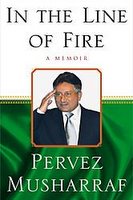
On the memoirs of President Pervez Musharraf of Pakistan

"At the precise instant of India's arrival at independence, I tumbled forth into the world," says Saleem Sinai in the first chapter of Salman Rushdie's Midnight's Children, as he reveals that "thanks to the occult tyrannies of those blandly saluting clocks I had been mysteriously handcuffed to history, my destinies indissolubly chained to those of my country." In the prologue to his memoir In The Line of Fire, Pakistan's president General Pervez Musharraf, born four years before the creation of the state of Pakistan, sounds very much like a Pakistani Saleem: "The story of my life coincides almost from the beginning with the story of my country - so the chapters that follow are not only the biography of a man, but of Pakistan as well".

Saleem Sinai's claim is supposed to be interpreted by the reader as comic: Rushdie wants us to marvel at this fantastical linking of the destinies of man and nation, and Saleem himself always bemoans "that benighted moment" that robbed him, as it were, of his own independence as a sovereign individual. But the good General's claim is made in all seriousness. Providence has singled him out - the son of middle-class immigrants, reconciled at one stage to seeing out his career as a high-ranking military officer - for some reason for a special place in history, and, handcuffed to history, it is his duty now to carry out his role, responsibly if reluctantly, of commander of the ship of the Pakistani state.

"My autobiography," he says solemnly, "is my contribution to the history of our era." A simple, plainspeaking, moral man ("truthfulness is a sine qua non of good character" he tells us in a passage on moral development), he will along the way also tell us the real truth, obscured until now, about many things - the tussle in which he overthrew Pakistan's erstwhile prime minister Nawaz Sharif, the Kargil episode, Pakistan's role in the War on Terror and the hunt for Osama Bin Laden. "I want the world to learn the truth." "It is time to lay bare what has been shrouded in mystery." This I-know-it-better-than-anybody-else air is the characteristic tenor of In The Line of Fire.

If In The Line of Fire reveals anything of interest about the president, it is the centrality of the army and the martial way of life to his worldview. "I was only eighteen when I entered the Pakistan Military Academy in 1961," he recounts in an chapter about his youth, one of the few which is low on rhetoric. Indeed, it is somehow symbolic that he has spent all his adult life as a soldier. In his book the word "army" is always associated with positive values: valour and heroism, commitment and sacrifice, integrity and intelligence. The army is a world within the world - a bastion of discipline and order to counterbalance the confused, disorganised sprawl of civilian life and of electoral politics.

When it comes to his beloved army, Musharraf is especially sensitive to insult and especially susceptible to grand posturing. What stung him most in the aftermath of what he sees as Sharif's ill-advised withdrawal from Kargil in 1999 is the sullying of the army's image by the country's own government: "I am ashamed to say, our political leadership insinuated that the achievements of our troops amounted to a 'debacle'. Some people even called the Pakistan Army a 'rogue army'."

The truth, he would have us know, is quite the opposite. "Considered purely in military terms, the Kargil operations were a landmark in the history of the Pakistan Army." Against all evidence he doggedly maintains that "whatever movement has taken place so far in the direction of finding a solution to Kashmir is due considerably to the Kargil conflict". This is a curious stand coming from a man who has, since coming to power, purported to taking the lead in resolving the Kashmir problem through dialogue.

For someone who considers himself "a soldier's man", the General also reveals himself to be an expert juggler with words. Although he agrees that he deposed Nawaz Sharif after the famous hijacking drama of October 12, 1999, he does not agree that it was a coup d'etat - instead it was "a countercoup". In the General's opinion it was Sharif who actually launched "a coup against the army and myself" by dismissing him as chief of the army while he was away in Sri Lanka and appointing another general in his place, and what the General did in reply was the countercoup - "for there can be no other word for it".

By refashioning the meaning of the word "coup", which my Shorter OED defines as "a violent and illegal change of government", the General carves out a kind of moral legitimacy for himself, even as he unintentionally demonstrates how in Pakistan, a country which has seen four military rulers in its short history, the army's self-image and functions often overlap with those of the state. To depose the chief of the army in such a country can also be a "coup".

The General drips with contempt for his two predecessors as the head of Pakistan's government, Benazir Bhutto and Nawaz Sharif - particularly Sharif. For him the decade between 1988 and 1999, when Benazir and Sharif each spent two terms in power after winning elections, was a period of "sham democracy". Nor does he think very highly of Indian democracy, using quote marks always to show what he thinks of "the largest democracy in the world".

But democracy, through elections, confers legitimacy upon leaders, and every leader craves legitimacy. Musharraf had his own tryst with the electorate in the infamous yes-or-no referendum on his rule in 2002, in which he emerged with a staggering 97% yes vote. In a piece on this exercise called "The April Fool Referendum", the Pakistani human rights lawyer Asma Jahangir testified that "the rigging was so brazen that it will embarrass any foreign government to accept the exercise and its result as a democratic process". But while Musharraf himself admits that the exercise "ended in a near catastrophe", here is his wily attempt at explaining it:

The referendum went smoothly. There was a very high turnout, and the overall count was strongly in my favour. There were some irregularities, though. I found that in some places overenthusiastic administrative officials and bureaucrats had allowed people to vote more than once, and had even filled out ballot papers themselves. I also later found out that this absolutely unwarranted "support" was helped along by the opposition in certain areas where they have a hold and where they stuffed ballot boxes in my favor as to provide supposed evidence for claims of foul play. The whole exercise ended in a near catastrophe.[…] Finally, in a national broadcast, I had to come clean. I thanked the people for their support but also admitted that some excesses had indeed taken place without my knowledge or consent. (my italics)
In this passage Musharraf appears more sinned against than sinning, with both his supporters and opponents remarkably conspiring towards the same ends (to rephrase the old saying: with enemies like these, who needs friends?). Meanwhile, the General was oblivious to these happenings, but the chorus of "I founds" are meant to attest that, insofar as he had any agency in the whole case, it was in bringing the wrongdoings to light.

To be fair to the General, life has not been easy since he came to power. He took over a country on the brink of economic collapse. Later, the American government's demands after 9/11 and the resentment of Pakistan's religious hardliners put him between a rock and a hard place. His crackdown on terrorism led to two attempts being made upon his life; Time magazine declared that he held "the world's most dangerous job". Musharraf's account of how he negotiated his way through these troubles shows a commendable understanding of realpolitik. One of his good qualities appears to be that, at least in domestic matters, he has no patience with fundamentalism and religious obscurantism. On the demonization of Islam around the world as a religion of intolerance, he sensibly observes:

It is all very well for us to say that Islam is nothing of the sort, that it is in fact a very progressive, moderate and tolerant religion - which indeed it is - but why should the people of the world bother to go out of their way and spend their precious time to explore the authentic sources of Islam? They are going to judge Islam by the utterances and actions of Muslims, especially those actions and utterances that affect their lives directly, and not just by the protestations of academics and moderates, no matter how justified.
Six years in power have taught the General to weight and to aim his words carefully - his book, which made it to the Amazon.com bestseller list, can itself be seen as a work tailored carefully for a Western audience interested in Asian affairs but not expert in the finer details. His book tour in the US in 2006, which featured amongst other events a hit appearance on Jon Stewart's "The Daily Show", was in stark contrast to his official visit to the US in 2005. That turned out to be a PR disaster after he spoke recklessly on the Mukhtar Mai rape case, suggesting that rape in his country was used as a tool by women to gain riches and to emigrate.

Now, in his book, his thoughts on the case are shoehorned into a chapter full of pieties called "The Emancipation of Women" written, as Tunku Varadarajan says in his piece on the book, "with all the passion of a government circular". It is a chapter that shows he has learnt that, whether or not he actually walks the walk, a statesman should always talk the talk. He drones:

Rape, no matter where it happens in the world, is a tragedy and deeply traumatic for the victim. My heart, therefore, goes out to Mukhtaran Mai and any woman to whom such a fate befalls.
"My heart, therefore" - how insincere is that? And what is the point of that phrase "no matter where it happens in the world" - how should that be relevant in any way? We understand when, a little later, the General reveals that no rape case should be allowed to besmirch the good name of the nation:
Rape and violence against women are universal phenomena, but this does not justify their presence in Pakistan. We need to set our house in order. I only object when Pakistan is singled out and demonized.
When a case of female victimization in Pakistan comes to light, sometimes the first victim is the truth.
In The Line of Fire itself often takes liberties with the truth, but in doing so it is so revelatory of the General's personality that it makes for a far more interesting book than a safer, more cautious account. Autobiography often stands at an angle to historical truth, but in doing so it lets us in on other valuable truths. This is not a book we need to read to understand contemporary Pakistan, as the General would have us believe, but it is certainly something to read if we want to understand the General.

A series of extracts from In The Line of Fire can be found here. And here are two perceptive pieces on the book, by Husain Haqqani and Vir Sanghvi. An audio clip of Musharraf's controversial remarks on the Mukhtar Mai case can be found here, and the video of his appearance on "The Daily Show" here.

Mukhtar Mai has also recently published a memoir called - in an uncanny echo of the title of Musharraf' memoir - In the Name of Honour. And see also a very good essay by Salman Rushdie, "Where is the honour in this vile code...?" on the parallels between the Mukhtar Mai case in Pakistan and the Imrana case in India.

Saturday, December 16, 2006

Coming up...

Coming up on the Middle Stage in the next fortnight: pieces on the Pakistan president General Pervez Musharraf's fact-and-fiction memoir In The Line of Fire and Vinod George Joseph's novel Hitchhiker, and a selection of Books of the Year.

Wednesday, December 06, 2006

Orhan Veli Kanik all of a sudden

The Turkish poet Orhan Veli Kanik (1914-1950), in the honorable tradition of poets the world over, lived in penury, drank too much for his own good, and died young. He left behind a body of work sometimes accused of being too simplistic, even unpoetic, but Kanik's rebellion was actually against what is conventionally thought of as the "poetic" - lyrical effusions, elaborate conceits, stifling metres.

Kanik's poems are about the texture of everyday life and about the sudden epiphany or realization glimpsed amidst life's chaos. Their language is simple and undecorative, all verbs and nouns, and they have a tone of casual, offhand utterance. We may hold that the special quality of poets is that they present (as Alexander Pope memorably put it) "What oft was thought, but ne'er so well expressed", but curiously with Kanik we feel as if he has expressed something in exactly the language we would have found ourselves. All readers of Kanik go from his work convinced, for good or for bad, that they are poets themselves. "Even I," they may say to themselves, "could write a poem such as 'Fine Days' - in fact I was thinking these very thoughts just the other day...." And why do I put those thoughts in quote marks? Even I have thought them - but here is the poem:


Fine Days

These fine days have been my ruin.
On this kind of day I resigned
My job in "Pious Foundations.''
On this kind of day I started to smoke
On this kind of day I fell in love
On this kind of day I forgot
To bring home bread and salt
On this kind of day I had a relapse
In my versifying disease.
These fine days have been my ruin.
(translated by Bernard Lewis)

Kanik's favourite poetic device is repetition, which confers upon his lines the rhythm without which poetry is impoverished, and which embodies at the level of form the moment when everything has suddenly become clear, and the connections between disparate things have become visible to the mind. A variety of experiences then appear filtered through some unifying phrase: the wistful "On this kind of day" in the earlier poem, and "All of a sudden" in this one, with its ascending notes of wonder:

All of a Sudden

Everything happened all of a sudden.
All of a sudden daylight beat down on the earth;
There was the sky all of a sudden;
All of a sudden steam began to rise from the soil.
There were tendrils all of a sudden, buds all of a sudden.
And there were fruits all of a sudden.
All of a sudden,
All of a sudden,
Girls all of a sudden, boys all of a sudden.
Roads, moors, cats, people...
And there was love all of a sudden,
Happiness all of a sudden.

Translated by Anil Mericelli
Elsewhere the repetitions evoke a child's querulousness and petulance, as in "Tree":

Tree
I threw a pebble at the tree.
My pebble didn't fall.
Didn't fall.
The tree ate my pebble,
The tree ate my pebble.
I want my pebble.
I always think of this poem when a public phone refuses to return my coin even though my call has not gone through.

And in this six-line poem called "Landscapes", Kanik is found making a cheeky jibe at nature poets:
Landscapes
The moon came up
Behind the house across the street.
Street noises began.
The air is cooler,
From far away comes the smell of the sea.
I am an expert on landscapes.
Five lines of comically jumbled observation ("From far away comes the smell of the sea" is particularly funny) are rounded off by the abrupt claim of the sixth.

The translations of "Tree" and "Landscapes" are by Murat Nemet-Nejat, who has done more than anyone else to make Turkish poetry available to an English-speaking audience. In 2004 Nemet-Nejat brought out Eda: An Anthology of Contemporary Turkish Poetry, and he also has published a book of translations of Kanik's work called I, Orhan Veli, and all of it is available to read online here. Among the poems I like best are "I, Orhan Veli", "I Am Listening To Istanbul", "The Poem of Being Lonely", "Sunday Evenings", and "Rumors".

Nemet-Nejat's introduction to I, Orhan Veli is here, and offers some very interesting thoughts on different approaches towards translation in an essay called "Translation and Style".

Other posts on poets: Osip Mandelstam, Nazim Hikmet, Attila Jozsef, Constantine Cavafy, Antonio Machado, Dunya Mikhail and Jorge Luis Borges.

Friday, December 01, 2006

The Man Asian Literary Prize, and the Manjunath Shanmugam Integrity Award

Two announcements about awards, one to do with literary excellence, the other for work done to improve the quality of public life in India.

The Man Group plc, sponsors of the Booker Prize, announces the 2007 Man Asian Literary Prize for a previously unpublished work of Asian fiction in English or English translation. The closing date for submissions is March 31, 2007, and first prize is $10,000. Submission guidelines are available here.

And the Manjunath Shanmugam Trust, set up in the memory of the upright Indian Oil sales officer who was murdered in November last year after coming in the way of the oil mafia, announces the Manjunath Shanmugam Integrity Award to honour those "working to uphold the values of truth and honesty in the Indian public life". Among the other important initiatives this Trust has taken is the launch of a National Right To Information Act Helpline recently to spread knowledge about the Right To Information Act, passed by the Indian government last year and the most powerful tool available now to the Indian citizen to fight corruption. All Indian citizens are allowed to nominate deserving parties for the award by December 19, 2006 latest. More details about the award can be found here.

Friday, November 24, 2006

Pankaj Mishra's Butter Chicken in Ludhiana at eleven

In 1993 the writer Pankaj Mishra, then in his early twenties, was living in a village called Mashobra in Himachal Pradesh, working on a novel, when he received out of the blue an offer from Penguin India to write a travel book. Mishra took up the offer and, formulating a project around the kind of Indian milieu with which he was best acquainted and his reading of writers like Thorstein Veblen, set out to across India for a period of six months to chronicle the signs of what he thought was "a nascent sensibility", a change in the self-conception and the aspirations of India's burgeoning middle-class. His account of what he saw and heard and sensed on those travels was published to great acclaim in 1995 as Butter Chicken in Ludhiana: Travels in Small Town India, and launched Mishra on travels that were to take him around the world.

Eleven years from the time it was first published, it is clear that Butter Chicken in Ludhiana (available in India next week in a splendid new edition published by Picador, with a new afterword by Mishra) stands as a classic of Indian non-fiction. Reading it this week for the first time, I was struck both by the smoothness of its style - it is a book without any dull bits, and the language has a full, rich flavour - and the strength of its argument, often more implied than asserted, from the picture of small-town Indian life it offers. It is a book that can be just as easily read to pass the time as to understand our age. Unlike most travel books, which suffer from more than a touch of the random and the inessential, it forges something cohesive from the writer's widely scattered rovings. Yet thoughout there is a sense of the thrill of being on the road, of not knowing who or what one is going to come across next.

Among the characters who appear on these pages are Mr.Sharma, a businessman from Ambala and star of one of the book's funniest sequences, in which Mishra realises that, although he is a lowly writer, he is being sized up as a prospective son-in-law ("Ab to suna hai ki kitaab-vitaab likhne mein bhi bahut paisa hai"); Mr.Tomar, owner of a haveli in a village in Rajasthan which he has turned into a hotel, who boasts nonstop about his contacts with the hoi polloi of the social world; a Jain teenager from Rajkot who declares the Hindus and the Jains have the same enemy, the Muslims, and declares that they must be finished off; Rajendra, an acquaintance of Mishra's from Allahabad university who wants to improve himself through reading ("he was the only person I knew who had actually read Dasgupta's five-volume study of Indian philosophy") but cannot come to terms with the fact that he is homosexual; Mrs.Shukla, escorting her daughter to Bombay because she wants to become a model; Salim, the caretaker of a museum in Murshidabad who speaks of how the city kept its peace after the demolition of the Babri Masjid ("Bas thoda ajeeb laga kuch dinon tak, It only felt slightly weird for some days"); and Raghubir Azad, a communist party worker in caste-conflict-ridden Jehanabad, who speaks of how the Ramayana and the Mahabharata legitimate taking up arms against oppression. They are individuals, but most of us know of other people like them: they also become types.

After a while it becomes possible to intuit a scale of values by which the various characters are judged. There are those who exhibit affectation, snobbery and high-handedness - such as Mr.Sharma's teenaged daughter, who throws a fit because a relative has used her bar of Camay soap, or Mr.Tomar with his preposterous blather - and are made the subject of ironical comment. Others exhibit a more serious, even shocking, failing, the absence of any kind of moral compass - such as the young men at the engagement ceremony in Muzaffarnagar, who "boasted about the bribes they had given to municipal officials and sales-tax inspectors, and spoke with awe and reverence of a certain police inspector who had personally killed seven Muslims in a communal riot", or the spiffily dressed teenager from Rajkot with murder in his heart, "oblivious to the morality of his desires and actions". These were people, writes Mishra, who seemed to have "translated the notion of laissez faire into both economic and social terms". Their modernity is a superficial one of dress, social demeanour and consumption; their thinking is barbarous, lacking any sense of good and evil.

On the other hand there are those, like Rajendra, who are striving to make use of their opportunities and to achieve a genuine self-fashioning - "Unlike his compatriots…he realized his incompleteness as a person and strove to overcome that" - and of whom we are given an extended and sympathetic portrait. Still others have become the victim of peculiar predicaments, such as Rajkumar, the owner of a guest house in Pushkar open only to foreigners, not Indians. Asked why, he begins to detail how Indians are filthy and bothersome. "I was struck by the way Rajkumar used the word 'Indians'," writes Mishra. "His foreign guests had 'modernized' him, and in the process had made him a man curiously at odds with his immediate environment, a man out of step with his own culture."

And from the hundreds of impressions of Indian life logged in Butter Chicken — the appalling civic conditions of most small towns; the "aggressive individualism" and ostentation of the newly moneyed classes and their love of kitsch; the cultural impact of satellite television and the adoption of new styles of dress and speech; the hunger for and respect given to wealth, power and prestige regardless of the route taken to them; the nonchalant, unselfconscious, voicing of caste and religious prejudice; the widespread sexual harassment and the ubiquity of pornography — there emerges a kind of double-sided critique of Indian society. On the one hand there is the old feudal, hierarchical India, in which discrimination and injustice are rampant, life is heavily circumscribed by one's caste or sex, and the free expression of personality is suppressed. As Rahul, an acquaintance in Banaras, says of life in many parts of Uttar Pradesh, "The modern idea of regarding people as individuals with their inalienable rights is still centuries away here. For the man with wealth and power everything in his domain, including land and human beings, is his property."

Such a world is antithetical to the spirit of modernity, and there is every reason for wanting to see it changed. But the supposed liberation that has arrived in its place in many parts is itself curiously distorted. To Mishra, while middle-class Indians show a great desire to embrace the the modern, all too often their modernity is only something tacked on to their old lives, such as their participation in consumer culture. It is an ambiguous revolution which has mostly to do with wants and aspirations and very little to do with thought or ideas, and there is often something grasping and pathetic, if not frankly disturbing, about it. The relevance of this argument has not diminished in the decade since Butter Chicken was published. "No other book defines as clearly, and with such troubled irony, our last decade of change," writes Amitava Kumar.

One of the book's best portraits is that of Mary Roy, mother of the novelist Arundhati Roy, describing her struggles against the Syrian Christian Church over inheritance rights and her complicated efforts to forge "an independent modern identity" in which all that is taken as given is reassessed. What faults the book has have to do with a tendency to read certain things too strongly, such as attendants in airconditioned textile shops in sleepy Kottayam "who, listlessly looking out from amid their brilliantly lit enclosures, gave off a strange forlornness", or business executives in an airport lounge: "Here, under the fluorescent lights of the departure lounge, they were set apart, they were an exalted breed".

But for all that it is a serious work, Butter Chicken in Ludhiana is a very funny book: Mishra can be both appalled and amused by what he sees and hears, and the characteristic confusion and comedy of Indian life leaps off these pages. By contrast the writer's prose today has a more detached, austere tone. Some of the humour is in the recorded speech of others, such as Mr. Sharma's "Aajkal to behenchod scheduled caste backward caste ka raj hai; Brahman saale scheduled caste ho gaye hain", or the objections of a Bengali tourist to the hit song "Choli ke peeche kya hai" being played on a bus. Elsewhere it is puzzlement building into incredulity. Leaving Udaipur, Mishra's car comes to a halt before an unusually high speedbreaker, and is immediately surrounded by a crowd "of suggestion- and advice-givers". Still more people come out from shops and houses to watch: "From the expectant faces around us, we could have been stunt-jumping a row of burning buses". If Indians can feel such consternation at life in India, then how must it be for foreigners? Mishra finds himself one night in the waiting-room of Banaras station, full of sleeping people:

I tried to doze off in the manner of the people beside me, but failed. I turned instead to following the progress of three large-sized rats, who fearlessly scurried about the floor, nimbly making their way among the recumbent bodies. Once, they accidentally climbed over a sleeping bag and started burrowing into it, mistaking its fluffiness for something edible, and woke up its occupant.

After a brief struggle inside, a startled-looking white face emerged from under the sleeping-bag.

'Jesus Christ!' he exclaimed. 'What the fuck was that?'

Deserving special mention are the chapter on Murshidabad (pages 223-230 in the new edition) and the beautiful note of grace on which the book ends - I would quote it here but that would detach it from its context.

Some pieces by Mishra: a three-part series of essays on Kashmir published in the New York Review of Books in 2000 (1, 2 and 3); "The Restless Children of the Dalai Lama", on the Tibetan struggle for autonomy; and "Gaining Power, Losing Values", a recent piece about the governments of India and China in the New York Times .

And here are some other essays from different perspectives: Consumerism in India: A Faustian Bargain? , a recent five-part series by Stephen Zavestoski, who writes the blog The Curious Stall; "Why Indian intellectuals and activists are hostile to the market" by Ramachandra Guha; "Democracy and Capitalism in India" by Gurcharan Das, and "Markets and Morals", the 1998 Hayek lecture by Rabbi Jonathan Sacks.

Other Middle Stage posts about Indian non-fiction writers: Ashis Nandy, Amartya Sen, Minoo Masani, Sasthi Brata, Ramachandra Guha, Mirza Abu Taleb, and Krishna Kripalani.

Saturday, November 11, 2006

Houshang Moradi-Kermani's "The Vice-Principal", and Literature from the "Axis of Evil"

"The Vice-Principal", a story by the Iranian writer Houshang Moradi-Kermani, is one of the most tender and sublime comedies I've read in a long time. It takes as its storyline a conflict between a schoolboy, Majid, and the vice-principal of the school, over an essay Majid has written on a familiar school topic: "Who Renders The Greatest Service to Mankind?". While the writing is very swift and alert, and there are laughs on almost every page, the story unfolds to become a meditation, on the one hand, on the conflict between oppressive authority and its subjects, and on the other, on the power of the moral imagination to enter into and empathise with the predicament of another.

Majid and the other boys of the class have been asked to write an essay by the ferocious vice-principal, who always carries a switch in his hand and a supply of candy in his pocket - not for the children, but for himself, as he is trying to quit his smoking habit ("Whenever he'd get the craving for a cigarette he would toss a few pieces of candy down the hatch instead" - all the charm of that sentence is contained in the phrase "down the hatch", with its image of something disappearing into the hold of a ship). He says grandly to the children that the question of who renders the greatest service to mankind is "entirely up to you", but upon doing the work - composition is his favourite subject, for he wants to become a writer when he grows up - Majid finds that this is not the case.

Majid is asked to read out his essay before the class, and in a long preamble he praises the members of various professions for all that they do to serve man. He continues (the translation from the Persian is by Constance Bobroff and M. R. Ghanoonparvar):

However, if we think a little, we find there is someone in this society who serves men much. He puts in an abundance of effort and if one day he should turn his back or not be there, no one would be willing to perform his job and then we'd all become helpless. Yet despite all this, we don't like him at all and he takes no pride in his work. We all flee at the sight of him and if, God forbid, one fine morning our glance should fall on him in some back alley or on the avenue, we would block our eyes and immediately turn around and get off the streets and go home or back to our job. Yet, no one can be found who does not, sooner or later, have need of his services.

Yes, it is the town body-washer who, in my opinion, more than anyone, renders the greatest service to mankind.
Majid's letter is a small masterpiece of imaginative reasoning. He holds that although many people work in a dedicated manner towards the service of mankind, it is only the man whose work is to ready corpses for dressing, the body-washer Kal Asghar, who is shunned by the rest of society because of his work. (There is a strong parallel here with the plight of low-castes in India). In spite of this he continues to ply his trade stoically without grudges or complaints. Since, for him and for him alone, work in the service of mankind brings with it not only monetary reward but also the penalty of social ostracisation, his sacrifice is greatest and he is most deserving of this accolade.

But for the vice-principal Majid's choice violates all civilised norms. He was expected to make his choice from any one of the conventional options, but instead he has inexplicably chosen as a hero the most marginal and despised figure in society. The vice-principal cannot fathom this alternative scale of values: he asks Majid (who is an orphan, and cared for by his grandmother) "Was your father a body-washer?". Finally he decides this is a attempt by Majid to make a fool out of him before the whole class - this ridiculous essay on the body-washer is really aimed at destabilising the authority of him, the vice-principal. Despite Majid's apologies, he demands to see his guardian the next day, and says he will be rusticated from school.

In one of the story's most beautiful scenes, we see Majid at home, cursing himself for his foolishness first in writing the essay and then in remonstrating with the vice-principal. His granny notices that he is very upset, and asks him what the matter is, but Majid imagines how stricken she will be to hear he has been rusticated, and cannot bring himself to tell her. Instead he spreads out his bedding and hides his face beneath his quilt. Shortly after he hears his granny crying all by herself. Just as, out of consideration for her feelings, he has been trying to deal with the situation all by himself without telling her, so too she, knowing that some great trouble is upon him which he cannot reveal, is thinking about what it might be and crying over his distress. Majid says:
I saw that if I didn't open up and tell her everything right out, the poor creature would stay awake till morning and plain die of grief. My heart melted for her. I was in a terrible bind. If I should lay everything upon the table, that they'd kicked me out of school, woe upon us all. I'd never hear the end of it. Granny, at that time of night, would raise a racket such that everyone in the entire neighborhood would come to know, and yet if I held my ground and didn't say anything, she'd let her imagination get the better of her. Granny was puffing away on her water pipe. She was sobbing away and rocking her head back and forth. I put my head under the covers. I waited until the bubbling sound of her water pipe stopped. I said softly and all choked up:
"Granny, you have to buy me soccer shoes."
The story is available to read online here, so I will leave you to enjoy it. One last remark: note the subtlety of the story's last sentence, which suggests by its particular emphasis that although Majid has had to truckle to the demands of authority, his defeat is not absolute. Were the story to be filmed (and Mehdi-Kermani has written for the cinema), it is clear that the film would end with a mid-shot of Majid running, moving into a close-up of a certain object.

"The Vice-Principal" is itself part of a significant new anthology called Literature From The "Axis of Evil", a selection by the brilliant online magazine for literature in translation Words Without Borders, and published in the USA by the New Press. This book brings together stories and poems by writers from countries dubbed the "Axis of Evil" by George W.Bush - Iran, Iraq and North Korea - as well as other nations with which the United States government shares hostile relations, such as Syria, Libya and Cuba.

As many writers and thinkers, including our own Ashis Nandy, have written, it is invariably the case in our age of the nation-state that when states are hostile to each other, then over time even their citizens grow to fear and demonise each other, and deny their shared humanity. (Growing up, I myself thought that Pakistanis were a specially antagonistic and bloodthirsty people till, at university in England, I met them in real life for the first time and discovered they were not so different from me, even in that they too came to the encounter with assumptions about Indians.) In the introduction to Literature From The "Axis of Evil" the editor of Words Without Borders writes:

The "Axis of Evil" is an abstraction that obliterates both the very great differences between the included countries, which are not even remotely in alliance with each other, and the distinctiveness of the individuals who live in them. …But it is not the place of this book to provide foreign policy or commentary. Our hope was that with this book we might simply celebrate diverse works of literature and through them, provide fresh perspectives on the notion of "enemy nation"….Literature, at its best, should allow us to see the individual rather than the general; to participate in some intimate way in other lives rather than melding them into shapeless abstractions. Newspapers give us accounts of tyrannical and corrupt leaders, and brave dissidents under trial - the heroes and the villains of the story - yet rarely do we have any contact with the more subtle hopes and ambitions of unique individuals, the oddballs and misfits as well as the "ordinary citizens".
Those are very sage words.

"The Vice-Principal" is taken from Moradi-Kermani's collection Qesehaye Majid (The Stories of Majid). I also had the good fortune recently of seeing the Iranian filmmaker Dariush Mehrjui's marvellous Mama's Guest (Mehman-e-Maman), based on Moradi-Kermani's novel by the same name.

And here are two more pieces from Literature From The "Axis of Evil": "Baghdad My Beloved" by the Iraqi poet Salah Al-Hamdani and "A Tale of Music" by the North Korean writer Kang Kwi-mi. The latter, I guarantee you, will be one of the strangest stories you've ever read, and provides an eerie glimpse of the suffocating and utterly bizarre atmosphere of a totalitarian state.

See also these essays: "Art Under Control in North Korea" by Jane Portal, with a superb slideshow of different kinds of North Korean art promoting state ideology, and "Encountering North Korean Fiction" by Stephen Epstein.

Thursday, November 02, 2006

Some thoughts on artistic time and real time

Some kinds of artistic creation, like painting, are experienced across space - we understand them by organising all their elements visually at the same time. Others, like music or film or written narrative, unfold in a linear fashion and are experienced across time. Further, the pleasure we derive from them has its source not just in their subject matter, their content, but in how they unfold over time - how they speed up and slow down, the particular direction they take and the sequence in which their parts are presented.

If we reflect upon our aesthetic experience we realise that time as we experience it in artworks is far more intense, more "rich" with sensory detail and with feeling, than time as we know it in real life. In the best works of art not a moment is wasted: every word, every note, or every shot seems essential. By comparison with artistic time, real time is almost unbearably tedious in its aimlessness, vacancy and sheer sprawl. When we say we opened a book or put on a CD to "pass the time", we are actually saying something quite significant. One of the reasons why we need art is because it allows us not just to forget our own selves (as I argue here, here and here) but also to transcend the quotidian experience and slow time to which we are irrevocably yoked.

Of course, human beings possess the resources to fill time up, to infuse it with urgency and meaning, even without art. Those resources are the memory and the imagination, and they allow us to prepare our own homemade version of artistic time. Each one of us has a private corpus of memories of the most significant events of our lives, memories we are always reexamining and reinterpreting. What has transpired once in our lives is replayed hundreds of times in the private theatre of our minds, with the inessential details sifted out as they would have been in a work of art. And on the other hand there is the imagination, which takes unrelated elements or inchoate yearnings and, by shaping them into a sequence or a whole, creates the same satisfying richness that we derive from art.

It might be said that our memories and our fantasies are our private works of art, only occasionally sensed or glimpsed by others but constantly in our own sights. They are our way of overcoming the tyranny of the present moment, of substituting the inessential with the essential. Even more than in behaviour and in speech, they are where we are most fully ourselves. In fact, art forms like the novel are premised upon this idea, that the dredging up of a person's interior life reveals what is most essential about him or her.

Even so artistic time, itself a product of the human imagination, has a special glow. Putting down a book, or leaving a movie hall, we cross the border from one kind of time to another, and wonder if somehow our lives could not be freighted with the same richness and intensity. Of course, this is a chimerical wish: reality will never support it. But on the rare instances that we do manage to live for extended periods in a state of elevated feeling, we often find the only parallel for that experience in the intensity of artistic time. "I felt suddenly as if I could hear life's music", we say, or "It was like I was a character in a novel".