Wednesday, March 09, 2011

On Patrick French's India: A Portrait

A slightly different version of this essay appeared in The National last weekend as "Your Mother, Your Sister, And All" .

As with the proverbial three blind men before an elephant, unable thanks to the vastness of its size and the diversity of its parts to make a reasonable guess as to the reality of the whole, all books about India “get” some things about the country and miss others. Each observer distinguishes or incriminates himself in his own way, and, for the reader, the task lies in making a reckoning of exactly what they see and what they choose to make of it. Advertised as “an intimate biography of 1.2 billion people” (the adjective alone is worth investigating), Patrick French’s India: A Portrait sets itself up from the very beginning alongside the most ambitious books written about the country.

Whole cupboards of non-fiction are now published every year about Indian politics, society, culture, religion, philosophy and business. Indology is a crowded market, buzzing with grand claims. French’s own contribution to the literature of Indocentrism is the somewhat nebulous: “India is a macrocosm, and may be the world’s default setting for the future.” But for most part French is sharper than this, and, indeed, he often has a merciless way with cant, whether the jargon-laden calls to war of Maoist revolution or the play-it-safe boilerplate of the Congress Party. Cutting up his book into three major axes of inquiry entitled Rashtra, Lakshmi, and Samaj, French deploys impressively the grasp of history and social context and the love of bright detail that he last displayed in his 2008 biography of VS Naipaul.

The only clunky section of French’s text appears right at the beginning. French’s long essay on Indian politics requires him to make a survey, for reasons of context and continuity, of events from the time of independence onwards: nation-formation and constitution-framing, the crisis of succession post-Nehru, the Emergency, the rise of dynastic politics. Here, even French’s talent for elegant synthesis and summary, often finished off with brief, probing glosses  – Jawaharlal Nehru’s classic The Discovery of India is “a fine, slanted and sometimes romantic version of history”– is not enough to reanimate an extensively reported period of national history, the personalities, contours and faultlines of which are familiar to even the casual reader on India.

Once it has emerged from this impasse, though, French’s narration begins to pick up steam, every page delivering something valuable. One of his most diverting studies is that of nepotism in Indian democracy. As a case study he takes the Lok Sabha or the Indian parliament, home to 545 elected MPs. With the assistance of a team of researchers, French attempts to figure out just how many of them might be considered to be what he called hereditary MPs or “HMPs” – that is, MPs with a strong family, if not directly filial, connection to politics.

He finds that almost 30 per cent of MPs fall into this category, including two-thirds of the 66 MPs aged 40 or under. Thus, he demonstrates just how much weight a family name carries when it comes to the restocking of Indian democracy with new blood. Sixty-three years after its ambitious inauguration, then, Indian democracy remains semi-feudal. “I am not suggesting that a ‘hereditary MP’ is a bad MP,” French says, concluding tidily, “merely that this system excludes the overwhelming majority of Indians from participation in politics at a national level”. With a new law mandating that 33 per cent of parliamentary seats be reserved for women about to come into effect in the 2014 general elections, the situation could grow worse as the mothers, wives and daughters-in-law of India are catapulted into the hustings. “India’s next general election,” warns French, “was likely to return not a Lok Sabha, a house of the people, but a Vansh Sabha, a house of dynasty.”

A pair of brief but trenchant sketches of Sonia Gandhi and Manmohan Singh sets off a convoy of polished portraits, the strength of which holds the diverse strands of the book together. The double-sided method that French employs is to let his subjects, when they open up to him, to speak for long stretches in their own voice, and to gird this with a few paragraphs of telling detail sourced from books, reports, and personal observation.By throwing together the famous, the modestly well-known, and the anonymous in complex formations, French achieves an effect of intimacy with both the powerful and the powerless that justifies the word “intimate” in his subtitle.

A Congress functionary in Uttar Pradesh, Yusuf Ansari, talks revealingly about the complexities of local politics and the weaknesses of the Congress Party at grassroots. The Indian telecom baron Sunil Mittal, head of Bharti Airtel, recalls, in a passage that is almost novelistic, wandering about street markets and trade fairs in east Asia in the eighties, looking for a business opportunity, before finally picking on phones as a growth area for the future. A fatalistic, enfeebled low-caste labourer in Karnataka who spent 21 months in chains, unable to put on underwear or trousers, after failing to pay off a debt to his employer, puzzles over his own story after he is freed. Nor far away, in the buzzing metropolis of Bangalore, a construction worker takes French around the pathetic camp thrown together for him and his colleagues by a company erecting premium apartments.

In Kashmir, the lapsed terrorist and political protestor Shakeel Ahmad Bhat (aka the “Islamic Rage Boy,” who made it to newspapers worldwide in 2007) speaks heartrendingly about outrages visited on his family by police in his childhood, a black-and-white that he still inhabits despite, or perhaps because of, his troubles. Elsewhere, in the closing sections of a forceful critique of Naxalism, French visits Delhi’s infamous Tihar Jail to meet one of the movement’s masterminds: the recently arrested Kobad Ghandy. He asks the ideologue how he can continue to believe in Maoism after the arbitrary snuffing out of hundreds of thousands of lives in Mao’s China. Ghandy acknowledges there have been mistakes, but valiantly defends the “philosophy” of the movement. “When taken to an extreme,” remarks French acidly, “idealism is little more than a form of prejudice.”

French’s ear for the exact registers and locutions of Indian speech, reported without smirks or condescension, elevates his work above most other books of reportage on the country, eliding the distance from one’s subjects that often appears in the work of other writers and turning his narrative into an impressive act of ventriloquism in the manner of the Suketu Mehta’s Maximum City or Sonia Faleiro’s recent Beautiful Thing.  Late in the book, an army officer is heard saying, as he describes a face-off between two colleagues, “The 2IC, the second-in-command, started abusing him when he was giving a report, saying your mother, your sister and all.” In such instances it is not the space granted to the subject as much as the attention to cadences of his voice that humanizes him.

Elsewhere, French remarks, inhabiting an Indian idiom instead of merely marking it, “Of the 38 youngest MPs, 33 had arrived with the help of mummy-daddy”. In a diverting passage on Indian school textbooks, he notes the resonant pan-Indian neologism “byhearting”, or committing to memory. One begins to feel that working on India has made an Indian of French. But this notion falls away when, interviewing one of the administrators of the famed dabbawalas of Mumbai, who declares he won't speak without a fee of Rs.5000, French asks for a receipt. Even so, India: A Portrait stands alongside the Australian journalist Christopher Kremmer’s Inhaling The Mahatma and the novelist MG Vassanji’s memoir A Place Within as the most linguistically rich and morally inquisitive books written by writers not native to India about India in recent years.

And an old post from 2008: "On Patrick French's biography of VS Naipaul".

Thursday, March 03, 2011

In Mumbai and Bangalore this weekend

I'll be speaking about "The Pleasures and Riches of Indian Literature" at the launches of my anthology India: A Traveller's Literary Companion in Mumbai tomorrow and in Bangalore on Saturday. In Bangalore, Anjum Hasan and Jayant Kaikini will read from their stories in the book.

The Mumbai event is at Crossword, Kemp's Corner, at 6.30 pm tomorrow, and the Bangalore event at Crossword, Residency Road at 7pm on Saturday. If you live in either of these cities, I hope you'll join me.

The introduction to the book is here, and an interview about fiction as a lens on landscape here.

Monday, February 28, 2011

Things I've Been Reading: An Indian Literature Special

 "Your Missing Person: Clearing House and The Bombay Poets" by the poet and novelist Anjum Hasan, a survey of the dynamic small presses of Bombay of the 1970s run by loose collectives of Bombay poets, the ripples of connection and influence they generated, and the idea of Bombay as a cosmopolitan space that loosened the tongues of Indian poets who both lived in Bombay and didn't.

"Three Mistakes This Decade", a short piece by the novelist Chetan Bhagat on the worst things to have happened in India in the decade just gone by. One of these cataclysms is what Bhagat calls "The Godhra Riots" of 2002:
"The train burning incident and the riots thereafter, were both terrible incidents that scarred India's entry into the new millennium. The innocent families who were affected, of course, suffered the worst of this mistake. While a few miscreants did the heinous acts, for a while it tarnished the image of the people of Gujarat, which (sic) in my opinion, are one of the most peace loving people on earth." 
Bhagat's brightly complacent, feel-good, syntactically incoherent reading of what some would call a small-scale genocide, organised by groups much more deadly and efficient than "a few miscreants", is an example of what for me is the main problem with his work, which is that it is deficient just in terms of style (which can be, as Bhagat himself has argued, a subjective position, and something on which one might defer to the taste of others) but also in its thought, in its grasp of what is going on in the world, as in the jeering, stereotypical portrait of Americans in his One Night @ The Call Center. 

"Bankim or Tagore" by the translator Arunava Sinha, who has translated both these novelists into English and now tries to weigh his preference for one or the other ("As a reader, I admire Bankim’s control, structure, richness, characterisation and narrative verve. But as a translator, I was perhaps more challenged by Tagore’s craft, his unfailing ability to create poetry out of sentences, to draw rich pictures in his descriptions, and to present a larger truth through his fiction.")

"Let Poetry Be A Sword!", an essay by Ananya Vajpeyi on the Indian writer DR Nagaraj, whose marvellous book of essays The Flaming Feet was reviewed here recently("In his home state, DR had been recognised from his early days as a student activist and a literary agent provocateur. DR, himself born into an extremely impoverished and backward weaver caste, gave a new kind of voice to Dalit and Shudra identity struggles: compassionate, confident, comfortably learned, and equally critical of both upper-caste humbug and Dalit self-pity.") Vajpeyi is also the editor of a marvellous recent issue of the Indian magazine Seminar called "The Indian Constitution at 60", from which I'd recommend her own introduction, "The Problem", and Pratap Bhanu Mehta's searching essay "What Is Constitutional Morality?"

"The Un-Victim", a long interview with Arundhati Roy by the novelist and non-fiction writer Amitava Kumar. While Roy is very much "in character" in this exchange ("To answer your question, I don’t really do research in order to write. Finding out about things, figuring out the real story—what you call research—is part of life now for some of us. Mostly just to get over the indignity of living in a pool of propaganda, of being lied to all the time, if nothing else"), I was surprised to see Amitava Kumar—usually so flamboyant, so jaunty, so debonair, so chirpy, so forceful—so restrained, so sweet, and so deferential, only once stirring up a bit of trouble by asking, "Is there anything you have written in the past that you don’t agree with anymore, that you think you were wrong about, or perhaps something about which you have dramatically changed your mind?"

"One-Eyed", a striking poem by Meena Kandasamy from her recent collection Ms Militancy.


"Cameron's Cuz Is More The Curzon", a reply by Patrick French to "A Curzon Without An Empire", a review by Pankaj Mishra of his book India: A Portrait ("I was depicted as a Bob Christo character, playing several villainous, alien roles: I was the viceroy Lord Curzon, a shocked 'foreign visitor', a writer influenced by 'right-wing Friedmans', whose book was aimed at 'western businessmen'—and not just any western businessmen, but the sort who 'remain indifferent to the benighted 800 million in rural areas.'") Elsewhere, and recently, the economist Jagdish Bhagwati criticises Mishra in a lecture in Parliament last December called "This Is How Economic Reforms Have Transformed India", arguing that "While economic analysis can often produce a yawning indifference, and Mishra's narrative is by contrast eloquent and captivating, the latter is really fiction masquerading as non-fiction."

"The Final Chapter", a story by the Gujarati writer Pravinsinh Chavda in a translation by Mira Desai, and with an introduction to Chavda's work ("When envoys reached him with news about the ticket allotment for the state assembly, Jagubhai was waiting at the village bus stand, a wet napkin wrapped to his head. He’d reached in a rush, but the one-thirty bus had left right before his eyes, and since the next bus was only after two hours, he sat by a banyan tree, his legs stretched out."). The Gujarati version of this story is here.

"The BJP's Sole Currency Is Its Anger" by Aakar Patel, whose intriguing, homespun view of the Indian public sphere and history is to my mind the most acerbic and the most distinctive of all the columnists in the English-language press today ("We can read all 986 pages of Advani’s My Country, My Life and not encounter a thought or idea about his country’s illiteracy and poverty. Someone else will worry about them. Advani’s concerns are emotional—how Mother India is being ravaged by Muslims and Christians in Kashmir, Assam, North-East and so on. The BJP isn’t interested in economics as a subject of politics, because Hindutva is not constructive but sullen. Though both Manu and Kautilya weigh in on it in their texts, economics has not been a Brahmin concern. The Brahmin’s concern has been keeping his identity pure.")

And last, "The Enigma of India's Arrival", a long and perceptive essay on trends in the Indian economy since independence, and particularly after liberalization, by Kaushik Basu, now chief economic advisor to the government of India and the author of the fascinating new book Beyond The Invisible Hand: Groundwork For a New Economics, which I've been reading ("Virmani’s characterization of the resurgence of India caused by its break from socialism does not survive scrutiny. The primary reason for this is that India never practiced socialism.") If you're interested in this kind of work, you might also enjoy mulling over a paper by Gaurav Datt and Martin Ravallion called "Why Have Some Indian States Performed Better Than Others At Reducing Rural Poverty?" ("Rural poverty rankings of Indian states in 1990 were very different from 1960. This unevenness in progress allows us to study the causes of poverty in a developing rural economy. We model the evolution of various poverty measures, using pooled state-level data for the period 1957-91.")

Monday, February 21, 2011

Arzee the Dwarf in The Drawbridge

The new issue of the British literary magazine The Drawbridge is dedicated to the theme "Flight", and it contains, alongside work by Italo Calvino, Mario Vargas Llosa, Julio Cortazar, and the Indian novelists Sankar and Anjum Hasan, a long excerpt from Arzee the Dwarf: the bit in which Arzee is seen walking to work, nearly falls down a stairway, and jumps over a wheelbarrow.

And, elsewhere, here is my short story, "Dnyaneshwar Kulkarni Changes His Name".

Monday, February 14, 2011

Ten Ways You Can Change Your Life By Reading Novels


I'd like to invite you to a one-hour lecture in Delhi called "Ten Ways You Can Change Your Life By Reading Novels" on Saturday, the 19th of February, at 5pm at the Alliance Francaise, Lodhi Road. Here's a short description of the lecture:
Novels, more than any other form of literature, offer a thoroughgoing, non-prescriptive education in all the arts of the human self.

How so? By reading novels, we are, through all the means and maneuvers of storytelling, given a contemplative education in the range and depth of human choice and human perspectives, a vantage point on the human mind as it sparks and leaps through thought. The narrative structures of novels allow us to contemplate all the pleasures and problems of the human experience of time.

By offering us language worked up to the most vivid, subtle, and musical meanings and sounds of which it is capable, novels teach us to cherish language, showing us how better language leads to better thought. By showing us the ways in which memory works, and how human decisions are always contingent on particular constellations of circumstances as much as on overriding beliefs and principles, novels allow us to develop a more rewarding understanding of time.
Novels demonstrate to us how doubt is just as useful a human virtue as certainty, and that the good life must respect both rationality and passion. By tracking experiences that lie behind closed doors or within human minds, they instill in us an awareness of the importance of the private life of individuals to the health of society. And by never offering any explicit advice, novels in fact offer the best kind of support to readers -- the confidence that trusts the adult reader to make up his or her mind after considering all the evidence. The wisdom of the novel is not the wisdom of answers, but that of questions.
Choudhury will make his points with concrete examples from novels by a wide range of writers, including Orhan Pamuk, Irene Nemirovsky, Bibhutibhushan Bandhopadhyay, Anton Chekhov, David Mitchell, and Vikram Chandra. 

And it'd also be good to see you at a prior event on Friday the 18th: the launch of India: A Traveller's Literary Companion.

The launch of India: A Traveller's Literary Companion in Delhi, February 18

I'd like to invite you this Friday, the 18th of February, to the launch of my new book India: A Traveller's Literary Companion at 6.30 pm at the Coffee Bean & Tea Leaf in M Block Market, GK-1, New Delhi.

The book has stories by many great Indian writers, from Salman Rushdie and Vikram Chandra to Bibhutibhushan Bandhopadhyay and Phanishwarnath Renu. The introduction to the book can be found here, and an interview about how it was put together here.

At the launch I'll give a short talk – highly opaque, theoretical, jargon-laden, and allusive – called "The Pleasures of Indian Literature". Please pre-tune your ears to the polysyllabic range.

You might also like to come to a lecture I'm giving on Saturday the 19th at the Alliance Francaise called "Ten Ways You Can Change Your Life By Reading Novels". All the details are here.

And here is an old post, "Arzee the Dwarf in Delhi, and in love with Delhi".

Thursday, February 03, 2011

Indian Literature 2000-2010: a survey

A shorter version of this essay appeared earlier this week as part of a special edition of Mint surveying the last decade in Indian politics, business, society, literature, and culture. I apologise for some lapses and omissions – I'd have liked to say something, for example, about poetry and drama, but I don't think I'm tuned in enough to the scene to have a secure sense of its shape. 

This is also my final piece as Mint Lounge's book critic, bringing to an end four fulfilling years of waking up every Saturday to find one of my reviews in the paper. An archive of about 180 reviews and essays for Lounge is here. These essays, and my two books Arzee the Dwarf and India: A Traveller's Literary Companion, were my own small contribution to Indian literature this decade. I'll continue to appear occasionally on the paper's books pages, but the space where I'm most reliably to be found is here.


The Decade In Literature
 
The book business encompasses three universes that overlap substantially but have distinct identities and histories. These are: publishing (the book as a physical object, the mechanics of book-editing, design and printing, the size of the market, the quality and diversity of the writers and publishing houses within it), bookselling (the bookshop as a site for browsing and buying and as a cultural space, the distribution networks of publishers, book launches and other publicity methods), and, less tangible than the other two but the idea grounding it all: the idea of literature, of a reading culture.  

This is the acknowledged power of the written word, deeply considered by an individual writer and then sifted through multiple quality-control filters and put between two covers, for nuanced thinking that calls on all the riches of language, creates unforgettable verbal patterns, beats on the reader's brain with provocative ideas or narrative methods, world-changing argument or a defence of the status quo, offers spiritual elevation or just thrilling timepass, supplies a mirror on the world or a vision of an alternative world. Across all books is a common idea of the book.

This idea, though, is changing. From a global perspective, not since Gutenberg invented the printing press in the fifteenth century has there been a more momentous decade in the history of the book as the one that just went by. Both book-publishing and bookselling have changed shape enormously from the turn of the millennium onwards. In the West, the decline of print culture and the arrival of the e-reader and the e-book have made it possible to imagine a day, due within our own lifetimes, when the printed book, like the printed newspaper, will be no more than a curiosity. Indeed, a hundred years from now the very word “book” may not mean anything, as we move further into a world of integrated multimedia. 

Simultaneously, the spread of the Internet and the growth and burgeoning power of Amazon have precipitated a crisis for bookshops, which all through the twentieth century were the sites where all the elements of literature came together, and mean something vital to you and me that they might not to our children. Meanwhile, globalization has, arguably, made “literature” a bigger and richer space for most serious readers, making more kinds of books more easily available to more readers, permitting old books to be sold alongside new books, and allowing readers, through the Internet, to have a stronger say in book discussion and, thereby, sales.

India’s book economy is, however, on a different arc, from that of the West and, like the Indian newspaper industry, is still on its way up rather than down. For an observer of Indian literature in English (for the purposes of this essay, I include under “Indian literature in English” both work originally written in English and that translated into English), the last decade was full of bright lights on all three counts of publishing, book-selling, and the density and internal diversity of the idea of literature and the spread of a reading culture.

As – whether we like it or not – the hub of the many literary cultures that make Indian literature the most complex and multilingual national literature in the world, Indian literature in English has a huge responsibility, one that it realised better this decade than in any one previously. 

Just as it has taken Indian democracy the best part of 60 years to activate the social and political energies of a majority of its citizens, including many traditionally disenfranchised groups, similarly, it might be said, it has taken Indian literature in English (which is a few decades older than Indian democracy) a very long time to achieve a density and diversity equal to the social and linguistic energies available to it. We might think of this decade as one in which Indian literature both went forward and expanded outward at the same time, bringing into its embrace many of the literary riches of its past and present that were hitherto restricted to speakers of a particular regional language or specialists. (Take an hour, for instance, to survey all the riches of the Clay Sanskrit Library project, which published about 50 titles over the course of this decade).

The birth of many new publishing houses and imprints in the last decade, the explosion in the number of books published,  the increase in the number of bookshops (particularly the big chains like Crossword, Landmark and Odyssey) and the growth of the online book trade all point to one thing. The book business is growing rapidly. In 2010, the estimated value of the trade book market (covering, that is, books published for the general reader, and not textbooks or technical books) was about 1500 crores . This is three times the size of the book market in 2000.

When Penguin, the market leader in the trade segment (with about 15%), started up its operations in India in 1987, it published seven titles that year. In 2000, it was up to 124 titles a year. This year, it was about 240 – a reliable index of how things have come along in two decades. Further, many more players have a slice of that pie than was the case ten years ago. A number of new English trade and academic publishing houses – Random House India, Permanent Black, Westland Books, Hachette,  Blaft, Navayana, Yoda, Niyogi, Amaryllis, and Srishti – appeared over the last decade to compete with the older guard of Penguin, HarperCollins, Rupa, Orient Blackswan, Oxford University Press, Seagull, Zubaan, Motilal Banarsidass, Picador, Katha, Roli, Mapin, and Stree Samya, claiming a share of the trade even as they helped increase its size with their distinct emphases.

Widening internet penetration has stimulated e-commerce, allowing readers in places without bookshops to buy books, and even those in areas with bookshops to access a much wider range of books, or buy books at substantial discounts. Online bookselling, almost negligible in 2000, now accounts for about Rs.100 crore worth of business annually, divided up between players like Flipkart (where I do most of my shopping), Rediff and Indiaplaza.  

The physical Indian bookshop, though, with some honorable exceptions, continues to be a disappointing place for the serious reader. Stocking an inadequate range of titles and usually manned by staff who have no real interest in or knowledge of books, bookshops in India don’t yet manage to fulfill the publisher Andre Shiffrin’s idea that “The good bookshop doesn’t just have the book you want, it has the book you never knew you wanted.” I find some of the better secondhand bookshops in India, such as Blossom in Bangalore and New & Secondhand Bookshop in Mumbai, far more rewarding than the big chain stores. Recently I spent some very productive hours in Arpita Das's Yodakin in Delhi's Hauz Khas Village, and Sachin Rastogi's Worldview Bookstore at Jadavpur University in Kolkata has an excellent range of academic and university press books at bargain prices.

A great part of the appeal of books, we must remember, is their allure as physical objects: the way they are designed, bound, typeset. This was the decade in which, for the first time in India, books as objects met world standards. When I was a literature student in the year 2000, it was possible to distinguish a book published by an Indian publisher from a foreign one just by taking a look a it. This is no longer the case, and Indian bookshops now take pride in a wealth of books by Indian writers that don’t just read well but look great. If there is something that Indian publishing needs now, it is better editors. To this book-reviewer, too many Indian books are currently let down by their sloppy English: hoary cliches, confusing syntax, superfluities, stilted dialogue, clumsy metaphors, and unselfconsciously purple prose.

Indian literature itself occupies a much larger place in world literary consciousness than it did at the beginning of the decade, with a small raft of big Indian names giving way to a whole schooner of exciting voices. The typical first-time Indian novelist or short-story writer in English today is much less self-conscious in his or her approach to the language than, say, two decades ago, and much more sure of his or her audience. The result is that good new works of fiction appear now not in their ones and twos but at the rate of a couple of dozen a year. In a multicultural and globalizing world, in the age of the Internet and with easy access to a hospitable market, Indian writers are also likely to be from more diverse backgrounds than previously, and to have a far wider range of narrative and aesthetic influences across mediums, from novels to films to music to comic books. 

Unfortunately, writers in English have a much greater chance of being published in markets outside India (something that distorts foreign perceptions of Indian literature). This is slowly changing, but it may take another decade to take full effect. The revolution must begin, however, by more Indian readers consciously seeking out Indian literature in translation (some older essays on what I think are great Indian novels in translation are here: 1, 2, 3, 4).

Indeed, the role and agency of readers, as much as writers, in a literature cannot be overestimated. Any vibrant literature requires a sizeable number of discerning readers who not only follow the work of writers but are in some sense in advance of them, and whose impatience with sterile forms and stories, and skepticism of prevailing power structures, creates an atmosphere of ferment and ambition where distinctive visions and bold new energies can exercise their spirits. Such readers are now everywhere in evidence in India, but their numbers are still too small or them to be gamechangers. Perhaps by the year 2020...

Another pointer to the maturation of Indian literature in English this decade was the emergence of genre fiction of various kinds, from thrillers to chicklit to campus novels to pulp fiction in translation, thereby opening out the market for Indian fiction dramatically and bringing in readers hitherto deterred by or unsympathetic to novels. Most of these books don’t yet meet the standards of the educated reader of literary or genre fiction (and some, as Aadisht Khanna pointed out in a hilarious piece, are so bad they’re good) but they are part of the story of Indian literature this decade as much as an Amitav Ghosh or Aravind Adiga.  

As a sign of India’s growing power within the world of Anglophone fiction, the decade was also marked by the establishment of a number of indigenous prizes for Indian or South Asian works of high literary merit. The Crossword book awards, established in 1998, were joined this decade  by the Man Asian Literary Prize, the DSC Prize for South Asian Literature, the Hindu Best Fiction award and the Shakti Bhatt First Book award. While still putting down roots in the Indian book world, these prizes allow us to envisage a day when they, rather than overseas stamps of recognition like the Booker, will be seen as the primary arbiters of Indian literary merit. 

Alongside literary prizes, a thriving literary culture also needs quality literary journals. The two established Indian literary journals in English, The Little Magazine and the Sahitya Akademi-published Indian Literature, were joined this decade by a number of excellent print and online literary journals, including the bilingual Pratilipi (which has recently gone into book-publishing), the eclectic Almost Island, and newer efforts like a webzine dedicated to short fiction, Out of Print. Even a magazine such as Time Out Mumbai, which started out in 2004 and over the course of the decade established itself not just as India's best-written magazine but as a journal integral to the self-conception and historical self-awareness of Mumbai, might be thought of as part of the story of Indian literature this decade, cities and literature always being closely connected. 

Book coverage in mainstream newspapers and magazines, though, is not noticeably better than it was in 2000. For this reason, despite the growth of Indian literature, books do not occupy a noticeably larger space in the minds of educated people than at the turn of the century. This one of the last missing links in the maturation of Indian literature, for without robust literary debate and the reasoned evaluation of books, literature is hamstrung both at the level of its influence in the public sphere and its power to school and widen the tastes of readers.

Currently, Indian literature is more deep and diverse than it has ever been, but no one newspaper or journal – perhaps not even all the periodicals collectively – is able to take full stock of this on its pages, and many outstanding titles (particularly academic publications, books from small presses, and works in translation) come and go without a trace. What Indian literature needs in the next decade is something like a New York Review of Books or a London Review of Books – a New Delhi Review of Books perhaps? – to consolidate the many gains of the decade gone by.


Friday, January 28, 2011

A response to Hartosh Singh Bal (again), and a note on Open magazine

Here are some thoughts, some of them reposted from the magazine website, on the recent Open magazine controversy about the current state of Indian literature (1, 2, 3), and especially Hartosh Singh Bal's last piece, "Does Dalrymple Know What Racism Really Is?"

Unfortunately, Open magazine strikes me as being greatly fascinated by the subject of Indian literature without really being interested in the actual books that comprise it – interested, that is, in literary opinion without the actual work of considered and independent-minded literary judgment.

Indeed, Open's own recent books coverage seems to me an excellent example of the very Anglo-servility that the magazine decries so passionately – and, on this evidence, hypocritically – in another section of its pages.

Consider this: two out of three books pieces in the current issue of January 22 are, respectively, an immensely long interview with the obscure Rowan Somerville, winner of this year's Bad Sex In Fiction Award (which is handed out by a British literary magazine) and then, even more perplexingly, a review of Somerville's book itself. It's as if no worthy books appeared in India this week, and as if the Bad Sex In Fiction prize is actually a major honour that requires readers to scramble towards the neglected book in question in the same way as a Crossword Literary Prize or a Booker.

If this isn't the most slavish genuflection at the feet of literary England (and that too over a minor episode within England's own literary culture) then what is? And aren't Indian writers who've put years of hard work into books that might have been released this week entitled to be dismayed by the magazine's misplaced priorities?

What is most disturbing for Indian writers about this is that Open's editor, Manu Joseph, is himself an Indian novelist of some repute, and winner of last year's The Hindu Best Fiction Award for his novel Serious Men. Serious Men, when it came out last year, was widely reviewed in the Indian press, perhaps partly because – if one wants to make an Open-like case for too much foreign influence – the book had already been sold in other major literary markets and gained plenty of pre-release notice, but also, to my mind, because it was indeed a genuinely good book (as I myself argue here).

But it seems clear, looking at the pages of Open, that the close consideration of literary merit from which Joseph himself benefited, and without which he might have not won the prize, is not a courtesy that he is usually willing to extend on the pages of his magazine to other Indian novelists – particularly those who appear in translation and need all the attention they can get (even if positive things are finally not said about their work) if we are to become a genuinely equitable literary culture.

It seems to me nothing short of scandalous that the magazine should allot precious review space to books like Somerville's, for no other reason than that the word "sex" and a constellation of related activities is activated by this focus, while blithely ignoring recent releases by major Indian writers, such as the great Kannada novelist UR Ananthamurthy's novel Bharathipura, which has just appeared in English translation.

If Mr.Bal and Mr.Joseph are really as exercised by the idea of a continuing Indian "literary Raj" as they claim to be, and are looking for further evidence to help prosecute their case, they need look no further than the books section of this week's edition of their own magazine. The questions they might pose to themselves then are, for the first time in this long-drawn and unsavoury episode, sure to yield some genuinely valuable answers.

Last, some of the atrocious tabloid-style reports that then appeared in the major Indian newspapers during the Jaipur Literature Festival only confirmed that this sort of bad faith and empty posturing is a widespread malaise in Indian letters.

Consider, for example, the absurdly snide and disrespectful tone of this fairly typical piece, for which it would be pointless to blame only the writer whose byline appears on it. If this kind of writing was merely the result of ignorance and linguistic disability, then it might still be condoned.

But the truth is such work actually represents a carefully worked out and calculated cynicism, which sees literature less as an autonomous entity with books at its centre, and more as a subset of the celebrity-and-entertainment-gossip industry, to be sexed up whenever possible and reduced to personalities rather than works. Let's face it – it's the newspapers (with a few honorable exceptions) that want writing like this, perhaps because it attracts eyeballs, even if for all the wrong reasons, and helps bring in advertising revenues. These are the kinds of ugly, trivialising, homegrown power structures, numbing our minds day after day, by which Indian literature is, far more than any foreign literary raj, tragically held hostage.

My original response to Bal's essay in the magazine is here:


Hartosh Singh Bal's latest salvo -- and his first in Indian letters as a chest-thumping, hard-drinking Sardar, a persona that was only implicit in his earlier detonations -- seems to me to make no other point than that he is spoiling for a fight. Reading his "rebuttal", I could hear the nagada drum booming violently in every paragraph.

What seems most suspicious about Bal's piece is that, although he insists that his argument is more about a larger issue than about personalities, he loses no opportunity to drag the debate down to just that: a wrestle in the akhada or a guzzle-contest in the bar. In his conclusion, he might have re-emphasised that, in making the arguments he does, he had the good of Indian literature at heart. Instead, we got a gust of hot air about Sikhs and Scots (which ended up, as one commenter pointed out, actually meaning the very opposite of what it intended).

There seems little point in trying to refute any of Bal's allegations and insinuations, as it seems clear from these pieces that he's not one to admit that he's anything other than one hundred per cent right. It was only if his piece had been properly reasoned to begin with that one could have had a reasoned debate with him.

I'd just like to make a few remarks about the point at which Bal says, of Dalrymple and Jaipur: "Much has also been made by him and others of the diversity or range of the Jaipur festival. That in no way takes away from the point I am making. In the same way that the need for equal-opportunity employment betrays an unequal society, the need to stress this aspect only emphasises that the people who remain the focus of attention at the festival are not homegrown."

Having been to the Jaipur Literaure Festival four of the five years it has been in existence (including the first year, when it had tiny audiences of 40 or 50 people at most events), I'd like to say that Bal's comparison of the festival programme to "equal-opportunity employment" is not just unfair but deliberately (and indeed predictably) disingenuous, particularly since he has never been to the event himself and relies, for his allegations, completely on hearsay.

Over the years I've gone with my notebook and pen to many of what, after Bal, one would have to call the "homegrown" events at the festival, and profited enormously from listening to Sheldon Pollock on the Sanskrit literary cosmopolis of a thousand years ago and Arvind Krishna Mehrotra on the state of Indian literary criticism, watching Naveen Kishore's film on Mahasweta Devi, learning from S.Anand and Omprakash Valmiki talk about Dalit literature. and hearing the electric sounds of Mahmood Farooqui and Danish Husain's dastangoi, the gravelly voice of Gulzar reading his poems, and the beautiful cadences and wit and rhetorical flair of Ashok Vajpeyi's Hindi.

In my experience, if there is a space where the festival is distorted, it's in its representation in the Indian media, which reports mostly on the big-name authors and ignores all the other riches on view, riches the worth of which our newspapers and magazines (and here Open is as guilty as anybody) should be doing their best to communicate to the lay reader.

I'd even meet Bal halfway, and grant that, buried deep somewhere in his unpersuasive and splenetic piece, he has a point about the larger power dynamics of Indian literature and publishing.

But if Bal really feels so passionately about Indian literature and how it remains a kind of satellite of the London literary establishment, looking westward for all its cues, then one would expect to see from his pen, alongside the work of attacking deeply entrenched interests and biases, pieces that advance the appreciation of actual Indian novels, plays, or poems, or that champion Indian writers who are unfairly neglected. But the only reading of an actual text that he offers anywhere in his work is that of William Dalrymple's bio on the festival website, one that he gleefully brings up again and again, as if by tracking it all our doubts and ambiguities can be magically resolved. This is just juvenile.

I've read some of Bal's other work, such as the essay on the Narmada river and Gond tribal narratives and artworks that he published in the Asia Literary Review in 2008, and found him, in this avatar, to be a much more complex and subtle writer than he comes across as being here. I'd like to submit (at the risk of discovering that he can no longer restrain his urge to reply in Punjabi) that, in crude jeremiads like this one, Bal is not only being unfair to William Dalrymple and the Jaipur Literary Festival, he is above all being unfair to himself.

And an old post from 2009: "A reply to Hartosh Singh Bal".

Wednesday, January 26, 2011

On the novels of Herta Müller

This essay appeared recently in The National.

To read the work of the Romanian novelist Herta Müller is to feel, instantly, that the lights of one's everyday world have been switched off, and that one is in a place of danger, of an amorphous dread. Müller's protagonists, powerless but mildly peeved individuals living under the yoke of a tyrannical regime, are the agents of this immersion into paranoia. Perennially watched, or suspecting they are being watched (for even the most innocent bystanders "might be doing a little spying on the side"), they are themselves ever-watchful, living, even at their most secure, in "a tousled state of fear".

The most common kinds of social interaction in Müller's world are interrogation, observation, or conspiracy -- power and the attempt to subvert power. Material life is abject, private life narrowed down to a set of desultory gestures, and small spurts of emotion or sensory stimulation take on a heightened significance in these novels, which enact, through the very texture of their bleak and enigmatic sentences, the debilitation of human personality in a world in which every person feels himself incarcerated, choiceless. "What am I taking away from this country by going to another," the narrator asks her interrogator in Müller's novel The Appointment. The answer, of course, is "yourself", for without subjects there can be no dictatorship.

The Appointment opens, familiarly, with a scene of coercion. "I was summoned," begins the narrator, a young factory worker whose name we never get to know. Desperate to leave the country, she has been caught sewing notes into the linings of men's suits bound for Italy, entreating the buyer to marry her. This real "crime" has become, in turn, the foundation for fictive ones. The narrator's supervisor, an older man called Nelu who is upset with her for spurning his advances, has concocted some new notes on the same lines as her own, signed off with a spiteful touch -- "Best wishes from the dictatorship" -- and passed these over to the authorities. State power and sexual resentment spin a web around the protagonist, and she and her boyfriend are now enmired. Her summoning engulfs her totally, and is thus aptly her introduction. As we see her taking a tram on her way to her menacing appointment, she tells us that she is expecting the worst, that "today I'm carrying a small towel, a toothbrush, and some toothpaste in my handbag."

Like The Land of Green Plums, perhaps Müller's best-known novel in English translation, The Appointment proffers a series of plangent, elliptical vignettes of life under the regime of Nicolae Ceausescu, Romania's dictator between the years 1974 and 1989. In these novels Ceausescu is never mentioned by name; rather, his reign is treated almost as a fact of life, like the coming and going of the seasons or the onset of old age and decrepitude.

Unlike many novels in the 20th century's vast library of the literature of totalitarianism, Müller's books do not offer us a redemptive map of the struggle to keep hope and humanity alive under conditions of the worst physical or psychological oppression (like the Russians Aleksandr Solzhenitsyn and Vasily Grossman), or else concoct a kind of grotesque comedy from the contradictions that they find before them (like, say, the Chinese novelists Mo Yan and Ma Jian). Their words and situations replicate, rather than contest with a vivid rhetoric of their own, the banality and the stupor of a life lived to the tune of empty slogans (in Green Plums, workers' choruses play all day long from loudspeakers attached to the walls of student dormitories) and reflexive persecution.

A network of causes and effects is not drawn out; the stoical protagonists just accept that the air is bad, and try to keep going a life that, in the words of one character, is "just the farty splutter of a lantern, not even worth the bother of putting your shoes on". These are books that, in effect, make the same demands of their readers as the life that they depict makes of their protagonists, with gradually accumulating tensions suddenly being muffled by anti-climax. Like JMG Le Clezio, the French-Mauritian novelist who won the Nobel Prize the year before her in 2008, Müller is one of those independent-minded writers who don't so much reach out to the reader as ask to be reached.

The Appointment is stretched out upon a frame of double time: the present moment, in which we see the protagonist taking the tram to her interrogation early one morning, watching the people around her and making guesses about their lives with a practised eye, and, balanced against this, the swoops and circles of memory as she lives what may be her last hours of freedom. She remembers her father, a bus driver whose affair with a vegetable seller is part of a recurring pattern in the book in which older men prey on young women; her friend Lilli, who was shot dead on the border while trying to flee with her lover, a retired army officer; her ex-husband, who nearly threw her off a bridge when he found out she wanted to leave him; and her lover Paul, whom she first met at the flea market while trying to sell her wedding ring.

In one of the novel's best moments, the narrator tries to imagine what might have gone through the mind of the young border guard whose bullet took the life of her best friend. "When he fired, he was just a man on duty, a miserable sentry under a vast heaven where the wind whistled loneliness day and night," she thinks. "Lilli's living flesh gave him shivers, and her death was heaven-sent, an unexpected gift of ten days' leave… Perhaps a woman like me was waiting, someone who, although she couldn't measure up to the dead woman, could nonetheless laugh and caress her man in the grip of love until he felt like a human being." By extinguishing the life of a human being then, the guard, under the incentive scheme of a perverted order, has his own prospects for humanity returned to him.

Müller documents the slow descent of her protagonist into paranoia ("I've been listening to the alarm clock since three in the morning ticking ten sharp, ten sharp, ten sharp"), and the small obsessive gestures and dependencies of someone in trouble ("Once the nut's been cracked, it loses its power if it opens overnight.") Sometimes this kind of work risks shrinking into mannerism. Her narrator spends almost unreasonable amounts of time thinking about things like the precise colour of apples or leaves or the surfaces of windows -- this is a world in which the life of objects almost equals that of human beings (a theme amplified in Müller's Nobel lecture, appended here to the text of the novel, in which a handkerchief laid out upon a staircase becomes Müller's office after she is thrown out of her workplace).

Indeed, at one point the protagonist finds, wrapped in a piece of paper inside her handbag, "a finger with a bluish-black nail", and cannot figure out whether this object, in its own grisly afterlife, connects to life or to death -- "whether the whole person was dead, or just his finger". It is this strange mingling of the quotidian and the macabre that one remembers when one puts down the work of this difficult but distinctive writer.

Sunday, January 16, 2011

In conversation with Orhan Pamuk this Friday

This Friday, the 21st of January, on the opening morning of the Jaipur Literature Festival, I'm going to be in conversation with Orhan Pamuk for an hour at a discussion called "Pamuk and the Art of the Novel".

I've always loved Pamuk's novels (which I find serious and playful in exactly the right proportions), and consider him fundamental to my own education as a novelist. His work combines, in a very original way, the realist novelist's love of psychological exploration and a compelling "illusion of reality" with a postmodernist's skepticism, trickery, and self-consciousness about form. My Name Is Red and The Musem of Innocence are two of the greatest stories about love, desire, the body, and time that I've ever read. An old post from 2006 on Pamuk's novel My Name Is Red is here, and a long review of his book of essays Other Colours here.

I'll also be in conversation with the Scottish novelist James Kelman, winner of the Booker Prize in 1992 for How Late It Was, How Late, at 3.30 that afternoon, and will be moderating a panel discussion called "Imaginary Homelands" on the afternoon on the 22nd.

Last, you'll find on sale in the festival bookshop the Indian edition of my anthology India: A Traveller's Literary Companion, just out this month from HarperCollins. The introduction to the book is here, and a short interview about how I put the book together here.

See you in Jaipur!

Tuesday, December 28, 2010

Things I've Been Reading: A New Year Special

The Middle Stage wishes all its readers a happy new year and a happy new decade. (It had some good times in the last one). Here are some things I've been reading recently that might interest you:

A new Indian literary webzine dedicated to the short story, Out of Print, run by three friends of mine: Indira Chandrasekhar, Samhita Arni, and Mira Brunner. The first two issues contain work by a number of excellent Indan prose writers, including Anjum Hasan, KR Usha, Nighat Gandhi and Mridula Koshy. If you'd like to submit work to the magazine, the guidelines are here.

The new issue of the Indian (but world-literature focussed) literary magazine Almost Island, including Adil Jussawalla's essay "Being There: Aspects of an Indian Crisis".

"The Danger of a Single Story", the Nigerian novelist Chimamanda Ngozi Adichie's lovely meditation on how we are both imprisoned and liberated by the kinds of narratives constructed about us ("This single story of Africa ultimately comes, I think, from Western literature. Now, here is a quote from the writing of a London merchant called John Locke, who sailed to west Africa in 1561, and kept a fascinating account of his voyage. After referring to the black Africans as 'beasts who have no houses,' he writes, 'They are also people without heads, having their mouth and eyes in their breasts.' Now, I've laughed every time I've read this. And one must admire the imagination of John Locke. But what is important about his writing is that it represents the beginning of a tradition of telling African stories in the West. A tradition of Sub-Saharan Africa as a place of negatives, of difference, of darkness, of people who, in the words of the wonderful poet, Rudyard Kipling, are 'half devil, half child.'").

"Desperately Seeking Susan", the writer Terry Castle's marvellously zingy memoir of her relationship with the American cultural critic and intellectual icon Susan Sontag ("We were walking down University Avenue, Palo Alto’s twee, boutique-crammed main drag, on our way to a bookshop. Sontag was wearing her trademark intellectual-diva outfit: voluminous black top and black silky slacks, accessorised with a number of exotic, billowy scarves. These she constantly adjusted or flung back imperiously over one shoulder, stopping now and then to puff on a cigarette or expel a series of phlegmy coughs. (The famous Sontag ‘look’ always put me in mind of the stage direction in Blithe Spirit: ‘Enter Madame Arcati, wearing barbaric jewellery.’)").

"L'Etranger In A Strange Land", Brendan Bernhard's hilarious essay from 2005 on a meeting in Los Angeles with the enfant terrible of French fiction, Michel Houellebecq, even as the writer tries to outwit two other journalists trying to write a profile of Houellebecq at the same time ("A passerby stopped at the table and stared down at the cup. “Is that a quadruple espresso?” he asked in amazement, and everyone except Houellebecq burst out laughing. What the passerby couldn’t know, of course, was that Houellebecq was a French writer; that all French writers worth their salt drink terrifyingly strong coffee, usually in enormous quantities; and that, historically, the crème de la crème like Jean-Paul Sartre have added to their coffee habit several packs of cigarettes a day along with amphetamines in the morning and barbiturates at night. It’s a tough tradition to follow, but Houellebecq was doing his best).

"In Search of Dieguito", the novelist Martin Amis's acute reading of Diego Maradona's autobiography ("In South America it is sometimes said, or alleged, that the key to the character of the Argentinians can be found in their assessment of Maradona's two goals in the 1986 World Cup. For the first goal, christened "the Hand of God" by its scorer, Maradona dramatically levitated for a ballooned cross and punched the ball home with a cleverly concealed left fist. But the second goal, which came minutes later, was the one that [England manager] Bobby Robson called the 'bloody miracle': collecting a pass from his own penalty area, Maradona, as if in expiation, put his head down and seemed to burrow his way through the entire England team before flooring Shilton with a dummy and stroking the ball into the net. Well, in Argentina, the first goal, and not the second, is the one they really like").

See you in 2011!

Tuesday, December 14, 2010

Ambedkar, Gandhi, caste and novels in DR Nagaraj's The Flaming Feet

Two imagined voices suddenly pipe up midway through The Flaming Feet, the Kannada intellectual DR Nagaraj’s book of essays on the history of the Dalit movement in India, and they turn out to be none other than those of the principal protagonists of the book: BR Ambedkar and Mahatma Gandhi. For once we, as early twenty-first century readers, see them not spoken about, but speaking in their own voices, as if restored to life. Nagaraj, a great lover of fiction and a skilled interpreter of its capacity to tell the truth about the world even more powerfully than reasoned argument or autobiographical testimony – unusually for an Indian observer of society and politics, his work is full of references to Indian novels – is found here taking the fiction writer’s license to compose “two imaginary soliloquies”.

It is 1997, the fiftieth anniversary of India’s independence – an independence about which both men were, from the very beginning and for different reasons, sceptical. Ambedkar and Gandhi occupy adjoining rooms in heaven, and look down somewhat disconsolately on an India that has moved on. Ambedkar speaks of his immense antipathy to religious superstition and myth-making, and acknowledges that “my intimate enemy, that Gujarati Bania Mr.Gandhi, also does not like these things”, even if Gandhi is always seen as a man of religion. Gandhi, meanwhile, is found contemplating “how Hind Swaraj would be if my nextdoor neighbour, the learned Babasaheb, had written it”, and thinks that Ambedkar, a trained economist and the quintessential rationalist, would have found an enormous array of statistics to improve the argument.

Perhaps no one in the pantheon of Indian intellectuals had earned the right to appropriate Gandhi and Ambedkar in this fashion more than Nagaraj. Although clearly written from a perspective sympathetic to the Dalit viewpoint, Nagaraj’s essays repeatedly dramatised, with the deepest understanding and attention to detail, the epic clash between the two over the kind of society and polity that would finally grant Dalits a life of dignity and self-respect.

For Gandhi, this could happen only if high-caste Hindus examined their consciences, took account of the historic wrongs committed against Dalits, and experienced “a conversion of the heart” that made them redress these injustices. Gandhi’s method seemed idealistic, but was in its own way practical, trying somehow to identify “simultaneously both with caste Hindu society and the untouchable” so as not to lose one or the other.

Nagaraj grants that this was an enormous step forward for upper-caste Hinduism, but remains sharply critical of it. He holds that the Gandhian project had no real role for untouchables themselves, once again making them spectators to history in a drama in which high-castes were the chief protagonists, experiencing the guilt of a tragic hero and acting upon it. The Gandhian appellation for Dalits – “Harijan”, or the child of God – was not so much a generous as a patronising one.

In contrast to Gandhi’s language of conscience (what Nagaraj acutely calls the mode of self-purification), Ambedkar spoke the language of rights and of political agitation (or the mode of self-respect). While Gandhi wished to bind Hindu society into a refashioned whole, Ambedkar’s vision was of a complete break with Hindu society and all its encrusted modes of viewing the beleaguered and alienated masses on its margins. Ambedkar wanted the Dalit to stop being a subject in history and start becoming an agent, thereby “eliminating dependence on mercy and benevolence”. The modern systems of democracy, rights, political suffrage, and the nation-state allowed Dalits all this, while the traditional village panchayat never had.

This bifurcation in views set up one of the pivotal clashes of modern Indian history: the disagreement in 1933 between Gandhi and Ambedkar over the issue of separate electorates for untouchables, which Ambedkar desired deeply. By launching a fast unto death in Yeravada Jail over this issue, Gandhi forced Ambedkar’s hand, and had his own way. But even if Gandhi won the immediate battle, the larger war over the next eight decades for the Dalit view of self and the world has been won by Ambedkar, whose vision of aggressive self-mobilization and minoritization has found a variety of expressions in Indian politics and public life, especially since the seventies.

But, Nagaraj acknowledges, even if Dalits have won themselves new rights and greater security, especially from upper-caste violence, the result is not so much a rapprochement but rather a kind of detente. The structure of caste society remains basically unchanged from the top, and the peace achieved is a fragile one – it needs a dose of Gandhi to convert it into something more meaningful. In this way, as the scholar Ashis Nandy remarks in a short foreword, Nagaraj attempts heroically to reconcile Ambedkar and Gandhi. This posthumously published book, the only one written by Nagaraj, is a memorable examination of the Dalit encounter with history and modernity, rage and healing.

One of the pleasures of reading Nagaraj is his constant awareness of local contexts and frames to ideas which, over time, we have come to see in a somewhat general or pan-Indian way (this applies even to the word "Dalit"). Here he is, for example, on the specific roots of Ambedkarism in Maharashtra and in ideas Ambedkar adapted from his western education, and on other "proto-Dalit" movements which over time have become invisible in history:
Untouchable activism, finally, came into being only with the arrival upon the scene of Ambedkar, a Maharashtra Mahar untouchable. However, the proto-Dalit phase is under-studied in modern Indian history; in this phase, and afterwards too, many other models of lower-caste revolt were active and disappeared only after the decisive victory of Ambedkarism over other competing discourses to define and shape the identity of Dalit politics. For instance, in order to get an accurate and comprehensive picture of the emergence and consolidation of Shudra identity in general and Dalit identity in particular, we must study the insider culturalist-rebel model of Narayana Guru, the religious reformer of Kerala; the model of Manguram of Punjab; and the South Indian model of gradualism. Only then will we arrive at a deeper understanding of the specific strengths of the Ambedkarite paradigms.
Another virtue of Nagaraj's work is his reluctance to restrict himself solely to an empirical style of argument. He is an adventurous rather than a safe writer. Sometimes he advances by applying a vivid metaphorical imagination to the reading of history, and very often he uses examples from Kannada novels, plays, and poems to illustrate particular cruxes and dilemmas in Dalit thought and the representation of Dalits (in an essay on representations of Gandhi, Nandy writes of how he follows in the tracks of Nagaraj, "who loved to claim, following William Blake, that stylised exaggeration could be a path to wisdom"). The Flaming Feet is full of allusions to the work of Shivaram Karanth (whose 1931 novel Chomana Dudi Nagaraj calls "perhaps the earliest Kannada novel to explore the theme of untouchablity"), Kuvempu, UR Ananthamurthy, Devanuru Mahadeva, and the radical Dalit poet Siddalingaiah. These allow us to glimpse a literary universe with very different themes and tropes than those thrown up by Indian fiction in English. Although Nagaraj very rarely offers close readings of literary texts at the level of word or phrase, he is frequently stimulating and provocative when looking at them at the level of ideas and thought systems. Here he is, for instance, on Devanuru Mahadeva's Kannada novel Kusumabale, which he compares to Ananthamurthy's much more well-known English novel Samskara:
While studying the narrative technique of the novel, an inevitable question came to my mind. Does the cosmology of lower castes mean the death of the realist novel? ...I have always been nagged by the doubt that realism can provide full justice to the collective psyche and worldview of the lower castes. Even at its best, realism can only, in our context, reflect and accommodate the rationalist and empirical worldviews of the modern middle class. It can only deal with untouchability as a theme. The life of untouchables and other lower castes –in a total sense –has always remained outside the patterns of realism. If images are the distillation of worldviews, then naturally realism can only create images out of human situations. Images do not appear there as the synthesis of myth and history. Realism can only transform history into fiction. In fact, the realist novel is even seen as a fictional strategy to appropriate a form of history wherein, for example, a cot cannot be made to talk in an autobiographical vein. in Kusumabale, as in folk tales, by contrast, an ill-used cot tells the story of the decadence of the family to which it belongs.

Such restrictions [placed on writers by the realist novel] do not merely reflect the aesthetic rules of a narrative game. They are basically the restrictions of philosophy and ideology. Even if the realms of experiences and worldviews barred by realism seek entry into the fictional world, they are permitted only after making sure that they do not wreck the narrative. It is without argument that their philosophical explanation has no legitimacy in this context: irrational structure are allowed, but only in order to be monitored by the inbuilt rationality of the realist novel.

The Flaming Feet is scheduled for publication in America early in 2011. A essay by Ramachandra Guha on Nagaraj is here, and a long essay by Nagaraj, "Critical Tensions in the History of Kannada Literary Culture", can be found in Sheldon Pollock's massive anthology Literary Cultures in History: Reconstructions From South Asia.

And here are some older Middle Stage posts on Indian history and politics: "On Mukul Kesavan's The Ugliness of the Indian Male", "Mark Tully and India", "Krishna Kripalani's Faith and Frivolity", "Jawaharlal Nehru As A Writer of English Prose", "Ramin Jahanbegloo on Gandhi's concept of freedom", "On the speeches of BR Ambedkar", "On Gandhi's autobiography", "Talking India With Ashis Nandy", "Harsh Mander and Gujarat", "Amartya Sen's large India", and "Utpal Dutt on Theatre and Film".

Thursday, December 02, 2010

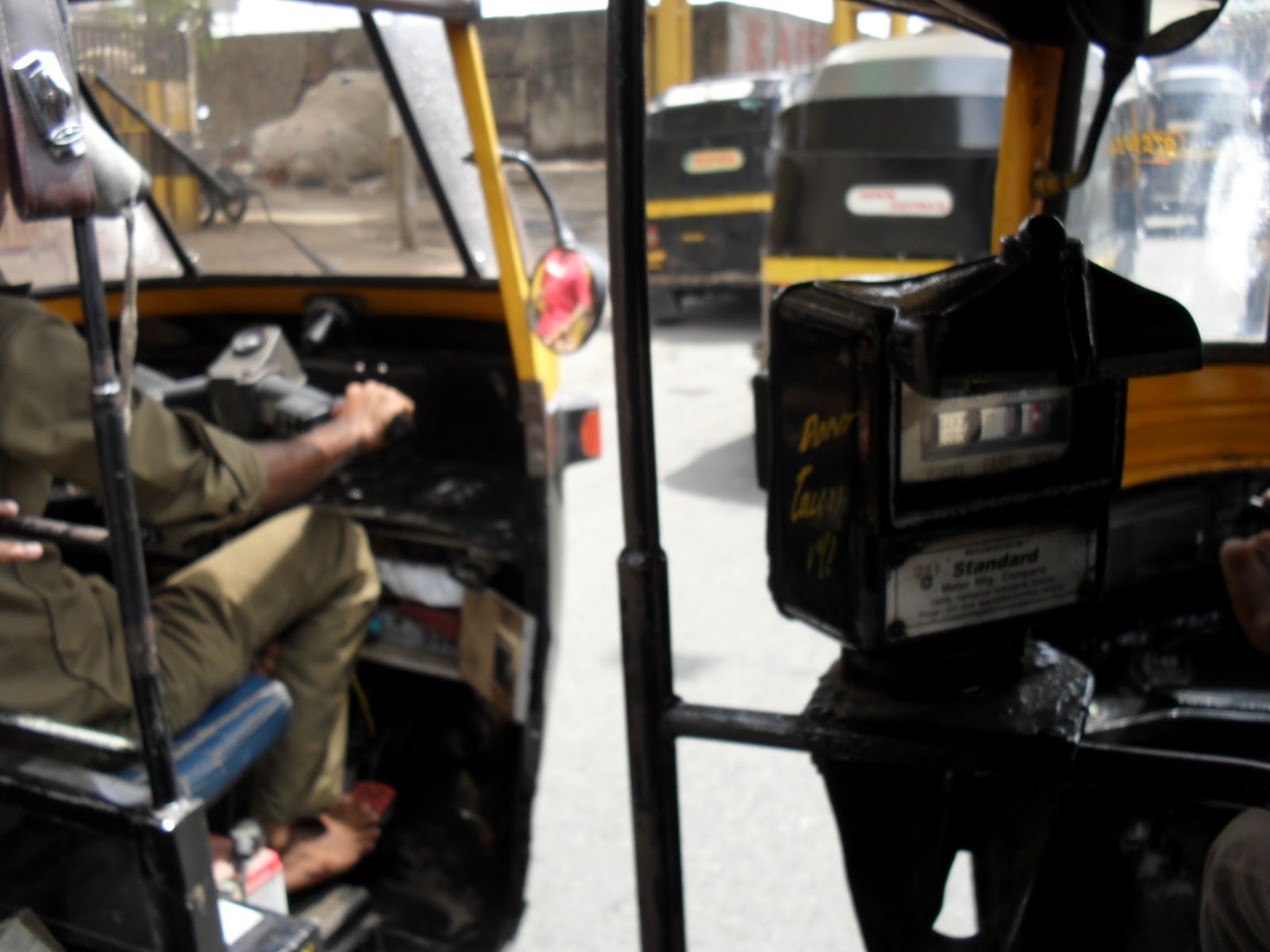
On the Auto-rickshaw Drivers of Bombay

I always like chatting with the auto-rickshaw drivers of Bombay. Over the course of this year I decided to pursue these conversations in a slightly more structured way, leading each one of them in the direction of a common set of questions, and to write up our conversations into a long essay.

This essay appears in the December issue of The Caravan, and can be read in full here. Here is a short excerpt:
Like most residents of the city, the drivers have their own, highly developed and opinionated Theory of Bombay: how life is lived here, what makes the city tick, and what their own place is in the scheme of things. Always on the streets, continuously in contact with all kinds of people, they possess wider knowledge and more persuasive intuitions about the city than most. Their descriptions of the city have a certain heartfelt poetry, especially since their Hindi—and its many dialects—has a purer, sweeter sound that the patois that is Mumbaiyya Hindi. Looking around as they drive, they seem almost to be thinking aloud, and their words are a distillation of many years of wandering and watching.  
And here are some more essays from my travels over the last two years:

"Under The BJP's Big Tent", a report from the BJP national convention in February this year ("Further into my twenties, as my own understanding of Indian politics and society expanded, the party’s view of Indian history and culture came to seem ever less satisfactory. Yet, through my interactions with people and on my travels, I had come to be intrigued, both as an observer of politics and as a novelist, by the narrative power exerted by the party’s founding fiction on the minds of many middle-class Indians like myself. This was the idea that Indian culture is rooted in a Hindu ethos and worldview, and that Indian Hindus, because a double-standard secularism that ignored the sentiments of the majority community, were disorganised, defensive about their faith, and therefore accomplices in the desertion of the central principle of their civilizational history.");

"At The Sun Temple of Modhera" ("Descending, I feel as if heaven and earth have exchanged places; I go past level after level of sharp-nosed, full-figured, deities reverentially captured in different poses, faces serene or half-smiling, eyes darting left and right, legs splayed or crossed, arms delicately outstretched or holding up weapons or musical instruments. Every wall, pillar, arch, or nook in the bav ripples with the agitation of faces and limbs suspended forever in stone, and as the day progresses the sun begins at the western face of the well and works its way downwards to light up this rapturous panorama level by level");

and a trip to Kanha National Park in Madhya Pradesh ("Thus it was that, over two six-hour mornings in the woods, this writer, who hitherto could only recognise such two-legged creatures of his native urban habitat as the Jostling Traincatcher, the Horn-Happy Motorist, the Beautiful Passing Lady and the Common Loafer, suddenly became alive to the beauties of the leaping air-dashes of the white-tailed paradise flycatcher, the hushed, monastic vigil of the crested serpent eagle, the breathtaking mid-air halt of the black-shouldered kite, the mellifluous call of the white-rumped shama, and the whooping of the racket-tailed drongo...").